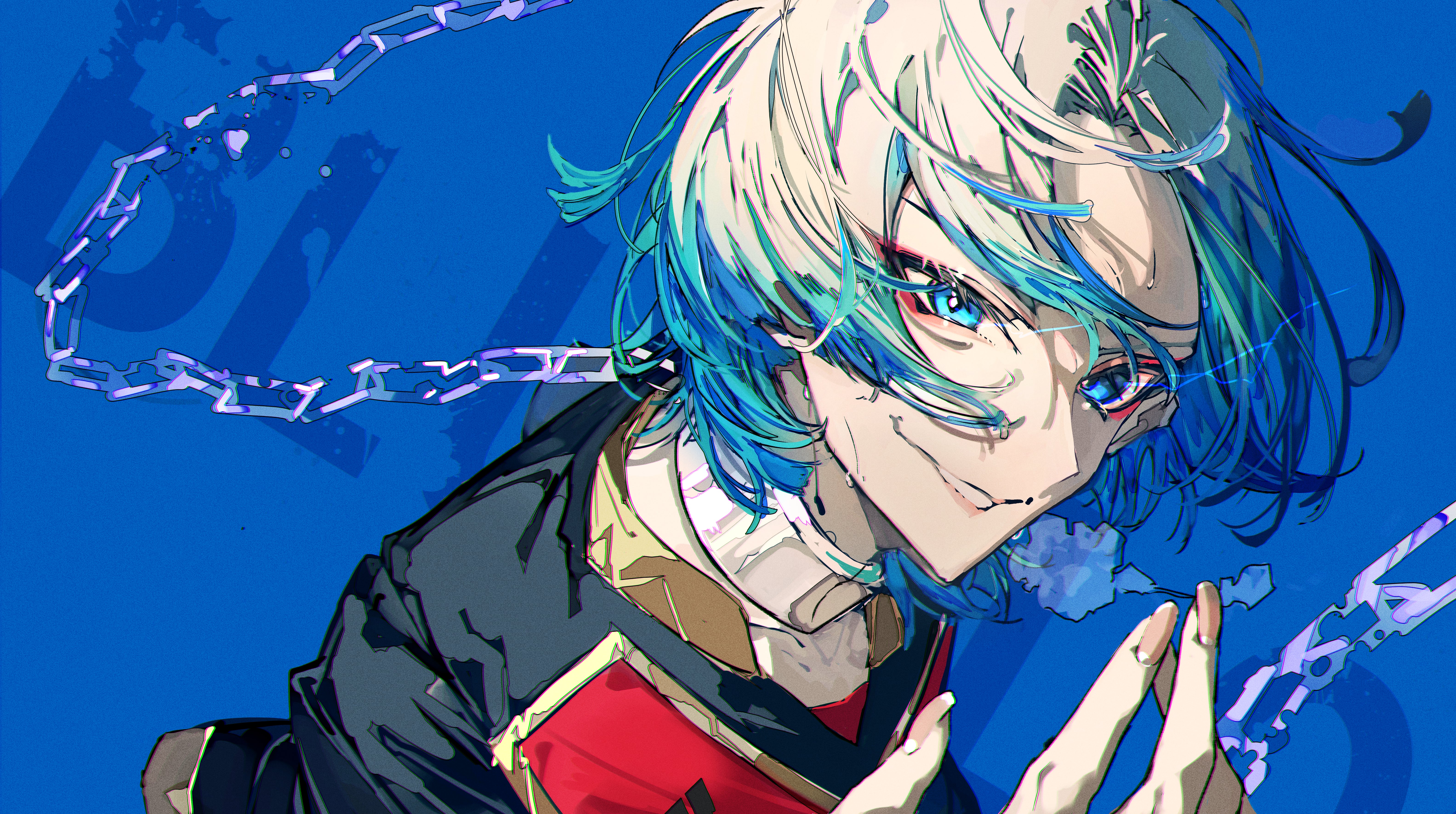
Michael Kaiser is a nightmare. Honestly, if you’ve been following the Neo Egoist League arc, you know he’s basically the final boss of arrogance. He’s got the "Ness" puppet on a string, a literal crown tattooed on his neck, and a strike so fast the world’s best cameras can barely track it. But for a long time, he felt like a one-dimensional obstacle. Just another "Gen 11" elite for Isagi to eventually devour. Then the manga shifted gears. It went back. We finally saw young Michael Kaiser Blue Lock fans had been theorizing about, and it wasn't the glamorous origin story people expected. It was gritty. It was violent. It actually makes you feel for the guy, which is a weird pivot considering how much of a jerk he is.
The backstory revealed in the Bastard Munchen vs. P.X.G match changed the community's perspective overnight. Kaiser wasn't born with a silver spoon. He was born into a basement.
The Basement and the Blue Rose
Most strikers in Blue Lock are driven by a hunger for glory. Kaiser? He was driven by a need to not die. His father, a failed theater director, was an absolute wreck of a human being. We're talking about a man who spent his life wallowing in his own mediocrity and taking it out on his son. Kaiser’s early life was spent in a literal basement, surviving on scraps and dodging blows. This isn't just "sad backstory" fluff. It’s the foundation of the "Kaiser Impact."
When you look at young Michael Kaiser Blue Lock panels, you see a kid who had nothing but a cheap soccer ball. That ball became his weapon. Literally. He used it to fight back against the police and the world that had discarded him. This is why his playstyle is so suffocating. To Kaiser, the soccer pitch isn't a game; it's a reclaimed territory. If he loses his dominance, he’s back in that basement. That’s a level of stakes that Isagi—who grew up in a loving, middle-class home—couldn't possibly understand until they locked horns.
Why the Tattoo Matters
You’ve noticed the blue rose on his neck. It’s impossible to miss. In the language of flowers, a blue rose represents "attaining the impossible." For a kid living in a gutter in Germany, becoming the world's best striker wasn't just a dream. It was a mathematical impossibility.
He got that tattoo as a reminder. It’s a middle finger to his father and the life he escaped. Every time Kaiser touches his neck or talks about "impossible" goals, he’s referencing that transition from the basement to the world stage. It explains his obsession with "impossible" goals. If it’s easy, it doesn't prove he’s escaped his past. He needs to do things no one else can do to justify his own existence.
The Ray Dark Connection
We can't talk about young Michael Kaiser Blue Lock history without mentioning Ray Dark. If you’re a fan of football manga, that name carries weight, but in the context of Blue Lock, he was the scout who saw a criminal and saw a king. Kaiser was literally in handcuffs when his talent was "discovered."
Dark didn't offer him a scholarship. He offered him a way to weaponize his malice.
- Kaiser’s "Impact" isn't just about leg speed.
- It's about the "point of impact" where his trauma meets his technique.
- He spent years kicking a ball against a wall in a cell or a basement.
- That repetitive, obsessive motion created the fastest swing in the world.
This puts his rivalry with Isagi in a weird spot. Isagi wants to be the best. Kaiser needs to be the best so he never has to be that powerless kid again. One is chasing a dream; the other is running away from a nightmare. It’s why Kaiser’s ego is so brittle. When Isagi starts outperforming him, Kaiser doesn't just get frustrated. He starts to spiral. He starts to see the basement walls closing in again.
Breaking the "New Gen 11" Aura
For a long time, the New Generation 11 were treated like gods. Sae Itoshi seemed untouchable. Kaiser seemed like a machine. But the look into his youth humanizes him in a way that makes him more dangerous. He’s not a machine; he’s a survivor.
His relationship with Alexis Ness is often criticized as being toxic. And, well, it is. But when you look at how Kaiser grew up, it makes sense. He doesn't know how to have "teammates." He knows how to have "subjects" or "enemies." He treats Ness like a tool because, in Kaiser's world, people are either tools or obstacles. It’s a miserable way to live, but it’s the only way he knows how to maintain control.
The Evolution of the Kaiser Impact
In the recent chapters, we've seen Kaiser trying to evolve. He’s realize that his "old" self—the one who relied purely on his physical gift and his arrogance—isn't enough to beat the monster Isagi has become.
- He attempted to throw away his pride.
- He started looking for a "Zero" point, much like Isagi did.
- He’s trying to merge his trauma with a new type of hunger.
This is the most exciting part of the young Michael Kaiser Blue Lock arc. We aren't just seeing a flashback for the sake of it. We’re seeing a character realize that his survival instincts, which got him out of the basement, are now the very things holding him back from becoming the actual World #1. He’s trapped by his own defense mechanisms.
What This Means for the Future of Blue Lock
Kaiser isn't going anywhere. Even if Isagi "wins" this specific battle in the NEL, Kaiser is the perfect foil for the U-20 World Cup. He represents the European standard—brutal, efficient, and deeply rooted in a professional system that rewards results over "heart."
The takeaway from Kaiser's youth is that Blue Lock isn't the only place that creates "monsters." Sometimes, life does it much more effectively than Jinpachi Ego ever could. While Ego builds a controlled environment to foster egoism, the real world forced it upon Kaiser through sheer suffering.
Actionable Insights for Fans and Analysts
If you're trying to predict where Kaiser's character goes next, stop looking at his stats and start looking at his mental state.
- Watch the "Thermal" vision: When Kaiser gets serious, the manga often uses specific visual cues. This represents his "Predator Eye." He’s looking for the weakest point in the defense to exploit, a habit born from needing to find exits in a world that wanted him trapped.
- Monitor the Ness dynamic: If Kaiser ever truly "grows up," he’ll either have to treat Ness as an equal or discard him entirely. The current master-servant dynamic is a remnant of his need for control.
- The Magnus Effect: His new weapon, the Kaiser Impact: Magnus, is a direct result of him being pushed to his absolute limit. It shows that he is capable of "metamorphosis," just like Isagi.
Michael Kaiser is a deeply flawed, occasionally loathsome, but undeniably brilliant character. His past as a "broken" youth gives him a layer of complexity that elevates the entire series. He’s not just a hurdle for Isagi; he’s a mirror. He shows what happens when egoism is born from pain rather than ambition. As the manga progresses, expect more callbacks to his early days, especially when he finally has to face the reality of not being the "king" of the pitch. He’s still learning that he doesn't need to be in a basement to be hungry.