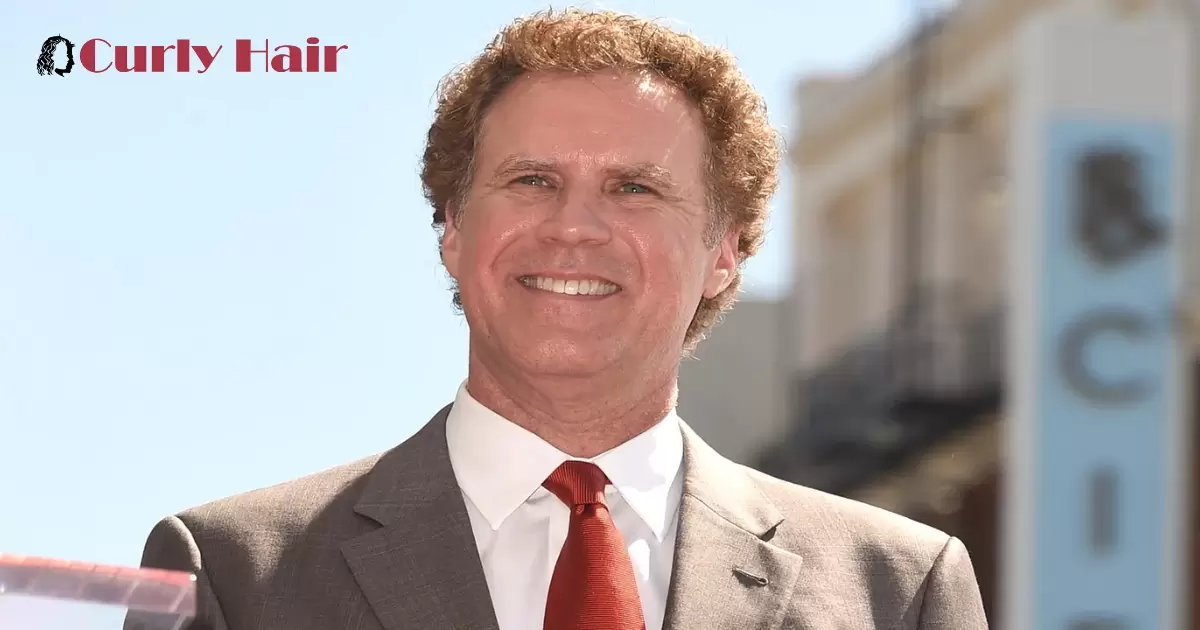
If you close your eyes and think of Will Ferrell, you probably aren't picturing a chiseled jawline or a somber dramatic monologue. You’re picturing the hair. That dense, chaotic, often unmanageable mop of Will Ferrell curly hair has basically become a supporting character in every movie he’s ever made.
It’s weirdly expressive. Honestly, it’s hard to imagine Ron Burgundy being quite so "glass case of emotion" without those perfectly coiffed 1970s waves, or Brennan Huff being such a convincing man-child in Step Brothers without that frizzy, unbrushed canopy.
But here’s the thing: most people think his hair is a series of clever wigs. They aren't. Mostly.
The Genetic Truth About the Curls
Will Ferrell wasn't always the poster boy for the "tight curl" look. In interviews, he’s mentioned that as a young kid, he actually had straight, towhead-blonde hair—very similar to his frequent co-star Amy Poehler. It wasn't until he got older that the texture started to shift.
It grew curlier. And curlier.
By the time he was a teenager, he was literally trying to sleep on his hair or part it specifically to force it to straighten out. It didn't work. Physics usually wins in these scenarios. What he ended up with was a classic "Type 3" curl pattern that is thick, prone to frizz, and incredibly resilient.
Why the Texture Works for Comedy
There’s a specific science to why Will Ferrell curly hair makes him funnier. In the world of clowning and physical comedy, "high" hair—hair that stands up or adds volume to the head—makes a performer look more vulnerable and less intimidating.
- The Silhouette: His hair adds several inches to his height, making his "big kid" characters look even more out of place in adult settings.
- The Frizz Factor: In Step Brothers, the production team leaned into his natural texture. By letting it get slightly "crunchy" and unkempt, he instantly looked like a 40-year-old who still has his mom do his laundry.
- Wig vs. Real: While Anchorman utilized a very specific 70s-style hairpiece to get that helmet-like rigidity, his role in Zoolander as Mugatu actually used his real hair for the most part. His stylist discovered that his hair was so hardy it could withstand the massive amounts of bleach and styling required for those "poodle" tufts without falling out.
Managing the Frizz: Ferrell’s Actual Routine
If you’re looking for a 12-step Korean skincare-equivalent for hair, you’re going to be disappointed. Ferrell is notoriously low-maintenance. He’s gone on record saying his grooming routine is basically "whatever is in the cabinet."
He doesn't perm it. That’s a common question fans ask—usually assuming that kind of volume requires chemical intervention. It’s all natural.
However, anyone with that level of curl knows that "low maintenance" usually leads to the "SideShow Bob" effect. If you have similar hair, the lesson from Ferrell’s career isn't necessarily about the products he uses (which are likely just standard salon moisture shampoos), but about embrace.
The Evolution of the "Dad" Curl
As Ferrell has aged into his 50s, his hair has transitioned into a "salt and pepper" phase. This is where curly hair gets tricky. Grey hair has a different texture; it’s coarser and often more wiry.
If you look at his recent red carpet appearances or his work in Barbie, you’ll notice the curls are tighter and more controlled. This is likely the result of a decent leave-in conditioner or a curl cream.
Without some sort of moisture barrier, grey curly hair tends to lose its definition and just become a cloud. By keeping the sides shorter—a look he’s favored more recently—he manages the "width" of his head while letting the curls on top provide the personality.
The Most Iconic Hair Moments
We can't talk about Will Ferrell curly hair without ranking the moments where the hair did the heavy lifting.
- Step Brothers: This is the peak "natural" look. It’s untamed. It’s sweaty. It looks like it smells like nap time and failure.
- Anchorman: Even though it was a piece, the "Ron Burgundy" became a cultural touchstone for how 70s masculinity was tied to hair volume.
- Zoolander: The white Mugatu curls are legendary. The fact that it was his real hair (bleached to within an inch of its life) makes it a feat of endurance.
- Semi-Pro: The Afro. It was the 70s, it was orange, and it was glorious.
How to Get the Look (If You Dare)
If you have naturally curly hair and want to channel your inner comedy legend, you have to stop fighting the frizz. Most men with this hair type try to buzz it off because they don't know how to handle the volume.
Ferrell’s "signature" look is actually just a uniform layer cut.
Basically, the barber cuts the hair to the same length all the way around the head. This allows the curls to stack on top of each other. It creates a rounded shape. Is it "fashionable" in the traditional sense? Not really. But it is iconic.
Actionable Insights for Your Own Curls:
- Hydration is King: Curly hair is naturally dry because the scalp oils can't travel down the "spiral" as easily as they can a straight shaft. Use a sulfate-free shampoo.
- Don't Towel Dry: Rubbing your head with a towel is the fastest way to look like a dandelion. Pat it dry or use an old T-shirt.
- Embrace the Volume: If you have the Ferrell-level thickness, don't try to slick it down with heavy gel. Use a light cream that lets the hair move.
At the end of the day, Will Ferrell’s hair is a testament to the idea that you don't need "perfect" hair to be a leading man. Sometimes, a bit of frizz and a lot of volume are exactly what you need to stand out. Keep the curls hydrated, get a trim every six weeks to keep the "cloud" under control, and don't be afraid to let it get a little weird.
Next Steps for Your Hair Care:
Start by swapping your regular bath towel for a microfiber one or a cotton shirt to reduce the "Ferrell-frizz" on days you want a more polished look. If you're struggling with the "triangle shape" that often happens with thick curls, ask your barber for "internal thinning" or "texturizing" to remove bulk without losing the length on top.