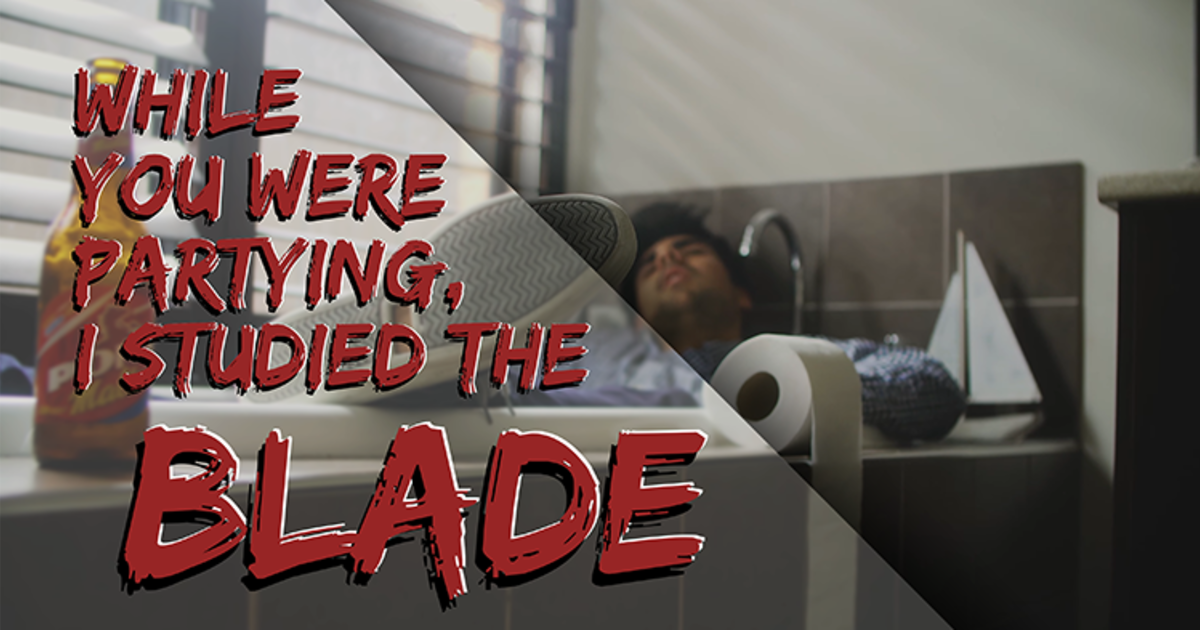
You know the image. A guy in a fedora, maybe a trench coat, definitely a mall-bought katana, looking into the camera with an intensity that borders on medical concern. The caption is always some variation of the same theme. It’s the "While you were partying, I studied the blade" meme, and honestly, it’s one of the few relics of the mid-2010s that still feels weirdly relevant today. It captures a very specific brand of "nice guy" bravado mixed with a desperate need for validation.
It’s hilarious. It’s tragic. It’s the digital embodiment of that one cousin who insists on bringing a tactical flashlight to Thanksgiving dinner.
But where did it actually come from? Most people think it just appeared out of the ether of 4chan or Reddit, but the roots of this specific brand of edge-lord posturing go back further than a simple Facebook post. We’re talking about the convergence of anime culture, the "mall ninja" phenomenon, and the rise of the "intellectual" loner archetype that dominated early internet forums.
The Viral Genesis of the Blade
The phrase officially blew up around 2016, but its DNA was coded much earlier. The most famous iteration—the one that launched a thousand ship-posts—originated from a Facebook post by a user named DownLo. The original text was a masterclass in unintentional comedy. It went something like this:
"When you were partying, I studied the blade. When you were having premarital sex, I mastered the blockchain. While you wasted your days at the gym in pursuit of vanity, I cultivated inner strength. And now that the world is on fire and the barbarians are at the gate, you have the audacity to come to me for help?"
It’s the "audacity" for me.
The image that usually accompanies this text features a young man who looks like he’s never actually seen a real sword fight, yet he talks like he’s the protagonist of a Seinen anime. This is the core of why while you were partying I studied the blade works as a meme. It’s the gap between the perceived coolness of the speaker and the reality of a guy holding a $40 stainless steel decorative sword in his mom's backyard.
Why the Mall Ninja Aesthetic Fueled the Fire
You can’t talk about studying the blade without talking about mall ninjas. For the uninitiated, a "mall ninja" is someone who buys low-quality, over-the-top tactical gear—serrated knives, throwing stars, neon-colored katanas—and believes they are prepared for a zombie apocalypse or a secret government coup.
These items are usually found at shops like BudK or those random cutlery kiosks in suburban malls. They aren't functional tools. They’re toys for adults who want to feel dangerous without actually doing the work of learning a martial art. When you combine this consumerist obsession with weapons with a sense of social isolation, you get the "studied the blade" mindset. It’s a defense mechanism. If you weren't invited to the party, it’s not because you’re socially awkward; it’s because you were busy honing a "lethal" skill that the "normies" couldn't possibly understand.
The Psychological Hook: Resentment as a Lifestyle
There’s a layer of bitterness here that we shouldn't ignore. The meme isn't just about swords; it's about the rejection of mainstream social norms. By devaluing "partying" and "premarital sex," the creator of the meme is trying to flip the script on their own social exclusion.
They aren't lonely. They’re dedicated.
Psychologically, this is a classic case of Sour Grapes. If I can’t have the social life I see others enjoying, I will declare that social life to be vapid and beneath me. It’s a way to reclaim power. The sword becomes a symbol of that power—a physical manifestation of "inner strength" that supposedly outweighs the "vanity" of someone who spends time at the gym.
Ironically, the gym-goer is probably much better prepared for the "barbarians at the gate" than the guy with the mall-bought katana. Real swordsmanship, like Kendo or HEMA (Historical European Martial Arts), requires years of grueling physical conditioning. Studying the blade, in the context of the meme, usually involves watching a lot of Naruto and practicing swings in front of a mirror.
The Evolution into "Mastering the Blockchain"
As the meme aged, people started swapping out "the blade" for other niche, supposedly superior pursuits.
- Mastering the Blockchain: This became huge during the crypto boom. It’s the digital equivalent of the katana—something complicated and "revolutionary" that makes the user feel smarter than everyone else.
- Studying the Lore: This version usually applies to deep-dive fandoms. While you were out having a life, I was learning the entire history of the Silmarillion.
- Mastering Python: The tech-bro version. It replaces the physical sword with code, but keeps the same "I’m better than you" energy.
The structure of the joke is so rigid that you can plug almost anything into it, and it still makes sense. It’s a template for arrogance.
Is There a Real-World Equivalent?
Believe it or not, there are people who genuinely live this life. Not the mall ninja version, but the total-immersion-in-a-craft version. The Japanese concept of Shokunin—the master craftsman—is about this level of dedication. But the difference is humility. A true master of the blade doesn't post on Facebook about how they’re going to laugh when the barbarians arrive. They just... keep practicing.
Miyamoto Musashi, perhaps the most famous swordsman in history and author of The Book of Five Rings, spent his life "studying the blade." He lived as a ronin, often in harsh conditions. But he also wrote about the importance of knowing all things—not just fighting. He studied calligraphy, painting, and strategy. He didn’t use his skill as a way to look down on others; he used it as a path to self-perfection.
The meme is the exact opposite of Musashi’s philosophy. It’s using a shallow version of a craft to fuel a deep sense of superiority.
The Cringe Factor: Why We Can't Look Away
Cringe culture is a complicated beast. We laugh at "the blade" meme because we recognize a version of ourselves in it. Who hasn't felt like an outsider? Who hasn't tried to justify their lack of a social life by claiming they were doing something "more important"?
The difference is most of us don't post it online with a picture of ourselves in a duster.
The meme has endured because it’s the ultimate example of "main character syndrome." It’s the belief that your life is a movie and everyone else is just an NPC (non-playable character) who will eventually realize how cool and mysterious you are. When that realization never comes, the resentment grows, and the blade gets sharper. Or, well, it stays just as dull as it was when it left the factory in China.
How to Avoid "Studying the Blade" (The Wrong Way)
If you actually want to learn a skill—whether it’s coding, a martial art, or a craft—there are ways to do it without becoming a meme.
First, ditch the "normie" vs. "expert" dichotomy. Real experts don't care about what people do at parties. They’re too busy actually doing the work. If you find yourself wanting to tell the world how hard you're working, you're probably doing it for the wrong reasons.
Second, get a real instructor. If you’re studying the blade, find a HEMA club or a Kendo dojo. Nothing kills the "I am a lethal weapon" delusion faster than getting tapped on the head by a 60-year-old sensei who has been doing this since before you were born.
Third, understand that "vanity" (like going to the gym) is actually incredibly useful. Physical fitness is a prerequisite for almost any "inner strength" you're trying to cultivate. You can’t defend the gates if you get winded walking up a flight of stairs.
Moving Beyond the Meme
The legacy of while you were partying I studied the blade isn't just a funny caption. It's a reminder of a specific era of the internet where niche subcultures were starting to bleed into the mainstream, and the resulting friction was often awkward and hilarious.
It taught us about the "incel" pipeline before that term was even widely used. It showed us how isolation can warp someone's self-perception. And most importantly, it gave us a shorthand for calling out unearned arrogance.
So, what should you actually do if you find yourself relating to the meme?
Start by diversifying your interests. Musashi didn't just study the sword; he studied the world. If you’re into tech, learn some soft skills. If you’re into martial arts, learn how to talk to people who don't know the difference between a rapier and a longsword. True mastery isn't about excluding yourself from society; it's about finding your place within it through your craft.
- Audit your hobbies: Are you doing them because you love them, or because they make you feel superior to others? If it's the latter, you're in the meme zone.
- Touch grass: It’s a cliché for a reason. Spending time in the physical world, interacting with people who don't care about your "niche" skills, is the only cure for main character syndrome.
- Invest in quality: If you are going to buy a sword, buy a real one and learn how to use it safely. Stop supporting the mall ninja economy.
- Practice humility: The moment you think you’ve "mastered" something to the point of looking down on others, you’ve stopped being a student and started being a caricature.
The world might not be on fire, and the barbarians might not be at the gate, but having a genuine skill is always better than having a fake one and a bad attitude. Study the blade if you want. Just don't forget to go to the party every once in a while.