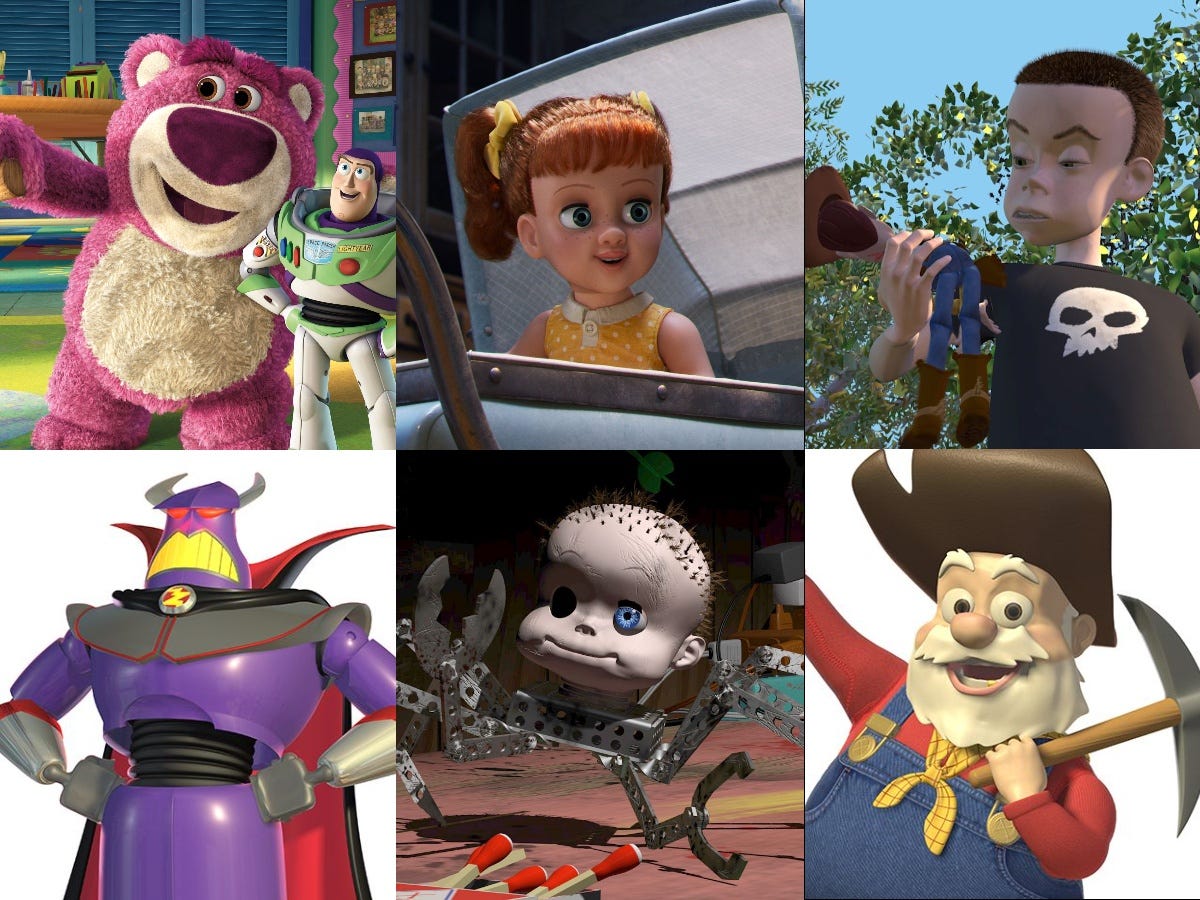
Everyone remembers the strawberry smell. It’s the first thing that hits you when Lotso, the pink, plush patriarch of Sunnyside Daycare, waddles onto the screen. He’s voiced by Ned Beatty with this incredible, grandfatherly Southern drawl that makes you want to trust him instantly. But honestly, the villain Toy Story 3 gives us is way more than just a bitter toy. Lots-o'-Huggin' Bear represents a total breakdown of the "toy-owner" social contract that the entire franchise is built on. While Sid was just a kid with some firecrackers and Stinky Pete was a selfish collector, Lotso is something else entirely. He’s a dictator.
Most people look at the incinerator scene as the peak of the movie. It’s harrowing. It’s dark. But the real horror of the villain Toy Story 3 introduced lies in the psychological manipulation. Lotso doesn’t just want to win; he wants to prove that love is a lie.
The Tragic Backstory That Actually Makes Sense
Lotso wasn't born bad. He was a gift for a little girl named Daisy. He was her favorite. This is where Pixar really twists the knife, because we see the flashback through Chuckles the Clown’s eyes. When Daisy accidentally leaves Lotso, Chuckles, and Big Baby at a rest stop, they don't give up. They trek back. They make it to her window. And what do they see?
Daisy has a new Lotso.
That moment is the "villain origin story" done right. It’s not about some grand scheme for world domination. It’s about the crushing realization that you are replaceable. Lotso’s heart didn't just break; it hardened into a philosophy. If he isn't special, then no toy is special. "We're all just trash," he says later in the film. "Waiting to be thrown out. That's what a toy is."
It’s bleak. It’s nihilistic. And for a G-rated movie, it’s remarkably heavy. He didn't just lose his owner; he lost his faith in the fundamental purpose of his existence. He took that trauma and turned it into a prison system at Sunnyside.
Sunnyside Daycare: A Managed Dystopia
When Woody and the gang first arrive, Sunnyside looks like paradise. The music is upbeat. The colors are bright. Lotso gives the grand tour like he’s a resort manager. But the brilliance of the villain Toy Story 3 script is how quickly that facade crumbles.
The "Butterfly Room" is for the elite. The "Caterpillar Room" is a torture chamber where toddlers—who haven't learned how to play gently—literally rip toys apart. Lotso uses this disparity to maintain power. He keeps the "cool" toys in the Butterfly Room to ensure their loyalty, while the newcomers are fed to the metaphorical lions.
He’s running a racket.
He’s got a lookout (the Chatter Telephone, who’s basically a broken man), a surveillance system using a creepy cymbal-banging monkey, and a muscle-bound enforcer in Big Baby. It’s a classic prison film trope. The "Newcomers" are the ones who suffer so the established hierarchy can live in luxury. It’s a cynical reflection of real-world power structures. If you play by Lotso’s rules, you get the soft life. If you don't? You end up in the "Box."
Why Lotso is Different From Other Pixar Antagonists
Think about the other bad guys.
- Syndrome (The Incredibles): Driven by ego and revenge.
- Charles Muntz (Up): Driven by a need for validation.
- Randall (Monsters, Inc.): Just a jealous corporate ladder-climber.
The villain Toy Story 3 features is different because he’s a true ideologue. He genuinely believes that he’s doing the "right" thing by stripping toys of their hope. To Lotso, hoping for an owner is a weakness. It’s a vulnerability. By forcing the toys at Sunnyside to accept that they are just plastic and stuffing, he thinks he’s "freeing" them from the cycle of heartbreak.
He’s a cult leader. He provides a community, sure, but it’s a community built on the shared trauma of being discarded. He’s the dark mirror to Woody. Woody believes that being there for a child is the highest calling, even if it ends in heartbreak. Lotso believes that because it ends in heartbreak, the calling itself is a scam.
The Moment of No Return
The true test of a villain is the "mercy" moment. In the climax, the toys are on the conveyor belt leading to the incinerator. Lotso is stuck. He’s going to be shredded. Woody and Buzz—the heroes who have every reason to let him die—save him. They risk their lives to pull him up to the emergency shut-off button.
They give him the chance to be the hero.
And what does he do? He reaches the button, looks Woody in the eye, and just... walks away. He leaves them to burn.
That is the definitive villain Toy Story 3 moment. There is no redemption arc here. There is no "he saw the light." He is fundamentally broken. He would rather see everyone die than admit that Woody’s brand of selfless love is real. It’s one of the few times a Disney/Pixar villain is given a chance at a redemptive pivot and flat-out refuses it. He chose malice.
The Fate of the Strawberry-Scented Dictator
The ending for Lotso is poetic, if a bit grim. He gets found by a truck driver who used to have a Lotso bear as a kid. But instead of being loved, he’s strapped to the grill of a garbage truck. He’s destined to be covered in bugs, mud, and road grime.
It’s the ultimate irony. He spent his whole life trying to avoid being "trash," and he ends up as a literal hood ornament for a trash collector.
But wait, think about this for a second. Is he still alive? In the Toy Story universe, toys only "die" if they are destroyed. So Lotso is just... stuck there. Indefinitely. Smelling the exhaust fumes instead of strawberries. It’s a living hell for a character who valued control above all else.
What We Can Learn From the Sunnyside Saga
Watching Toy Story 3 as an adult is a completely different experience than watching it as a kid. As a kid, Lotso is just a mean bear. As an adult, he’s a warning about what happens when you let bitterness define your worldview.
If you're looking at the villain Toy Story 3 created from a narrative perspective, there are some specific takeaways:
1. Empathy isn't always a cure. Woody tried to empathize with Lotso’s loss. It didn't work. Some people (or toys) are so deeply committed to their own narrative of being a victim that they will hurt anyone who tries to show them a different way.
2. Hierarchy is a tool of control. Lotso didn't rule through strength alone; he ruled through the distribution of resources. He kept the "good" playrooms for his friends and the "bad" ones for his enemies.
3. The power of the "Replacement." The fear of being replaced is universal. Whether it's a job, a relationship, or a kid’s bedroom, the feeling that you are a commodity is a powerful motivator for "villainous" behavior.
4. True evil is the absence of hope. Lotso’s greatest crime wasn't locking toys in bins; it was trying to convince them that their lives had no meaning.
To really understand the impact of this character, you have to look at how he changed the franchise. Toy Story 4 moved away from the "dictator" model and went for something more internal and existential with Gabby Gabby, who actually does get a redemption. It makes Lotso stand out even more. He is the outlier. He’s the one who couldn't be saved because he didn't want to be.
If you want to dive deeper into the lore, I’d suggest re-watching the "Life of a Toy" montage in the first film and then jumping straight to Lotso's flashback. The contrast is devastating. It shows exactly how the dream can turn into a nightmare.
Next Steps for Toy Story Fans:
- Check out the "Black Friday" reel on YouTube to see the much darker, original version of Woody that actually inspired some of Lotso's more cynical traits.
- Look for the hidden "Lotso" cameos in other Pixar films like Up (he’s in the background of the bedroom scene) to see how early they were planning this character.
- Analyze the lighting choices in the Sunnyside scenes—notice how the "warm" yellow light becomes sickly and oppressive as the film progresses.