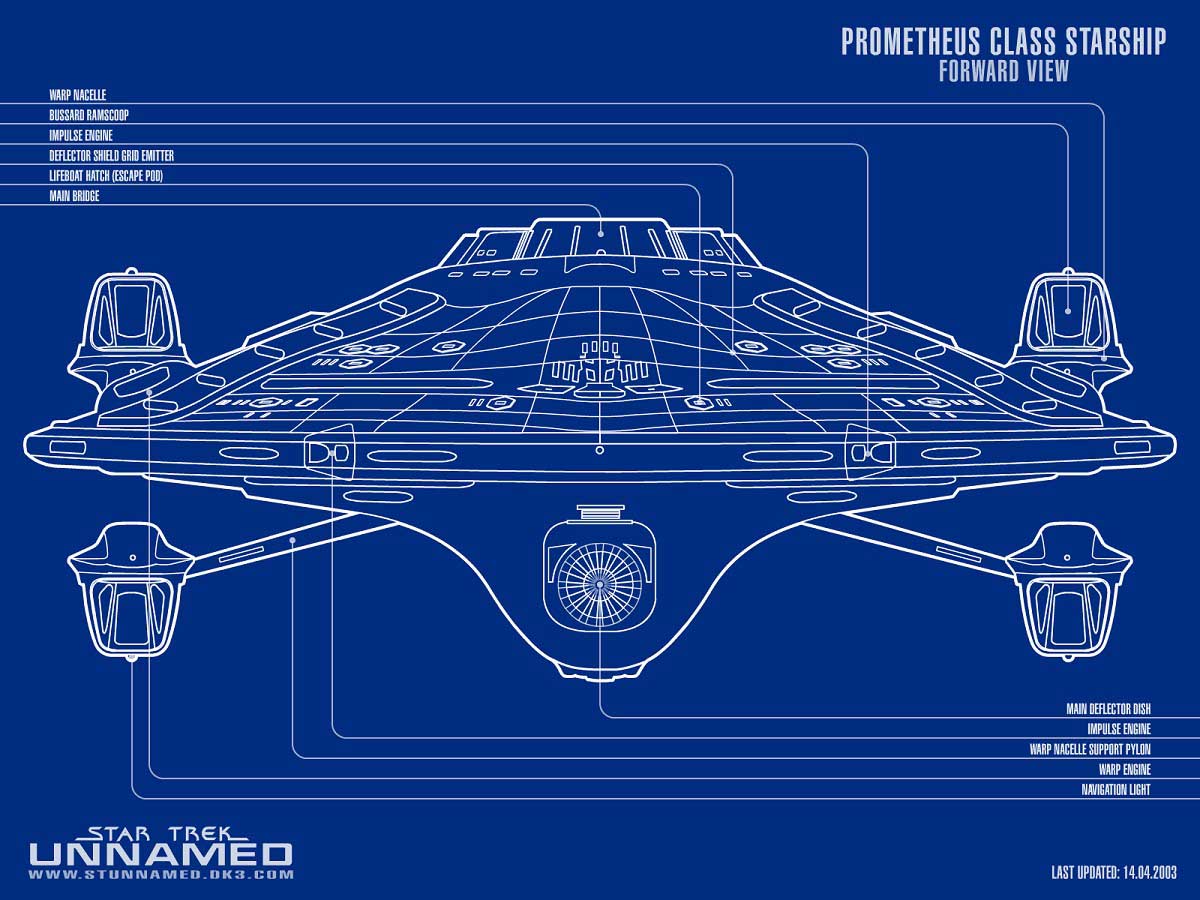
It looks like a wedge. A sharp, angry, multi-vector assault wedge that was designed to do one thing: ruin a Romulan’s afternoon. When the USS Prometheus first streaked across our screens in the Star Trek: Voyager episode "Message in a Bottle," it wasn't just another Federation ship. It was a statement. Starfleet, usually the guys talking about peace and "seeking out new life," had finally built a purebred predator.
Most people remember the ship for its trick. You know the one. It splits into three separate pieces, each with its own warp drive and tactical computer, and then proceeds to absolutely dismantle a Nebula-class ship like it was made of cardboard. It’s cool. It’s flashy. But if you actually look at the technical specs and the lore behind the Prometheus-class, there is a lot more going on than just a fancy separation sequence. Honestly, the ship is kind of a nightmare from a logistical and ethical standpoint, which is probably why we didn't see a thousand of them flying around during the Dominion War.
The USS Prometheus and the Multi-Vector Assault Mode Gamble
Let’s talk about the Multi-Vector Assault Mode (MVAM). On paper, it sounds like a dream. Why have one target when you can have three? In practice, this required a level of automation that Starfleet had historically been terrified of. Ever since the M-5 computer incident in the Original Series, the Federation has been wary of giving too much control to an AI. The USS Prometheus, however, didn't have a choice. You can't manually pilot three separate ship segments with a standard crew. The bridge of the Prometheus was actually quite small, designed for a minimal crew because the computer was doing 90% of the heavy lifting during combat.
The ship was a prototype, registry NX-59650. It was the fastest thing in the fleet at the time, capable of sustained speeds that made the Enterprise-E look like it was dragging an anchor. We’re talking about a top speed of Warp 9.99. That’s "get across the quadrant before lunch" fast. But speed wasn't the goal; tactical redundancy was. When the ship splits, the "Beta" and "Gamma" sections are controlled by the "Alpha" section's tactical processors.
Think about the processing power required to coordinate three independent warp signatures and weapons arrays in a 3D battlespace. It’s staggering. During the skirmish with the Romulans, we saw the ship use these vectors to flank and overwhelm opponents with surgical precision. It wasn't just firing more phasers; it was creating firing angles that a single-hull ship literally cannot defend against. It’s basically the "cheat code" of the 24th century.
Why We Rarely Saw the Prometheus Again
You’d think after seeing a single ship take on multiple Romulan Warbirds and win, Starfleet would have mass-produced them. They didn't. Why? Well, for starters, the USS Prometheus was a security disaster waiting to happen. In its very first outing, it was hijacked by Romulan Tal Shiar agents. If two Mark II Emergency Medical Holograms (EMHs) hadn't been there to bicker their way into the life support systems, the Romulans would have had the Federation's most advanced tactical asset.
There's also the "glass cannon" problem. To make a ship that can split into three, you have to sacrifice internal volume. You have three sets of warp cores, three sets of structural integrity field generators, and three sets of shield grids. That is a maintenance nightmare. Imagine being the Chief Engineer on that ship. You aren't just maintaining one engine room; you're maintaining three, all crammed into a hull that is smaller than an Intrepid-class ship.
- The ship used regenerative shielding, a massive upgrade over the standard "bubble" shields.
- Ablative hull armor, similar to the Defiant, gave it a physical layer of protection.
- It featured the first widespread use of Type XII phaser arrays on a ship of its size.
- The interior was cramped, utilitarian, and lacked the "luxury" of a Galaxy-class ship.
Rick Berman and the production team at the time wanted something that looked "fast even when standing still." Senior illustrator Rick Sternbach delivered exactly that. But from a narrative standpoint, the ship was almost too good. If you have ten Prometheus-class ships, the Dominion War ends in a weekend. By keeping it a rare, experimental prototype, the writers maintained the stakes of the show.
The Technical Reality of Warp 9.99
We need to address the speed. In the late 2370s, Warp 9.9 was the standard "high-end" speed. The USS Prometheus pushing Warp 9.99 isn't just a small decimal jump. Because the warp scale is logarithmic, the power requirements to hit 9.99 are exponentially higher than 9.9. This suggests the ship was essentially a giant engine with some guns bolted onto it.
The ship's geometry was also unique. It was very flat. Sharp edges. Minimal surface area for sensors to lock onto. It looked more like a stealth fighter than a research vessel. Honestly, it’s one of the few Starfleet designs that feels genuinely intimidating. When you see a Sovereign-class, you feel "inspired." When you see a Prometheus-class, you realize someone is about to get hurt.
Legacy and the Beta Canon
While the ship only appeared a few times in the actual shows (most notably in the Voyager finale "Endgame" and briefly in Enterprise during a temporal vision), it lived a long life in books and games. In the Star Trek: Prometheus novel trilogy by Bernd Perplies and Christian Humberg, we get a much deeper look at the ship's crew and its role in patrolling the volatile borders near the Klingon and Romulan empires.
In Star Trek Online, players flock to the Prometheus because it allows for a "pet" mechanic where you can actually trigger the MVAM in real-time. It remains a fan favorite because it represents a specific era of Trek design—the transition from the cozy, carpeted "hotels in space" of the early TNG era to the battle-hardened, sleek machines of the late DS9 and Voyager years.
What Most People Get Wrong About MVAM
There’s a common misconception that the USS Prometheus is just three small ships docked together. It's not. When joined, it functions as a singular, cohesive spaceframe with integrated systems. The separation isn't like the Enterprise-D saucer sep, which was an emergency move. For the Prometheus, separation is the primary offensive configuration.
The bottom section (Gamma) typically holds the most massive warp core and provides the primary thrust. The middle (Beta) and top (Alpha) sections are essentially high-mobility weapons platforms. This allows the ship to "swarm" a target. In naval terms, it's like a destroyer that can suddenly turn into three torpedo boats and then fuse back into a destroyer once the smoke clears.
Actionable Insights for Trek Fans and Modelers
If you're looking to dive deeper into this specific piece of Starfleet history or perhaps build a collection around it, here is how you should approach the Prometheus:
- Study the Rick Sternbach Sketches: If you can find the original concept art, look at how the docking clamps were designed. It gives you a much better appreciation for the engineering "logic" of the ship.
- Watch "Message in a Bottle" with a focus on the background LCARS: The bridge displays on the Prometheus were some of the most detailed of the era. They show the power distribution between the three hulls in real-time.
- Compare the Scale: Place a model or a digital render of the Prometheus next to an Akira-class. You’ll notice the Prometheus is surprisingly small. Its power comes from density, not size.
- Check out the Eaglemoss Model: While the company had its ups and downs, their USS Prometheus XL edition is widely considered one of the best physical representations of the ship's complex geometry.
The USS Prometheus remains a high-water mark for Starfleet tactical R&D. It was the moment the Federation stopped playing nice and started building ships that could dominate any engagement. It’s sleek, it’s dangerous, and even decades after its debut, it still looks like it’s from the future of the future.
If you’re researching the ship for a tabletop game or a fan-fiction project, remember that its biggest weakness isn't its shields or its phasers—it’s the crew requirement. Operating a ship that is mostly "computer-run" leaves you incredibly vulnerable to cyber-warfare and internal sabotage. That’s the trade-off. You get the most powerful ship in the quadrant, but you better hope your firewall is up to date.
To truly understand the ship's impact, you have to look at it as the bridge between the 24th-century design philosophy and the even more advanced, automated ships we see in the 32nd century of Star Trek: Discovery. It was the first step toward a fleet that didn't need thousands of people to maintain a presence in the stars. It was, and is, a beautiful, terrifying piece of technology.
Next Steps for Deep-Diving the Prometheus
To get the full picture of the Prometheus-class, start by re-watching the Voyager Season 4 episode "Message in a Bottle" to see the MVAM in its debut. From there, explore the Star Trek: Fact Files or the Starship Spotter guide for the specific deck-by-deck breakdowns that explain how the three warp cores interact. Finally, if you're a gamer, test the ship's tactical flexibility in Star Trek Online to see how the multi-vector mechanics hold up against different enemy types. This will give you a hands-on feel for why this ship is considered a tactical anomaly in the Star Trek universe.