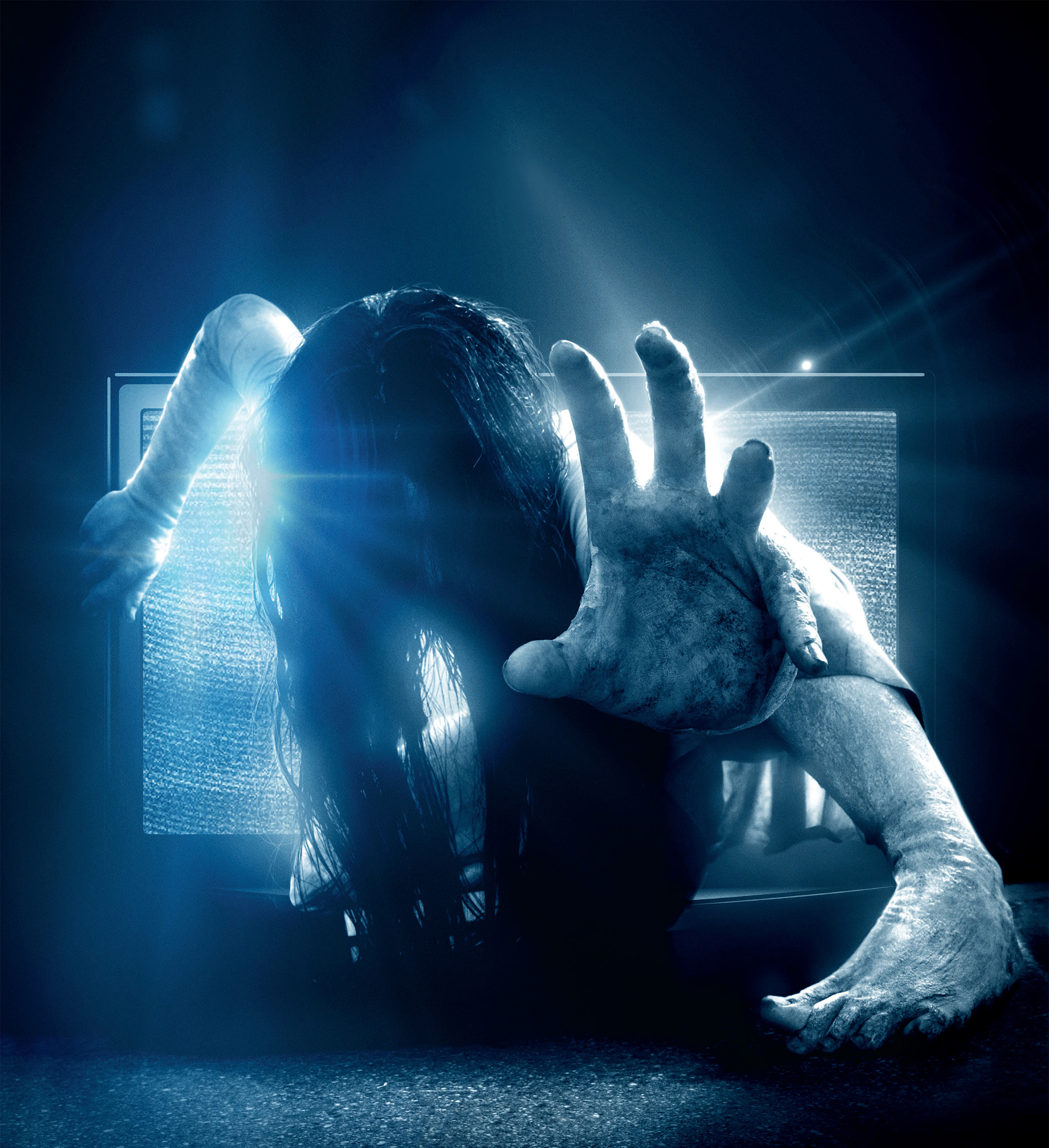
It’s just a flickering screen. You’re sitting there, maybe with some popcorn, watching a grainy VHS tape of a well. The camera doesn’t move. Then, a hand grips the edge of the stone. Most horror movies would cut away here or blast a loud violin screech to make you jump. But Hideo Nakata’s 1998 masterpiece Ringu didn't do that. It let the camera linger. It forced us to watch as a pale, disjointed figure crawled toward the lens, and then, in a moment that fundamentally broke the "rules" of cinema, the girl in the ring coming out of the tv became a physical reality.
It was a violation.
Think about why we watch movies. There is an unspoken contract between the viewer and the screen: whatever happens in that glowing box stays in that glowing box. You are safe in your living room. But when Sadako Yamamura pushed her way through the glass, she didn't just scare the protagonist, Ryuji; she threatened the audience. She crawled over the fourth wall. Honestly, it’s the most iconic moment in J-horror history, and even after twenty-five years and a dozen American remakes or sequels, nothing has quite topped the sheer, primal wrongness of that visual.
The Practical Magic Behind the Nightmare
You might think that scene was some high-end digital wizardry. It wasn't. In 1998, the budget for Ringu was relatively modest, and CGI was still in its awkward teenage years. To get that unsettling, stuttering movement as Sadako approaches the screen, Nakata used a brilliantly simple trick. He had the actress, Rie Inō, walk backward while performing jerky, exaggerated movements. Then, in the editing room, they played the footage in reverse.
This is why she looks so "off."
Human joints don't naturally move that way when we walk forward. By reversing the film, the physics of her clothing and hair defy gravity in subtle, nauseating ways. It creates an uncanny valley effect where your brain recognizes a human shape but your instincts scream that something is biologically impossible.
Then there’s the eye. You know the one. At the very end of her crawl, we see a close-up of a single, bloodshot eye peering through a curtain of black hair. That wasn't even the actress. A male crew member volunteered his eye for the shot because he could open it wide enough to look truly manic and inhuman. It’s those tiny, gritty details that make the image of the ring coming out of the tv stick in the back of your mind when you're trying to fall asleep in a dark room.
Why the TV Was the Perfect Victim
In the late 90s, the television was the altar of the home. We didn't have smartphones in our pockets yet. We had these giant, heavy cathode-ray tube (CRT) boxes sitting in the corner of every room. They were "on" even when they were "off," humming with static and drawing in dust.
Ringu tapped into a very specific urban legend energy. It turned a household appliance into a portal. Before this, horror was usually about a monster in the woods or a slasher in the closet. But Sadako? She lived in the technology you used to watch the news. She was a literal ghost in the machine.
Koji Suzuki, who wrote the original novel Ring, was fascinated by the idea of a virus. In the book, the curse isn't just a spooky video; it’s a biological-digital hybrid. It’s a mutation of smallpox and psychic energy. While the movie shifted more toward a traditional ghost story, it kept that "infectious" quality. If you watch the tape, you’re part of the chain. You have seven days. The TV isn't just a screen anymore—it’s a countdown.
The American Remake: Gore Verbinski’s Blue Filter
When DreamWorks decided to remake the film as The Ring in 2002, people were skeptical. Usually, American remakes of Asian horror are... well, they’re bad. But Gore Verbinski understood the assignment. He replaced the gritty, brownish tones of the Japanese original with a cold, damp, Seattle blue.
He also leaned harder into the surrealism of the tape itself. The American version of the "cursed video" is a masterpiece of experimental filmmaking—fingers being pierced by nails, giant centipedes, and that ladder leaning against a wall.
When Daveigh Chase (who played Samara, the US version of Sadako) makes her move toward the screen, the effects were upgraded. We see the TV screen physically ripple like water. It was a bigger spectacle, but it served the same purpose: it proved that no matter where you are—Tokyo or Seattle—the screen cannot protect you.
Interestingly, the success of this scene birthed an entire era of "long-haired ghost girls" in cinema. We got The Grudge, One Missed Call, and Dark Water. But eventually, the trope got tired. We started seeing parodies in Scary Movie, and the terrifying girl crawling out of the screen became a punchline. Yet, if you go back and watch the 1998 original today, in the dark, without your phone to distract you, that sequence still carries a weight that parodies can't touch.
Is the Curse Still Relevant in the Age of Streaming?
Let’s be real. Nobody uses VHS tapes anymore. If Sadako tried to haunt a modern household, she’d have to deal with 4K OLED screens, Netflix algorithms, and TikTok.
There was a 2017 movie called Rings that tried to modernize the concept. In it, the cursed video goes viral via email and file sharing. It makes sense on paper. A digital virus is way faster than mailing a physical tape to a friend. But something was lost in the transition.
The clunky, mechanical nature of the VCR was part of the dread. The sound of the tape clicking into place, the tracking lines on the screen, the static—it felt tactile. When the figure is the ring coming out of the tv in the original films, she is breaking through glass and vacuum tubes. There’s a heaviness to it. A sleek, paper-thin iPad just doesn't have the same "weight" for a ghost to crawl out of.
However, the psychological core remains. We are more tethered to screens now than we were in 1998. We stare at them for eight to twelve hours a day. The idea that the thing you are looking at is also looking back at you? That’s more relevant now than it ever was during the VHS era.
How to Revisit the Legend (Without Losing Sleep)
If you're looking to dive back into the world of Sadako and the cursed tape, don't just stick to the movies. The franchise is surprisingly deep and, frankly, pretty weird.
- Read the original trilogy: Koji Suzuki’s books (Ring, Spiral, Loop) are more sci-fi than horror. By the third book, the story involves virtual realities and DNA coding. It’s wild.
- Watch the "Versus" film: If you want to see how far the franchise went, watch Sadako vs. Kayako. It’s a crossover between the girls from The Ring and The Grudge. It’s definitely more of a popcorn flick than a psychological thriller, but it's a blast.
- Check out the "Sadako" YouTube channel: Believe it or not, the official Japanese promotional team created a YouTube channel for Sadako where she does "normal" things like cleaning her house or playing video games. It’s a great way to de-mystify the character if she still gives you the creeps.
The legacy of the TV crawl isn't just about a jump scare. It’s about the moment horror stopped being "over there" and started being "right here." It changed how directors think about space and how audiences look at their own furniture. Next time your TV flickers or a video takes a second too long to buffer, just remember: Sadako is probably just looking for a better Wi-Fi signal.
To really appreciate the craft, watch the original Ringu (1998) side-by-side with the 2002 remake. Look at how they handle silence. The Japanese version uses silence like a weapon, while the American version uses sound design to build tension. Both are valid, but notice how much scarier the girl is when you can't hear her coming. That’s the real secret to the nightmare.