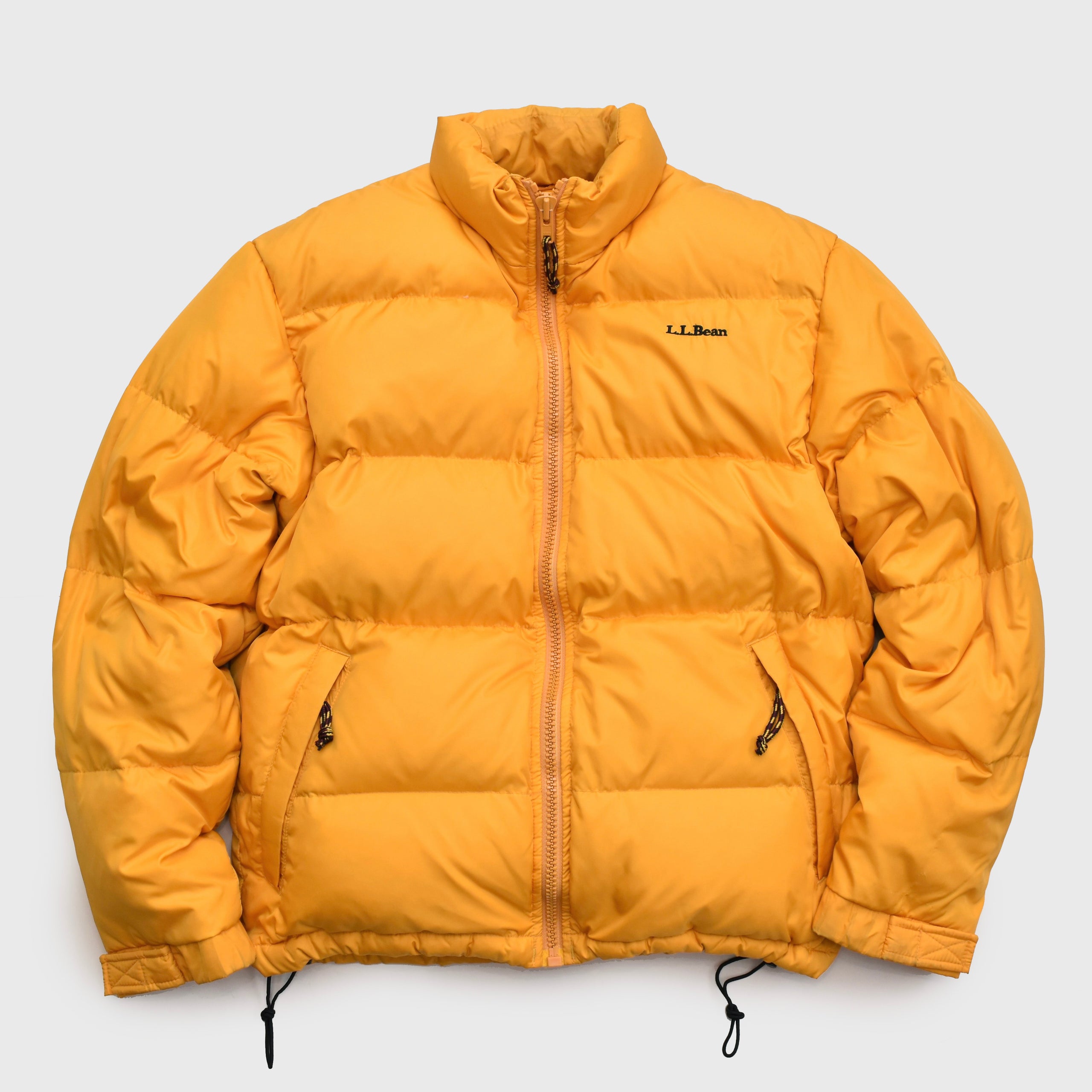
You’re standing on a train platform in Portland, Maine. It’s 6:00 AM. The wind is whipping off the Casco Bay, and the "real feel" temperature is deep into the negatives. Look around. You aren't going to see a fashion show. You're going to see a sea of rugged, slightly oversized, and incredibly warm outerwear. Most of it has that iconic mountain logo on the chest. The LL Bean goose down jacket isn't just a piece of clothing in this part of the world; it’s basically a survival tool that people happen to wear to the grocery store.
Down is weird if you think about it. It’s the fluffy under-feathers of waterfowl. Nature spent millions of years perfecting this specific insulation to keep birds warm in freezing water, and somehow, we haven't really beaten it with lab-grown plastics yet. While synthetic insulation has come a long way—think PrimaLoft, which LL Bean also uses—nothing quite matches the warmth-to-weight ratio of high-quality goose down. It’s light. It’s compressible. Honestly, it feels like wearing a very warm cloud.
But there’s a lot of noise in the outdoor gear world right now. You’ve got high-end technical brands like Arc'teryx charging $800 for a puffer, and then you’ve got fast-fashion clones that lose their feathers the second you pull them out of the box. LL Bean sits in this weird, comfortable middle ground. They aren't trying to be "tactical" or "runway ready." They just want you to not freeze while you’re scraping ice off your windshield.
The Fill Power Myth and What Actually Matters
Most people look at a tag, see "850-fill power," and assume it’s warmer than a "650-fill" jacket. That’s not exactly how it works. Fill power is a measure of loft—basically how much space one ounce of down occupies. Higher fill power means the down is higher quality and can trap more heat for its weight.
A 850-fill power LL Bean goose down jacket like the Ultralight series is fantastic because it’s feather-light and packs down into its own pocket. You can toss it in a backpack and forget it’s there. However, if you have a 650-fill jacket that is stuffed with twice as much down as the 850 version, the 650 one will actually be warmer. It’ll just be bulkier. It’s a trade-off. Do you want to look like a marshmallow but stay toasty in a blizzard, or do you want a sleek layer for active hiking?
LL Bean is pretty transparent about this. Their "Warmest" rated parkas, like the Maine Guide or the Baxter State Parka, use a mix of high fill power and sheer volume. They use DownTek, too. If you’ve ever owned an old-school down jacket, you know the nightmare: you get caught in a light drizzle, the down gets wet, clumps up, and suddenly you’re wearing a cold, soggy bag of feathers. DownTek is a PFC-free water-repellent treatment applied to the actual down clusters. It stays dry longer and dries out faster. It’s a game changer for anyone living in "slushy" climates where it’s never just a dry, crisp cold.
The Ethics of the Feathers
We have to talk about where the fluff comes from. In the past, the down industry had some pretty dark corners involving live-plucking. It was grim. Today, LL Bean adheres to the Responsible Down Standard (RDS). This means the down is a byproduct of the food industry and the animals are treated humanely. You can actually track the down in many of their products back to the source. It’s a "must-have" for a modern brand, and frankly, if a company isn't doing this in 2026, you shouldn't buy from them.
Real World Performance: The "Big Night" Test
I remember a specific night in New Hampshire. It was one of those "polar vortex" events where the air feels brittle. I was wearing an older LL Bean goose down jacket—the hooded Ultralight version. I was worried it was too thin. But because goose down creates these tiny air pockets that trap your body heat, I stayed perfectly regulated. That’s the magic of it. Synthetics often feel "sweaty" because they don't breathe as well. Down manages that micro-climate around your torso much better.
The shell material matters almost as much as what's inside. Bean usually uses a recycled nylon ripstop. It’s tough. I’ve brushed against pine branches and granite walls, and while I wouldn't recommend taking a knife to it, it holds up better than the tissue-thin fabrics you see on some "ultralight" boutique brands.
- Wind Resistance: Goose down is great, but it’s the shell that stops the wind from stripping that heat away.
- Elastic Cuffs: If the sleeves are loose, you’re losing heat. Bean’s cuffs are usually low-profile but snug.
- The Hood: Seriously, get the hooded version. A huge percentage of heat loss happens through your head and neck. A down-filled hood feels like a hug for your brain.
Why Do People Keep Buying the Same Jacket for 20 Years?
Longevity is where the value proposition hides. A cheap $60 puffer from a big-box retailer uses "down feathers" (which includes the sharp quills) rather than "down clusters." Those quills eventually poke through the fabric and leak out. You’ll find them on your car seat. You'll find them on your sweater. Eventually, the jacket has no insulation left.
The LL Bean goose down jacket uses high-quality clusters. If you wash it correctly—using a front-loading machine and a specific down detergent like Nikwax—it can last decades. Throw it in the dryer with three clean tennis balls. The balls smack the jacket as it tumbles, breaking up the clumps and restoring the loft. It’s a satisfying process. You take out a flat, sad-looking garment and it emerges as a puffy, revitalized shield.
Comparing the Lineup: Which One Is for You?
Honestly, LL Bean has too many options sometimes. It's confusing. But if you break it down by how you actually live your life, it gets simpler.
The Ultralight 850 Down Jacket is their bestseller for a reason. It’s the "everyday" jacket. It works in the fall as a standalone and in the dead of winter as a mid-layer under a heavy wool coat or a shell. It’s the one you see people wearing in airports because it’s so easy to pack.
Then there’s the Mountain Classic Down Parka. This one is a bit more "old school." It has a thicker shell that feels more like canvas or heavy nylon. It’s less about being "light" and more about being durable. If you’re chopping wood or doing actual work outside, this is the move. It’s less likely to snag on a rogue nail or a dog’s claw.
Finally, you have the heavy hitters like the Baxter State Parka. This is overkill for most people. It’s rated for -45 degrees Fahrenheit if you’re active. Unless you’re going on an expedition to the Arctic Circle or you live in International Falls, Minnesota, you might actually overheat in this thing just walking to your car.
What Most People Get Wrong About Down
There’s this weird misconception that down is high maintenance. People are afraid to wash it. They think they have to dry clean it. Never dry clean your down jacket. The chemicals used in dry cleaning can strip the natural oils from the feathers, making them brittle and useless.
Wash it at home. Just be patient. The drying process takes forever—sometimes three or four cycles on low heat—but it’s worth it.
Another mistake is storage. Do not store your LL Bean goose down jacket compressed in its little stuff sack all summer. You’ll crush the feathers and lose the loft. Hang it up in a cool, dry place. Give it some room to breathe. Treat the feathers with respect, and they’ll keep trapping your body heat for the next twenty winters.
Practical Steps for Choosing and Maintaining Your Gear
If you’re ready to pull the trigger on a new jacket, don’t just look at the price tag. Look at the temperature ratings LL Bean provides. They are some of the only folks who actually field-test their gear in Maine to give you an "active" and "inactive" rating. It’s remarkably accurate.
- Check your climate: If you live in a place with wet, heavy snow (like the Pacific Northwest), prioritize the DownTek water-repellent versions. If you’re in a dry, "deep freeze" area (like Montana), go for the highest fill power you can afford.
- Size for layers: Bean’s "Slightly Fitted" cut is great, but if you plan on wearing a thick fleece or a "commuter" blazer underneath, consider sizing up. There is nothing worse than a down jacket that is too tight; if you compress the down with your own body, it can't hold air, and you’ll get cold.
- Inspect the seams: When you get your jacket, look at the stitching. You want tight, consistent seams. LL Bean is known for quality control, but it’s always good to verify.
- Invest in a down-specific wash: Buy a bottle of down soap now. Don't wait until the jacket is salty and dirty. Regular detergents are too harsh and will gum up the fluff.
The reality is that a good goose down jacket is an investment in your comfort and your ability to actually enjoy being outside when the weather is miserable. It turns a "stay inside" day into a "let's go for a walk" day. That’s worth the price of admission. Stop settling for cheap synthetics that lose their warmth after one season and get something that was designed to handle a Maine winter. You'll feel the difference the second you zip it up.