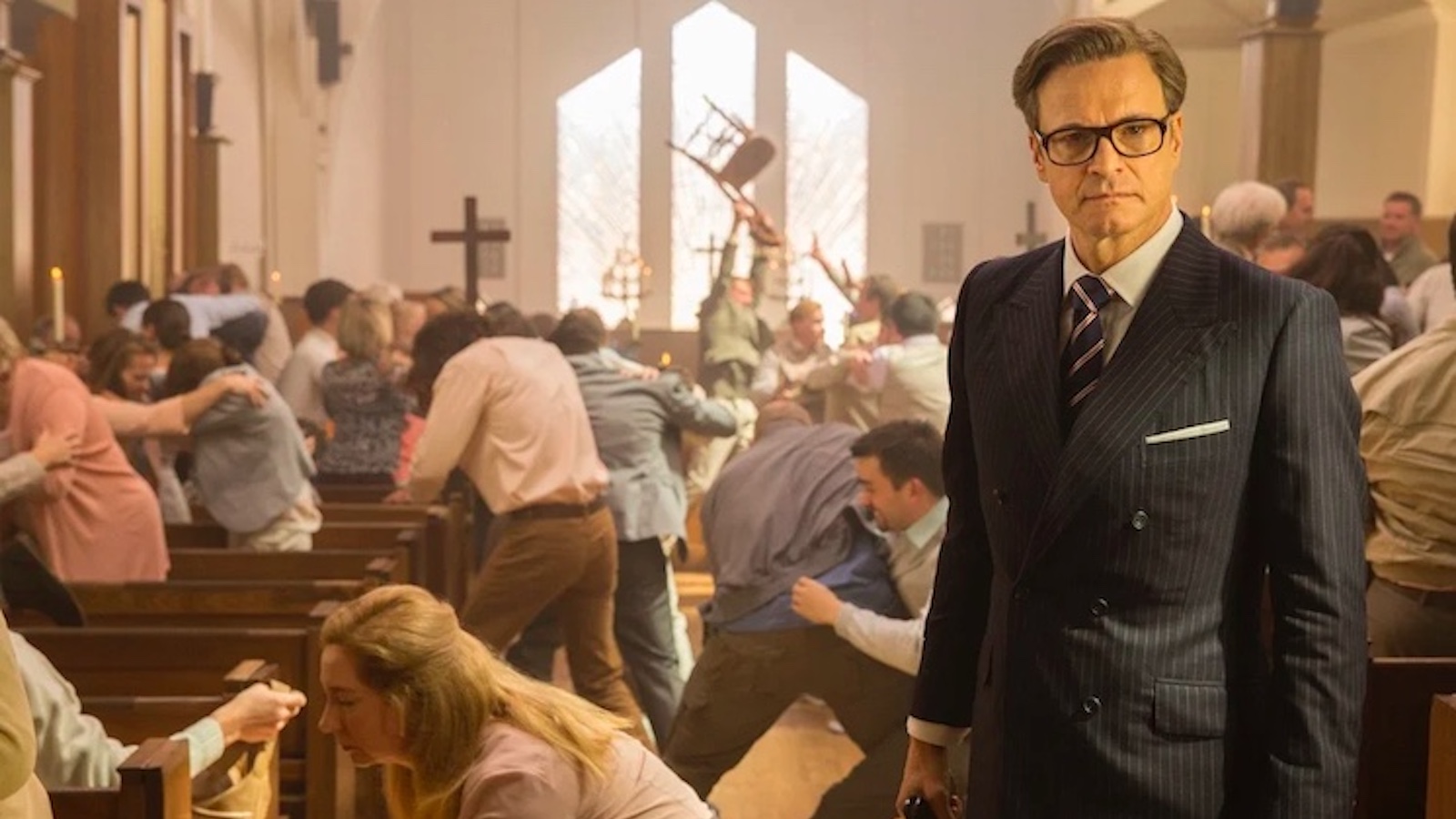
You know that feeling when you're watching a movie and suddenly, the gears shift so hard you get whiplash? That’s what happened in 2014. People walked into Kingsman: The Secret Service expecting a fun, slightly edgy James Bond riff. What they got instead was three minutes and forty-four seconds of absolute, unadulterated carnage set to the tune of Lynyrd Skynyrd. It changed things. Honestly, the church scene from Kingsman remains one of the most polarizing, technically complex, and downright insane sequences in modern action cinema.
It's visceral. It’s messy.
If you haven't seen it in a while, your brain probably remembers the gist: Colin Firth’s Harry Hart, a man who is the literal definition of "manners maketh man," loses his absolute mind and murders an entire congregation. But looking back, there’s so much more happening under the hood than just high-octane violence.
The Orchestrated Chaos of the Church Scene from Kingsman
Matthew Vaughn, the director, didn't just want a fight. He wanted a "ballet of death." Most people don't realize that the church scene from Kingsman was actually filmed in a way that makes it look like one continuous shot, even though it’s peppered with clever hidden cuts. It took twenty days to film. Think about that for a second. Twenty days of filming for less than four minutes of screen time. That’s the kind of obsession that creates a cult classic.
Colin Firth did a staggering amount of his own stunts. We're talking about an actor who, at that point, was best known for playing Mr. Darcy or kingly figures with speech impediments. He wasn't an "action guy." He spent six months training with a team that included former Special Forces members and Jackie Chan’s stunt legends. You can see the work in his posture. Even when he’s jamming a sharpened pole through someone’s chest, he maintains that stiff, British upper lip. It’s the contrast that makes it work.
The technical term for what they used is "stitch-cutting." It’s the same trick used in movies like 1917 or Birdman. By panning the camera quickly or moving behind a pillar, the editors can hide a cut between two different takes. This allows the action to feel relentless. There is no breathing room. You are stuck in that cramped, wooden interior with Harry Hart as he systematically deconstructs a room full of people.
Why "Free Bird" Was the Only Choice
Music matters. Imagine that scene with a generic orchestral score. It wouldn't work. It would feel like a horror movie. But by using the iconic guitar solo from Lynyrd Skynyrd’s "Free Bird," Vaughn tapped into something primal. The song starts slow, then builds into that frantic, legendary crescendo that perfectly mirrors Harry’s descent into madness.
The solo is long. It’s messy. It feels like it’s spiraling out of control, which is exactly what’s happening to Harry’s brain. Because remember, he isn't doing this because he wants to. He’s being manipulated by Valentine’s (Samuel L. Jackson) neurological signal. He is a passenger in his own body. The music makes the audience feel that same frantic energy. You’re almost rooting for him, which is the uncomfortable genius of the whole thing.
Pushing the R-Rating to the Limit
The church scene from Kingsman is the reason the movie is rated R. In the original comic book by Mark Millar and Dave Gibbons, the scene is actually quite different. In the book, it’s a bunch of people at a wedding who start killing each other, and it’s arguably even darker. But Vaughn moved it to a "hate group" church in Kentucky to give the audience a bit of a moral safety net.
If Harry was killing "innocent" people, the audience might have completely turned on him. By making the victims members of a fictional extremist group, the movie gives you permission to enjoy the choreography. It’s a sneaky bit of screenwriting.
Despite that "permission," the scene was still heavily censored in several countries. In some versions released in Vietnam and parts of Latin America, the scene was cut entirely. Can you imagine? You’d just see Harry walk into a church and then walk out covered in blood with no context. It ruins the narrative flow, but it shows just how much the sequence pushed the boundaries of what mainstream audiences were expected to handle.
The Stunt Team Behind the Madness
We have to talk about Bradley James Allan. He was the stunt coordinator, a protégé of Jackie Chan, and sadly he passed away in 2021. His DNA is all over this sequence. He brought that "Hong Kong Style" of fighting to a British spy flick. In most American action movies, the camera cuts every two seconds so you can't tell the actors aren't really fighting. Here, the camera stays wide.
You see the hits land. You see the environment being used.
Harry uses a Bible. He uses a handgun. He uses a jagged piece of wood. He uses an umbrella. It’s improvised weaponry at its finest. The choreography had to be rehearsed to the point of muscle memory because if one person was six inches off their mark, the "long take" illusion would be shattered.
Is It Too Much? The Ethics of Style
There is a legitimate argument that the church scene from Kingsman is "style over substance" taken to an extreme. Some critics at the time, like those at The Guardian, found the scene to be mean-spirited or unnecessary. They argued that it revels too much in the gore.
But here’s the counter-point: The scene is the emotional pivot of the movie. Up until this point, Harry Hart is invincible. He’s the mentor. He’s the hero. By forcing him to commit these acts, the movie strips away his dignity. It’s a tragedy disguised as an action set-piece. When he walks out of that church, dazed and horrified, and is immediately met by Valentine, the stakes are higher than they’ve ever been.
It’s also a satirical jab at American violence. Vaughn has always been a director who likes to poke the bear. By setting this bloodbath in a place of worship, he’s making a very loud, very messy statement about the contradictions of extreme belief systems. It’s not subtle. Then again, nothing in Kingsman is.
The Legacy of the Scene
Since 2014, we’ve seen a lot of movies try to recreate the magic of the church scene from Kingsman. You can see its influence in the John Wick sequels and even in some of the more experimental sequences in the Marvel Cinematic Universe. Everyone wants that "one-shot" fight scene now.
However, few have managed to capture the same mix of humor, horror, and technical prowess. Most "oners" feel like they're showing off. This one feels like a fever dream. It’s the sheer speed of it that stays with you. Most fight scenes have a rhythm of hit, pause, hit, pause. This is just one long, continuous scream.
Surprising Details You Might Have Missed
If you watch the scene frame-by-frame (which some enthusiasts have), you’ll notice some wild details. There’s a moment where Harry uses a woman’s head to block a bullet. There’s another where he reloads his pistol with one hand using the edge of a pew.
- The Lighting: Notice how the lighting shifts from warm, natural sunlight to a harsh, almost sickly yellow as the fight progresses. It’s subtle, but it builds the sense of unease.
- The Body Count: Depending on who is counting, Harry takes out roughly 40 to 50 people in that short span.
- The Sound Design: If you mute the music and just listen to the sound effects, it’s a horror movie. The squelches, the breaks, the thuds—it’s incredibly grounded, which contrasts with the hyper-stylized visuals.
How to Analyze the Action Yourself
To really appreciate why this works, you have to look at the "lines of action." In cinematography, you generally try not to cross the "180-degree line" because it confuses the viewer. In the church scene from Kingsman, they break this rule constantly. Normally, that’s bad filmmaking. Here, it’s used to make the viewer feel as disoriented and chaotic as the characters.
Next time you watch it, don't look at Harry. Look at the people in the background. Every single person in that room is acting their heart out, throwing themselves over chairs and lunging with terrifying intensity. It’s a masterpiece of background coordination.
Actionable Insights for Cinephiles
If you’re a fan of this kind of filmmaking or an aspiring creator, there are a few things to take away from the church scene from Kingsman:
- Preparation is everything. You cannot "fix in post" a sequence this complex. The six months of training Colin Firth underwent were the foundation. If the actor doesn't sell the fatigue and the precision, the scene fails.
- Contrast creates impact. The reason the violence hits so hard is that it’s being performed by a man in a bespoke suit who just finished a polite conversation. Use "The Unthinkable" to your advantage in storytelling.
- Music isn't just background. It should be a character. Choose a track that offers a counterpoint to the visuals rather than just mimicking them. "Free Bird" provides a triumphant energy that makes the horror of the actions feel even more jarring.
- Study the "stiches." Watch the camera movements. Every time the camera moves behind a character’s back or whips 180 degrees, look for the subtle shift in lighting or texture. That’s where the magic happens.
The church scene from Kingsman isn't just a movie clip; it's a case study in how to push a genre forward. It’s uncomfortable, it’s brilliant, and honestly, it’s kind of a miracle it got made at all. Whether you love it or think it’s a bit much, you can’t deny that it’s one of the most significant moments in 21st-century action cinema. It reminds us that movies can still genuinely surprise us, for better or worse.