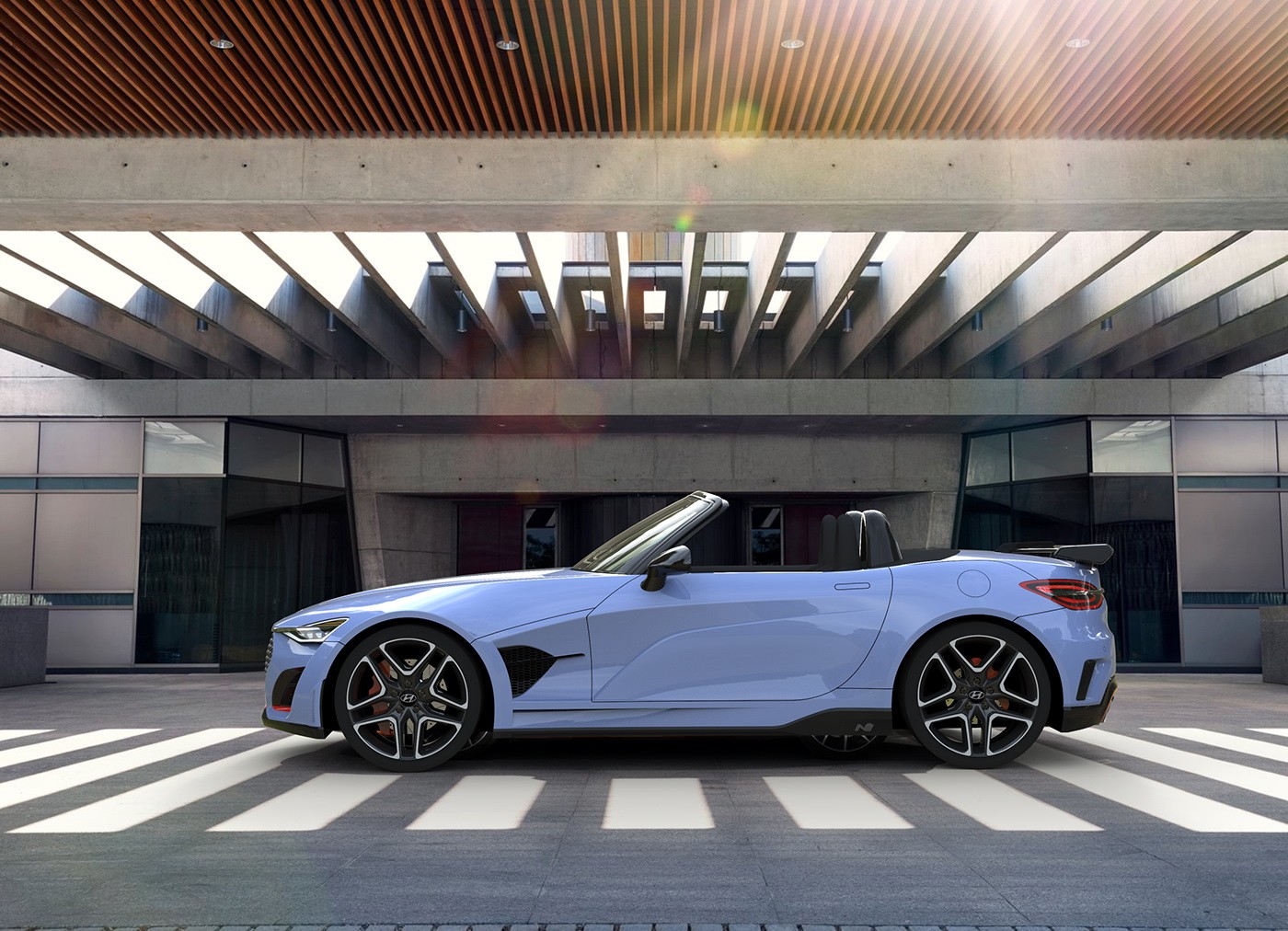
You’ve seen it on the highway. Maybe it was a quick glimpse of a sloping roofline or the way the light hit those pixelated taillights at dusk. For a split second, you probably thought a brand-new Porsche Taycan just zipped past you. But then you saw the badge. It’s a Hyundai. Specifically, the Hyundai Ioniq 6.
It happens all the time.
Honestly, the "Hyundai that looks like a Porsche" phenomenon isn't just a coincidence or a case of lazy design. It’s a deliberate, high-stakes gamble by a South Korean giant that used to be known for "sensible" commuter cars. Now? They’re chasing aerodynamic perfection, and it turns out that when you follow the laws of physics to make a car go further on a single charge, you end up looking a lot like a brand from Stuttgart.
The Design DNA of the Hyundai Ioniq 6
Designers call it the "Streamliner" look. If you go back to the 1930s, cars like the Stout Scarab or the Phantom Corsair were obsessed with minimizing drag. Porsche has owned this silhouette for decades—that iconic "flyline" that slopes from the roof down to the rear bumper.
When Hyundai revealed the Ioniq 6, the internet went into a bit of a meltdown.
People pointed at the ducktail spoiler. They pointed at the low-slung nose. They basically accused Hyundai of tracing the Porsche 911’s homework. But here is the thing: Hyundai’s design lead, SangYup Lee—who, by the way, worked at Bentley and knows a thing or two about luxury—wasn't just trying to copy-paste a German legend. He was trying to hit a drag coefficient of 0.21. That is incredibly low. To get there, you need a specific shape. Porsche just happened to get there first.
There's a specific tension in the car's body. The Ioniq 6 uses "Parametric Pixels"—those little square LED lights—to differentiate itself. It’s a weird mix of retro-futurism and 90s tech vibes. While a Porsche Taycan feels like a solid piece of carved marble, the Hyundai feels like a digital gadget that somehow learned how to breathe. It’s different, yet the silhouette remains the primary reason people do a double-take.
Aerodynamics vs. Aesthetics
Why does the Ioniq 6 look like a Porsche? Physics.
In the EV world, range is king. If your car is shaped like a brick, the wind hits it like a wall. To get 361 miles of range out of a battery—which the long-range Ioniq 6 actually achieves—you have to make the air slide off the back without creating turbulence.
Porsche mastered this with the 911 to keep it glued to the road at 180 mph. Hyundai is doing it to keep you from having to stop at an Electrify America station every two hours.
If you look closely at the rear wing of the Ioniq 6, it’s actually a dual-spoiler setup. One is integrated into the glass, and the other is a literal "whale tail." That’s a direct nod to the Porsche 930 Turbo from the 70s. Is it a rip-off? Maybe. Is it effective? Absolutely.
Beyond the Shell: Is it Actually a "Budget Porsche"?
This is where the comparison usually falls apart for the purists. If you get behind the wheel, you aren't going to feel like you're in a $150,000 sports car. And that’s fine.
The Ioniq 6 starts around $38,000 to $45,000 depending on the trim and current incentives. A Porsche Taycan starts at roughly $100,000 and can easily double that with options. You’re paying for the badge, the suspension tuning, and the heritage. But Hyundai is offering something the German brands often struggle with: usable tech that doesn't feel like a chore.
Inside the Ioniq 6, the floor is completely flat.
It feels cavernous.
While a Porsche wraps around you like a cockpit, the Hyundai feels like a lounge. It has "Relaxation Comfort Seats" that recline almost fully, meant for when you're sitting at a charger. It’s a different philosophy. Porsche is about the drive. Hyundai is about the experience of getting from point A to point B without any stress.
Performance Specs That Surprised Everyone
Don't let the "lifestyle" vibe fool you, though. The dual-motor version of the Ioniq 6 puts out 320 horsepower and 446 lb-ft of torque. It hits 0-60 mph in about 5 seconds.
Is it a Taycan Turbo S? No. But it’s faster than many entry-level Porsches from ten years ago.
- Platform: E-GMP (Electric Global Modular Platform)
- Charging: 800V architecture (This is the "Porsche" killer)
- Speed: 10% to 80% charge in about 18 minutes
That 800V system is the real secret sauce. Most EVs, like the Mustang Mach-E or the Tesla Model 3, use a 400V system. Only a handful of cars—the Porsche Taycan, the Lucid Air, and the Hyundai/Kia twins—use the 800V setup. This means the "Hyundai that looks like a Porsche" actually charges like a Porsche, too.
The N Vision 74: The Other "Looks Like a..." Hyundai
We can't talk about Hyundais looking like other cars without mentioning the N Vision 74. While the Ioniq 6 is the Porsche lookalike you can actually buy, the N Vision 74 is the one everyone wants to buy.
It looks like a DeLorean. Or a BMW M1. Or a Lancia 037.
Actually, it’s a tribute to the 1974 Hyundai Pony Coupe concept designed by Giorgetto Giugiaro. People often forget that Hyundai has its own history to pull from. But because that history was dormant for so long, we naturally associate these bold shapes with more established European brands.
When you see a Hyundai N Vision 74 on the street (mostly as a rolling laboratory or at car shows), the reaction is visceral. It proves that Hyundai isn't just copying Porsche; they are experimenting with "emotional" design. They want you to feel something when you look at the car. For the Ioniq 6, that feeling just happens to be "Wait, is that a Porsche?"
Why This Strategy is Working for Hyundai
Brand perception is a hard thing to change. For decades, Hyundai was the "economy" choice. You bought one because it had a 10-year warranty and it was cheap.
By releasing a car that mimics the silhouette of one of the most prestigious brands in the world, Hyundai is performing a massive "halo effect" maneuver. They are tricking your brain into associating their brand with luxury and performance.
And it's working.
Sales of the Ioniq 6 have been solid, but more importantly, the conversation has changed. People aren't talking about how many cup holders it has; they're talking about its drag coefficient and its stance. They're comparing it to cars that cost three times as much. That is a massive win for a company from Seoul.
Common Misconceptions
People think because it looks like a Porsche, it handles like one.
Let's be real: it doesn't.
The Ioniq 6 is heavy. It's a comfortable cruiser. If you take a sharp corner at high speed, you'll feel the weight of those batteries. The steering is light—maybe a bit too light for someone used to a 911. It’s a great car, but it’s a grand tourer, not a track weapon.
Another misconception is that it's "just a rebadged Kia EV6." While they share the same platform, the Ioniq 6 is much more efficient because of that Porsche-esque shape. The EV6 is a crossover; the Ioniq 6 is a sedan. That lower profile gives it a significant edge in highway range.
Real World Ownership: What to Expect
If you're looking at a Hyundai Ioniq 6 because you love the Porsche aesthetic but don't love the Porsche maintenance costs, here’s what you need to know.
First, the visibility isn't great. That sloping rear window looks cool, but it’s like looking through a mail slot. You’ll rely heavily on the cameras. Second, the trunk is surprisingly small. Because of that "streamliner" tail, you lose a lot of vertical space. It’s a "trunk," not a "hatchback."
But the pros?
You get the best charging tech currently available to humans. You get a car that turns heads in every parking lot. You get an interior that feels like a spaceship. And you get a warranty that Porsche wouldn't dream of offering.
Actionable Insights for Potential Buyers
If you are genuinely considering the Ioniq 6 as your next vehicle, don't just walk into a dealership and pay MSRP. The EV market in 2026 is wildly different than it was a few years ago.
- Check the Lease Deals: Because of how federal tax credits currently work, leasing an Ioniq 6 is often thousands of dollars cheaper than buying one outright. Many dealers are passing the $7,500 credit directly into the lease terms.
- Verify the Trim: If you want the maximum "Porsche" look, the Limited trim comes with the 20-inch wheels. However, those wheels drop your range by about 50 miles. If you want the looks and the utility, stick to the 18-inch wheels on the SEL or SE Long Range.
- Test the Digital Mirrors: In some markets, the Ioniq 6 comes with cameras instead of side mirrors. In the US, we still have traditional glass. Make sure you're okay with the "standard" look if you're watching international reviews.
- Compare to the Ioniq 5: They are built on the same bones. If you find the Ioniq 6 too cramped but love the tech, the Ioniq 5 offers a "retro-80s" vibe that is just as striking, even if it doesn't look like a Porsche.
The Hyundai Ioniq 6 is a statement piece. It’s proof that "economy" brands don't have to be boring. Whether you think it’s a brilliant homage or a derivative copy, you can't deny that it’s one of the most interesting cars on the road today. It forces you to look. And in the world of automotive design, that’s more than half the battle won.