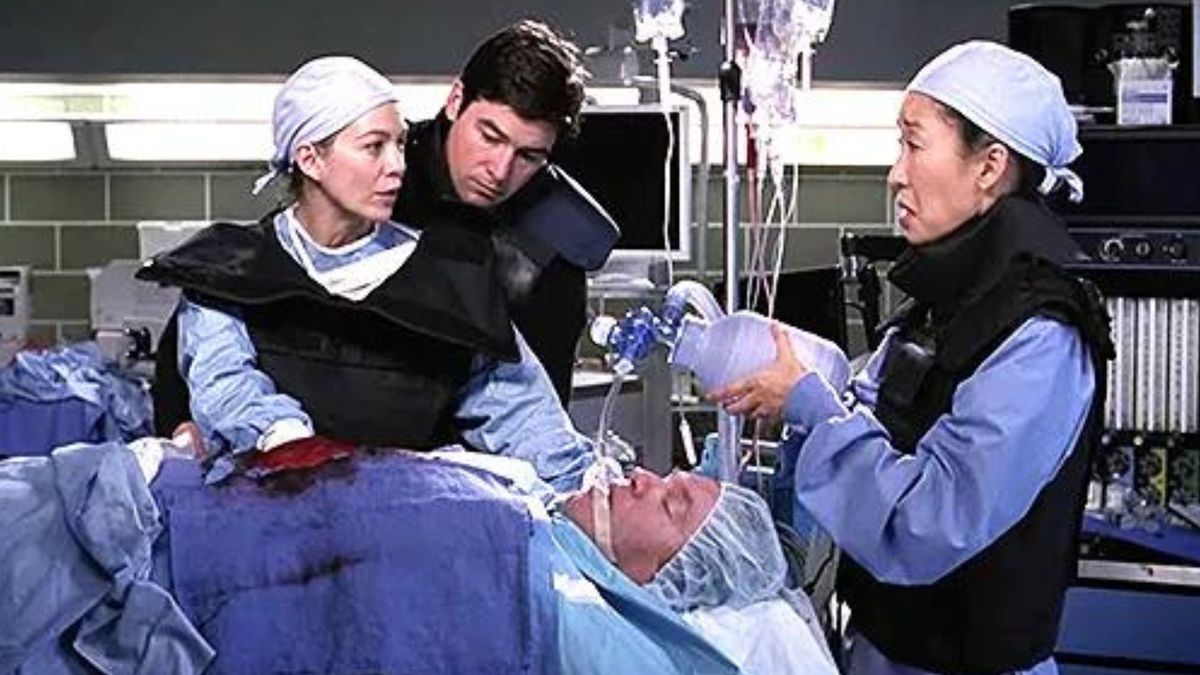
It’s been nearly two decades, but I still can’t look at a pink bouncy ball without thinking about Kyle Chandler. That’s the power of the Grey's Anatomy code black episode. If you were watching TV back in February 2006, you remember exactly where you were when the Super Bowl ended and the screen cut to Meredith Grey staring down the barrel of a literal weapon. It wasn’t just a medical drama anymore; it was a thriller.
Honestly, the two-part event, titled "It's the End of the World" and "As We Know It," changed how we looked at Seattle Grace. Before this, the stakes were high, sure. People died on operating tables. Relationships crumbled in elevators. But this was different. This was life-or-death on a scale the show hadn't touched yet. Shonda Rhimes basically told the audience, "Nobody is safe," and we believed her.
What Actually Happened During the Grey's Anatomy Code Black Episode?
The setup is almost too simple, which is why it works. A guy named James Carlson comes in with a wound in his chest. His friend was playing with a homemade bazooka—classic TV logic, but grounded in a weirdly believable sense of "people do stupid things." The twist? The projectile is still inside him. It’s unexploded. If anyone moves, or if the surgical tools create a spark, the entire OR goes up in flames.
Meredith ends up with her hand inside the body cavity, holding the ammunition steady. It's a terrifying image. Ellen Pompeo’s performance here is underrated because she has to convey total, paralyzing fear while barely moving a muscle. You’ve got the bomb squad leader, Dylan Young (played by a very stoic Kyle Chandler), trying to talk her through it. The tension is thick enough to cut with a scalpel.
While this is happening, the rest of the hospital is a mess. Bailey is in labor but refuses to push because her husband, Tucker, is in surgery after a car accident. George is the one who has to step up and be her support system. It’s one of the first times we see George O'Malley as more than just "007" or the bumbling intern. He’s a rock for his boss. That contrast between the quiet, high-stakes bomb room and the chaotic, emotional labor room is what makes this episode a masterpiece of pacing.
The Physics of the Danger
Let's talk about why a "Code Black" is even a thing. In a hospital, different codes mean different emergencies. Code Red is fire. Code Blue is cardiac arrest. Code Black is a bomb threat. When Dr. Milton (the anesthesiologist who famously ran away) realized what was happening, he panicked. Can you blame him?
The medical reality of the Grey's Anatomy code black episode is obviously heightened for drama, but the fear of volatile materials in an OR is real. Static electricity is a genuine concern in surgery. Oxygen-rich environments are highly flammable. When Dylan tells Meredith she can't move, he isn't exaggerating. One slip of a finger or a sudden jolt from the patient’s heart could trigger the firing pin.
Why This Two-Parter Still Ranks So High
Most fans agree this is the peak of the early seasons. It didn't feel like a "very special episode" gimmick. It felt earned.
- The Character Growth: We saw Izzie and Alex deal with their burgeoning feelings in the middle of a crisis.
- The Guest Stars: Kyle Chandler won an Emmy nomination for this role, and he’s only in two episodes. That’s wild. Christina Ricci as the terrified paramedic Hannah Davies was equally haunting.
- The Score: The use of "The 2nd Law" and "Breathe (2 AM)" cemented the show's reputation for having the best soundtrack on network television.
The ending of the second part is what really sticks. Meredith finally pulls the bomb out. She hands it to Dylan. He walks down the hallway. You think they’re safe. You really do. Then, the hallway explodes.
It’s a brutal, sudden moment. One second he's there, the next he's gone. It’s the kind of TV that makes you sit in silence while the credits roll. There was no "happily ever after" for the hero who saved the day. There was just pink mist and a very traumatized Meredith Grey.
Common Misconceptions About the Bomb Episode
People often confuse this with the hospital shooting, but that came much later in Season 6. The Grey's Anatomy code black episode happened in Season 2. It was the lead-out program for Super Bowl XL, which explains why the budget looked so much bigger than a standard episode.
Another thing people forget? Derek Shepherd was stuck in surgery on Bailey’s husband the whole time. He knew Meredith was in danger, but he couldn't leave his patient. That "McDreamy" angst was dialed up to eleven. It established the core conflict of their relationship: the struggle between being world-class surgeons and being people who love each other.
The Impact on the Medical Drama Genre
Before Grey's did the bomb in the chest, medical shows were mostly about the mystery of the week—think House or ER. This episode proved that you could mix high-octane action-movie tropes with a soap opera heart. It paved the way for every "disaster" episode that followed, from the ferry boat crash to the plane crash.
Actionable Takeaways for Grey's Fans and Rewatchers
If you’re planning to revisit these episodes, keep a few things in mind to get the most out of the experience.
- Watch the buildup. Don't just skip to the explosion. The episodes leading up to it show the exhaustion of the interns, which makes their mistakes in the OR feel more human.
- Notice the cinematography. Notice how the camera gets tighter and tighter on Meredith’s face as the episode progresses. It’s meant to make you feel as claustrophobic as she does.
- Check the soundtrack. "Breathe (2 AM)" by Anna Nalick became a massive hit because of this episode. Listen to how the lyrics mirror Meredith’s internal monologue.
- Observe the foreshadowing. Meredith’s opening voiceover about having a feeling she’s going to die isn't just fluff. It sets the tone for the entire two hours.
The Grey's Anatomy code black episode remains a blueprint for how to do "Event TV" correctly. It wasn't just about the bomb; it was about the people holding it. It showed us that even in a place built for healing, destruction is only a heartbeat away.
To truly appreciate the writing, pay attention to the silence. In an era where TV shows are filled with constant dialogue, the quiet moments in the OR—where all you hear is the hiss of the ventilator and the hum of the monitors—are where the real terror lives. It’s a masterclass in tension that hasn't been matched by many shows since. If you haven't seen it in a while, it's worth the rewatch, even if you know exactly what happens when Dylan walks out that door.
To revisit this iconic moment, start your rewatch at Season 2, Episode 16, "It's the End of the World." Make sure you have the next episode, "As We Know It," ready to go immediately after, because that cliffhanger is still one of the most stressful moments in broadcast history. Pay close attention to the interaction between Meredith and Cristina Yang in the aftermath; it defines their "person" dynamic for the rest of the series.