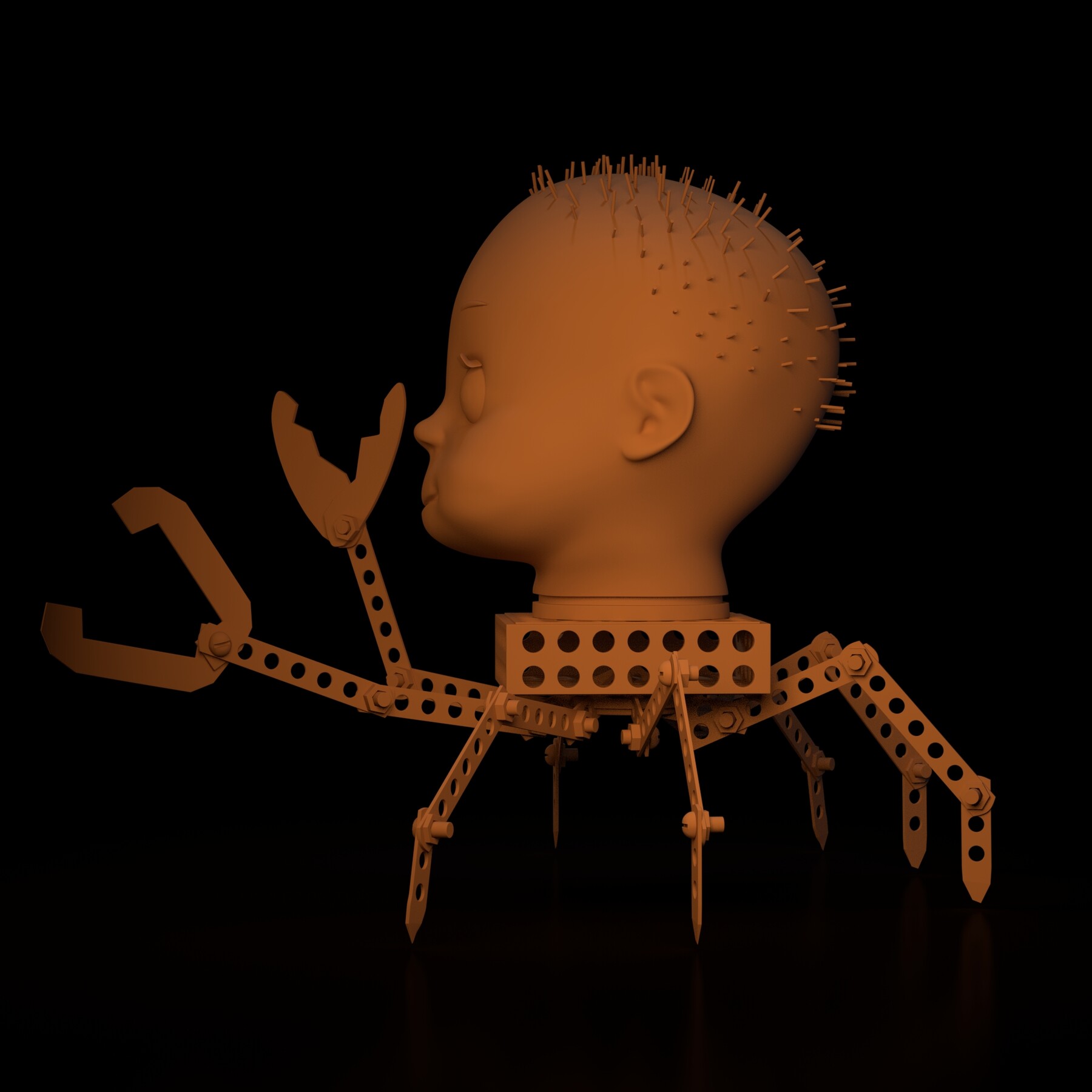
You remember the sound. It’s that rhythmic, metallic clicking against the wooden floorboards of Sid Phillips’ bedroom. For a generation of kids watching Pixar’s breakout hit in 1995, the spider from Toy Story—officially known as Babyface—was the stuff of genuine nightmares. It wasn't just a toy; it was a visual representation of what happens when childhood innocence gets twisted into something unrecognizable. Honestly, it’s kinda wild that a movie marketed to toddlers featured a hairless doll head fused to a mechanical Erector Set body.
Babyface isn't a villain. That’s the big misconception people still have. When we first see those red glowing eyes in the dark, we’re conditioned to think "monster." But if you actually look at the narrative arc of Toy Story, the spider from Toy Story is actually a hero. He's the leader of the "Mutant Toys," a group of survivors who have been dismantled and rebuilt by a kid who clearly needed a therapist.
The Anatomy of a Childhood Phobia
Why does Babyface hit so hard? It's the Uncanny Valley. This isn't just a spider; it's a combination of organic-looking human features and cold, industrial metal. The doll head is missing an eye, and the scalp is completely bald, giving it a look that mimics both infancy and old age simultaneously.
Pixar’s animators, led by John Lasseter, were working with incredibly limited technology back then. They couldn't do fur or realistic hair very well—which is why Andy’s dog Buster looks a bit like a plastic potato in the first film. By making the spider from Toy Story a bald, mechanical hybrid, they turned their technical limitations into a legendary design choice. The movement was inspired by arachnids, but the clicking sounds were purely mechanical. It creates this cognitive dissonance in your brain. You see a baby, but you hear a machine. You see a toy, but you feel a predator.
Breaking Down the "Bad Toy" Myth
If you go back and watch the "Big One" scene where Buzz and Woody are trapped in Sid's room, the tension is suffocating. Woody is panicked. He thinks these things are going to eat him. He uses a severed arm as a club. But look at what the spider from Toy Story is actually doing. He’s not attacking. He’s communicating.
The Mutant Toys don't speak. They can't. Sid likely ripped out their voice boxes or they never had them to begin with. Babyface communicates through a series of taps and gestures. He’s essentially the foreman of a surgical team. When Janie the doll and the Pterodactyl get switched, it’s Babyface who performs the "surgery" to fix them. He’s a healer. It’s a brilliant subversion of the "scary monster" trope.
Most people forget that the spider from Toy Story is the one who signals the attack during the climax of the film. When the toys finally "break the rules" and reveal themselves to Sid, it’s Babyface who leads the charge out of the sandbox. He’s the tactical mastermind. He spent years being tortured by a kid with a magnifying glass and a penchant for explosives, yet he still had the presence of mind to organize a silent rebellion. That’s not a monster; that’s a survivor with nerves of steel. Or, well, legs of steel.
The Real-World Legacy of Babyface
Toy Story changed everything for Disney. It proved that 3D animation was the future. But for the merchandising department, Babyface was a bit of a headache. How do you sell a "scary" toy to kids? Interestingly, the spider from Toy Story has become one of the most sought-after collector's items from the original 1995 line.
Think about the Thinkway Toys releases. They had to balance the creepiness with the "collectible" factor. Today, a mint-in-box Babyface can fetch hundreds of dollars on secondary markets like eBay. People who grew up with the film now view him as a symbol of resilience. He’s the patron saint of the broken and the misunderstood.
There’s also the influence on the horror genre. Directors like James Wan and even the creators of the Chucky franchise have touched on the idea of the "distorted doll." While Toy Story is a G-rated flick, the spider from Toy Story opened the door for more complex, darker imagery in family films. It taught us that "scary-looking" doesn't mean "bad."
Why Sid Wasn't a Psychopath (Maybe)
We have to talk about Sid Phillips for a second. Everyone calls him a villain. But if you think about it, he was just a creative kid with no supervision. He was an engineer. He saw a toy and wondered, "What if I make this better?"
The spider from Toy Story is the ultimate proof of Sid’s raw talent. He built a functional, multi-legged walking apparatus using nothing but an Erector Set and a doll head. If Sid had grown up in a different neighborhood, he’d probably be working for NASA or Boston Dynamics. The tragedy of Babyface is that he was created through "play" that felt like torture to the toys, but from a human perspective, it was just 90s-era DIY experimentation.
Actionable Insights for Collectors and Fans
If you're looking to dive deeper into the world of Sid’s room or if you're hunting for a spider from Toy Story of your own, here is the reality of the current landscape:
- Check the Eye: If you are buying a vintage 1995 Thinkway Babyface, ensure the "missing" eye hasn't been tampered with. Some knock-offs or "refurbished" versions try to add a second eye, which completely ruins the screen accuracy.
- The Legs are Fragile: The plastic used in the 90s for the Erector Set pieces is prone to "brittle plastic syndrome." If you’re displaying him, keep him out of direct sunlight. The UV rays will make those spider legs snap like toothpicks.
- Scale Matters: Disney released several versions of the Mutant Toys over the years. The "Signature Collection" is generally considered the most movie-accurate in terms of scale and weight.
- Revisit the Short Films: Babyface makes cameos and is referenced in various Pixar "Easter eggs." Keep an eye out in Toy Story 4—there are nods to the old Sid toys in the antique mall that most people miss on their first watch.
The spider from Toy Story remains a masterpiece of character design because he challenges our prejudices. We see something ugly and we assume it’s evil. Then, the movie flips the script and shows us that the most "monstrous" looking creature in the room is actually the most empathetic. He’s a reminder that we are more than our parts, even if those parts include a missing eye and some rusted metal legs.
To truly appreciate the craftsmanship, go back and watch the "Wind-up" scene. Pay attention to the way Babyface moves. It isn't random. It’s calculated, careful, and strangely graceful. He’s the heart of Sid’s room. And honestly? He’s the bravest toy in the entire franchise.
Next Steps for Enthusiasts:
Research the "Signature Collection" series if you want the most accurate replica of the spider from Toy Story for your shelf. These models use the original digital files from Pixar to ensure the proportions of the doll head and the mechanical legs match the 1995 film exactly. Also, look into the "Art of Toy Story" books which detail the early sketches of the Mutant Toys—many of which were even more disturbing than the final Babyface design we saw on screen.