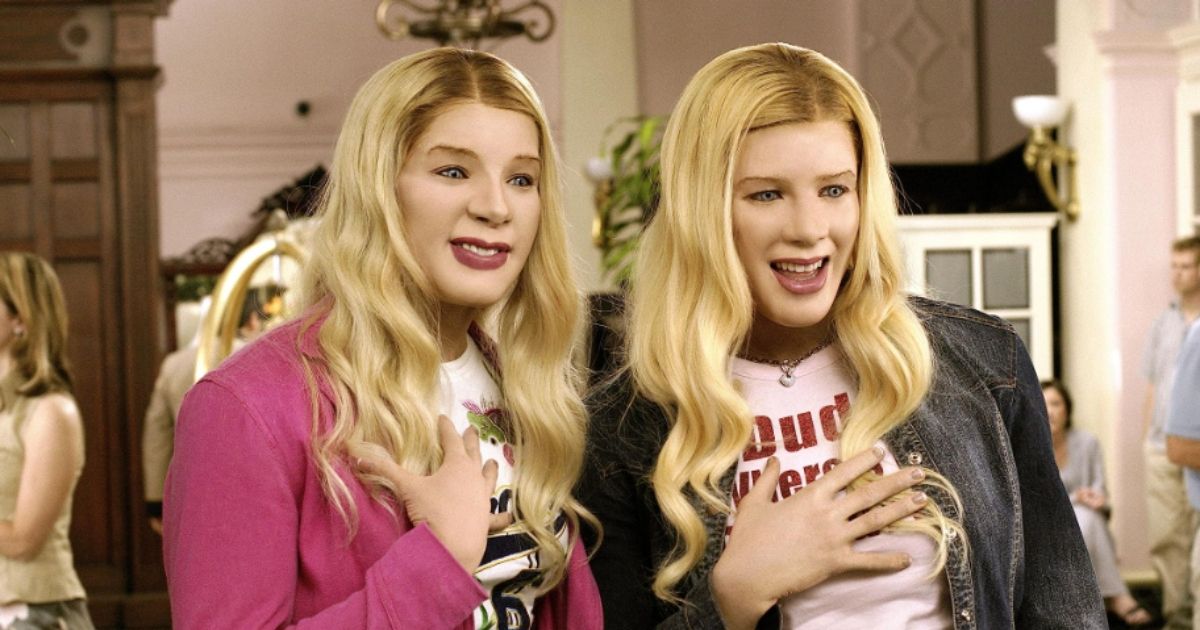
Let’s be real. If you hear the opening notes of "It’s Tricky" by Run-D.M.C., your brain does not go to the golden age of hip-hop. It goes straight to a crowded nightclub in the Hamptons where two FBI agents in terrifyingly high-maintenance latex masks are absolutely destroying a pair of heiresses on the dance floor. It’s been over two decades since Keenen Ivory Wayans released this masterpiece, and yet, the White Chicks dance battle scene remains a cornerstone of internet culture, a meme goldmine, and a masterclass in physical comedy that most modern sitcoms couldn’t touch with a ten-foot pole.
It’s iconic. Honestly, it’s more than iconic—it’s a cultural reset.
The Setup: Why the Stakes Were Weirdly High
Before we get into the actual footwork, we have to look at the context. Kevin and Marcus Copeland (played by Shawn and Marlon Wayans) aren't just trying to fit in; they’re trying to survive a social gauntlet. The Vandergeld sisters, Megan and Heather, are the "villains" here, played with perfect "mean girl" energy by Brittany Daniel and Anne Dudek. They represent the peak of early 2000s elitism. They’re rich. They’re thin. They’re incredibly mean.
When the Vandergelds challenge the "Wilson sisters" to a dance-off, they think they’ve won before they’ve even started. They do this highly choreographed, pop-princess routine that was very "of the era." It was stiff, professional, and honestly, kind of boring. But then? Then the beat drops.
That White Chicks Dance Battle Scene Breakdown
The moment Marcus (as Tiffany) shouts "Hold my purse!" the energy shifts. This isn't just a scene; it's a declaration of war.
The choreography for the White Chicks dance battle scene was actually quite complex. Marlon and Shawn Wayans aren't just flailing around. They are hitting specific marks that blend street dance, breakdancing, and pure slapstick. You’ve got the robot, the pop-and-lock, and that incredible moment where they use their "heels" as weapons of rhythmic destruction.
One thing people often forget? The extras. Look at the faces of the background actors during the "It's Tricky" sequence. Those aren't just paid reactions; half of them look genuinely terrified and impressed. The physical commitment from the Wayans brothers is what sells it. They aren't worried about looking cool. They are worried about being funny.
The Music Choice Was Genius
Why Run-D.M.C.? Well, in 2004, nostalgia for the 80s was just starting to peak. By using a track that was already a classic, the movie bridged a gap. It contrasted the "posh" Hamptons setting with aggressive, high-energy rap. It’s the sonic version of the Copeland brothers themselves: something that doesn't "belong" in this world, forcing its way in through sheer volume and talent.
Why Does It Still Rank On TikTok and Reels Today?
You see it every week. A new creator tries to recreate the choreography. A soundbite of the "Hold my purse" line goes viral again. Why? Because the White Chicks dance battle scene relies on a universal comedic truth: the subversion of expectations.
We see two "women" who have been treated as social outcasts suddenly dominate a space where they were supposed to fail. It’s a classic underdog story told through the medium of aggressive breakdancing. Plus, the sheer absurdity of the makeup. In 2026, we have high-definition everything. We can see every pore. Back in 2004, the "uncanny valley" look of the Wilson sisters was part of the joke, but now it’s become a specific aesthetic.
It’s creepy. It’s hilarious. It’s unforgettable.
The Secret Ingredient: Physicality vs. Dialogue
While the movie is packed with quotable lines ("Your mother's so old her breast milk is powder!"), the dance battle doesn't need words. It’s pure silent film energy. If you muted the TV, you’d still know exactly what was happening. You’d feel the triumph.
The Wayans brothers grew up in a household where comedy was a survival skill. They understood that a well-timed leg kick or a synchronized head snap is worth a thousand punchlines. In the White Chicks dance battle scene, their chemistry is palpable. You can tell they’ve been doing bits like this since they were kids in the Chelsea projects.
Breaking Down the Vandergeld Response
We have to give credit to Brittany Daniel and Anne Dudek. Their "defeat" faces are legendary. As the Wilson sisters escalate their routine—incorporating backflips and aggressive chest-pops—the Vandergelds' transition from smug superiority to "what is happening" is a masterclass in reaction acting. They represent the audience's disbelief.
What Most People Get Wrong About the Film’s Impact
Some critics at the time dismissed White Chicks as low-brow humor. They called it "uninspired." History has proven them wrong. The movie, and specifically this scene, tapped into something deeper about identity and the performance of gender and class.
By taking the White Chicks dance battle scene and making it the emotional peak of the party, the film argues that being "authentic" (even while wearing three inches of latex) is more powerful than being "perfect." The Vandergelds were rehearsed. The Wilsons were raw.
Actionable Takeaways for Comedy Fans and Creators
If you’re looking to analyze why this specific moment works so well, or if you're a content creator trying to capture that same "viral" energy, here is the breakdown of the magic:
- Commit to the Bit: The Wayans brothers didn't "wink" at the camera. They played the scene as if their lives depended on winning that dance-off. In comedy, the moment you look embarrassed is the moment you lose the audience.
- Contrast is King: Place something loud in a quiet place. Place something "street" in a "high-society" ballroom. The friction between the character and their environment is where the sparks fly.
- Visual Pacing: Notice how the music starts slow and builds. The moves get bigger, faster, and more ridiculous as the song progresses. It’s a ladder of escalation.
- The Reaction Shot: Never underestimate the power of the "bystander." The dance battle is only 50% about the dancing; the other 50% is about how the crowd reacts to it.
The White Chicks dance battle scene isn't just a relic of the early 2000s. It’s a blueprint. It shows us that when you combine physical talent with a total lack of ego, you get something that stays funny for twenty years.
To truly appreciate the technicality, go back and watch the scene on a high-refresh-rate screen. Look at the synchronization during the "hand-clap" segment. It's tighter than most professional music videos of that era. That's not luck; that's rehearsal. That's the Wayans family legacy in action.
Next time you're at a wedding and the DJ puts on a throwback track, remember Marcus Copeland. Drop your bag. Clear the floor. And maybe, just maybe, don't forget to tell someone to hold your purse.
The best way to keep this legacy alive is to stop viewing White Chicks as a "guilty pleasure" and start recognizing it for what it is: a brilliant piece of physical satire that hasn't aged a day. Go watch the "It's Tricky" sequence one more time—pay attention to the footwork, ignore the logic, and just enjoy the chaos.
Practical Next Steps for Fans:
- Study the Choreography: If you're into dance, look for the behind-the-scenes clips of the Wayans brothers working with choreographers for this specific sequence; the "making of" featurettes show how much work went into making it look "accidentally" brilliant.
- Playlist Curation: Add "It's Tricky" (Run-D.M.C.) and "Crazy in Love" (Beyoncé) to your workout or party playlist to see the immediate psychological shift in the room.
- Rewatch with Focus: Watch the film again, but this time, specifically look at the background actors' faces during the club scenes to see the genuine reactions to the brothers' improvisations.