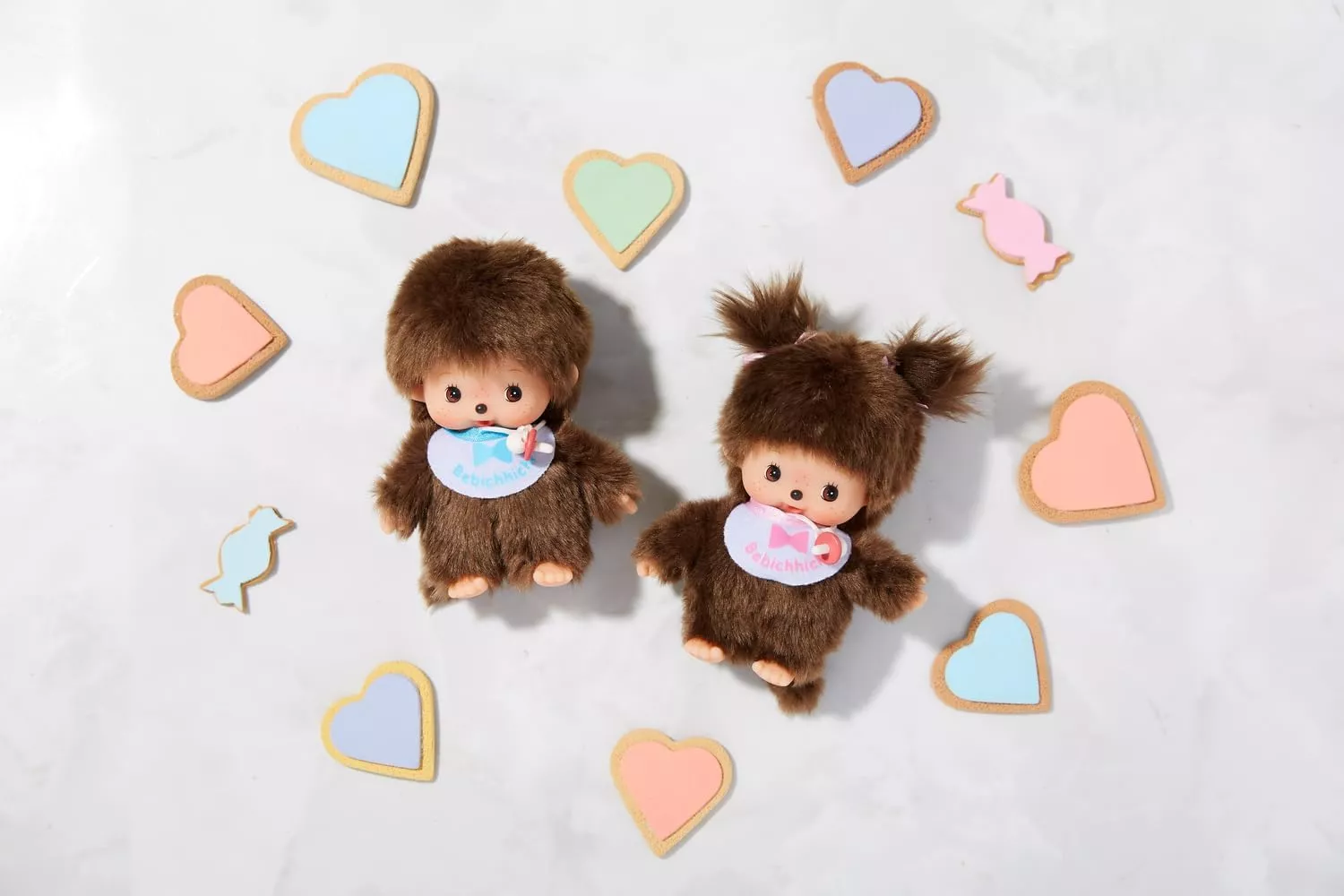
You’ve seen the face. It’s that weirdly cute, slightly unsettling blend of a monkey and a human infant, usually sucking its thumb or holding a plastic pacifier. Seeing a picture of a Monchhichi today feels like a direct hit of 1970s and 80s nostalgia, but these little creatures aren't just relics of a disco-era toy chest. They are a massive cultural export from Japan that managed to survive the rise and fall of Cabbage Patch Kids, Beanie Babies, and every other flash-in-the-pan fad.
Honestly, it’s a bit of a miracle.
Most people look at a vintage photo of these dolls and think "Oh, I remember those!" without realizing the sheer complexity behind the brand. Created by Koichi Sekiguchi in 1974, the Monchhichi was intended to inspire love and respect in children. Sekiguchi, who ran the Sekiguchi Corporation in Tokyo, didn't just want a toy; he wanted a companion. The name itself is a clever bit of linguistic gymnastics, blending the French words "Mon" (mine) and "Petit" (small) with a Japanese "chu-chu" sound that mimics a baby sucking a pacifier.
It worked.
By the time the late 70s rolled around, these dolls were everywhere. If you check out any archival picture of a Monchhichi from 1979 or 1980, you’ll see them in boutiques from Paris to New York. They weren't just for kids, either. In Europe, they became a bit of a fashion statement for young adults, often clipped to bags or dashboards.
Why collectors go crazy for the blue eyes
Not all Monchhichis are created equal. If you are scrolling through eBay or looking at a picture of a Monchhichi and the doll has blue eyes, pay attention. Those are the originals.
From 1974 until roughly 1985, the Sekiguchi Corporation produced the dolls with bright blue eyes. Later, around the time Mattel took over distribution in the United States, the eye color shifted to brown. For a hardcore collector, that tiny color change is the difference between a $15 thrift store find and a $200 vintage treasure.
It’s about the freckles, too.
Take a close look at the bridge of the nose. Real vintage dolls have a specific, slightly irregular spray of freckles. Modern reproductions—and yes, they still make them—often have a much more uniform, "perfect" look that lacks the soul of the hand-painted originals. People forget that in the early days, the manufacturing process involved a significant amount of manual labor.
The Mattel Era and the Saturday Morning Cartoon
In the early 80s, the Monchhichi went "Hollywood." Mattel snatched up the rights to sell them in the U.S., and suddenly, the marketing machine went into overdrive. You might remember the 1983 cartoon produced by Hanna-Barbera. It was... well, it was definitely a product of its time.
The show featured characters like Moncho, Kiki, and Ti-Ti. They lived in Monchia in the tops of tall trees, which was basically a ripoff of the Ewok village from Return of the Jedi, but with more fur and less spears. While the show only lasted one season, it cemented the "Monchhichi jingle" into the brains of an entire generation.
"Monchhichi, Monchhichi... oh so soft and cuddly!"
If you find a picture of a Monchhichi where they are wearing elaborate outfits—like a space suit or a wedding dress—it’s likely from this Mattel era. Mattel realized they could sell more than just the doll; they could sell the lifestyle. This led to "Boutique" sets and a staggering array of accessories that rivaled Barbie’s closet.
Spotting a fake in a digital world
The internet is flooded with "Monchhichi" dolls that are actually "Kiki" dolls or "Chic-a-boo" knockoffs. If you’re looking at a picture of a Monchhichi online and trying to verify its authenticity, look at the feet.
Genuine Sekiguchi dolls usually have a stamp on the foot or a very specific tag sewn into the side seam. The fur should feel dense, not scratchy or "plastic-y." In the 70s, they used a high-quality synthetic plush that has held up remarkably well over fifty years. If the fur looks matted or "melted," it’s likely a cheaper imitation or has been stored in a hot attic (which is the death of any vintage toy).
Another tell is the thumb.
The classic Monchhichi pose is the thumb-in-mouth. The thumb should fit snugly and stay there. On many knockoffs, the hand is molded poorly, and the thumb just flops out. It’s a small detail, but it’s how you separate the icons from the pretenders.
The 2026 Resurgence: Why they are back
Everything old is new again, but the Monchhichi has a weird staying power that other retro toys lack. In Japan, they never really went away. The Sekiguchi headquarters in Tokyo even has a dedicated Monchhichi museum.
Lately, the "Kidult" trend has brought these dolls back into the spotlight. Adults are buying them not for their kids, but for themselves. They represent a simpler time before screens and social media. When you see a picture of a Monchhichi on Instagram today, it’s often staged in a "travel photo" style—the doll sitting in front of the Eiffel Tower or a ramen shop in Kyoto.
It’s cute. It’s weird. It’s aesthetic.
There is also a new CGI animated series, Monchhichi Tribe, which has introduced the characters to a whole new crop of toddlers. While the designs are a bit sleeker and the "fur" is digital, the core appeal remains the same. It’s that face. It’s the eyes. It’s the comfort of something small that you can carry in one hand.
How to care for a vintage find
If you happen to find one of these in a box of old toys, don't just throw it in the washing machine. That is the fastest way to ruin the internal stuffing and the delicate paint on the face.
- Spot Clean Only: Use a damp cloth with a tiny bit of mild detergent.
- Brush the Fur: Use a soft-bristled toothbrush or a doll brush to fluff up the plush.
- Avoid Sunlight: The vinyl of the face and hands can discolor or "weep" plasticizers if left in a sunny window.
- The Smell Test: Vintage dolls often pick up a "musty" attic smell. Placing them in a sealed container with a charcoal odor absorber (not touching the doll) for a week usually does the trick.
Checking the value of your Monchhichi
If you’re looking at a picture of a Monchhichi and wondering if you’re sitting on a goldmine, check for these specific high-value markers:
- Boutique Boxes: A doll still in its original 1970s blue box can fetch $300+.
- Large Scale: The "Giant" Monchhichis (around 18-20 inches) are much rarer than the standard 8-inch versions.
- Grandparents: Sekiguchi released a "Grandparents" set with grey fur and glasses. These are highly sought after.
- Collaborations: Recently, brands like Lacoste and various Japanese streetwear labels have done limited runs. These hold their value incredibly well.
The market fluctuates, but the "blue-eye" 1974 originals remain the gold standard. Even if the doll is a bit "well-loved" (meaning the fur is a bit thin), collectors often buy them for parts or for the nostalgia of a specific outfit.
Honestly, the Monchhichi is more than just a toy. It’s a piece of design history. It bridged the gap between Eastern and Western toy aesthetics in a way few things have. It’s not as "cool" as a Transformer or as "glamorous" as a Barbie, but it has a heart.
Next time you see a picture of a Monchhichi, don’t just scroll past. Look at those weird little freckles. There is a whole history of Japanese craftsmanship and global marketing hidden in that tiny vinyl face.
Actionable Next Steps for Collectors
If you've discovered an old doll or want to start a collection, start by identifying the eye color. Blue eyes indicate a pre-1985 Sekiguchi original, while brown eyes usually point to the Mattel era or modern reproductions. Check the tag for the Sekiguchi logo to confirm it isn't a "Chic-a-boo" or other regional knockoff. To preserve the value of a vintage find, never submerge the doll in water; instead, use a soft, dry toothbrush to gently lift dust from the plush fur. For those looking to sell, search "sold" listings on specialized toy auction sites rather than general marketplaces to get a realistic sense of the current "Kidult" market demand.