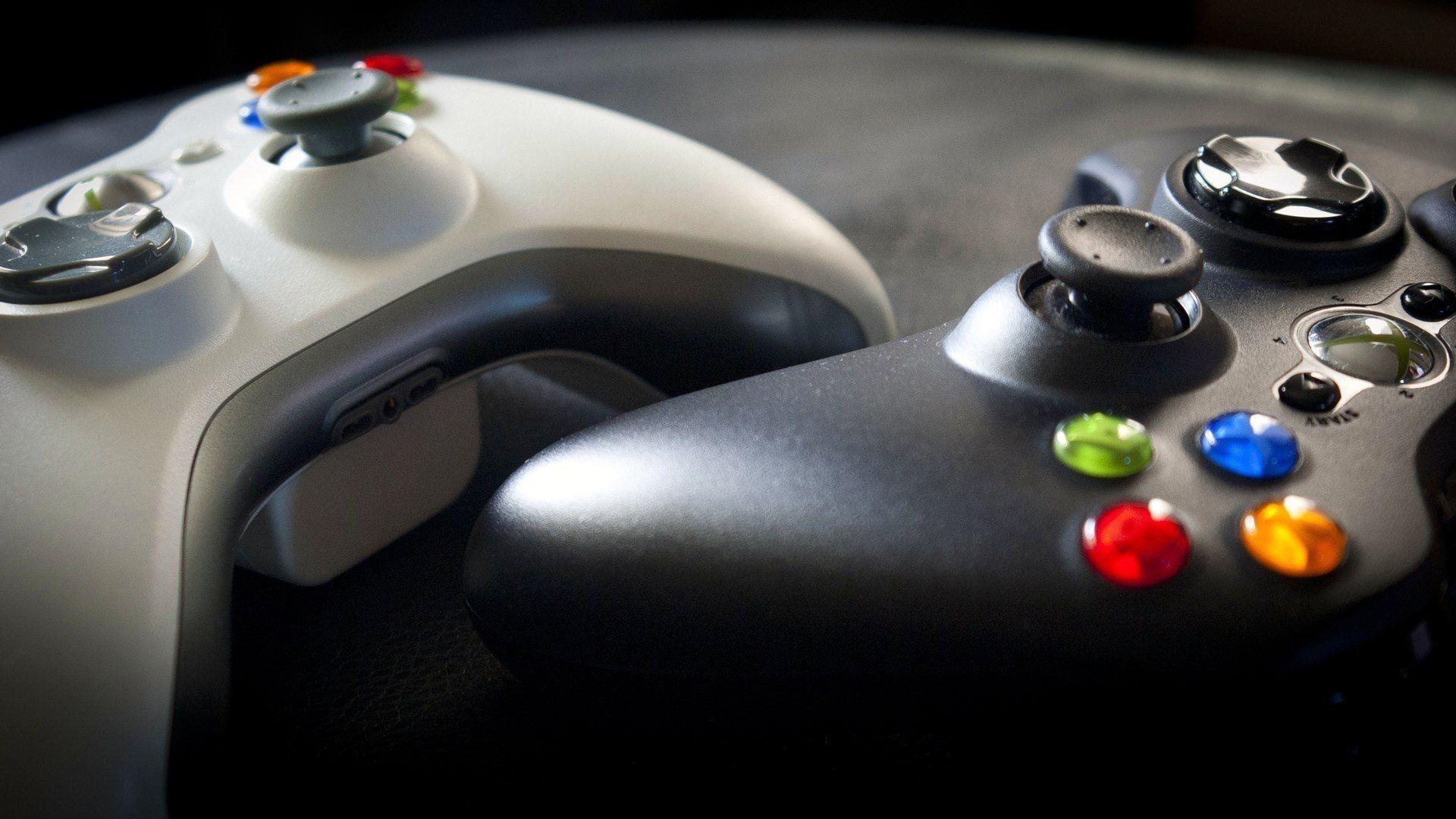
Look at a photo of that curved, white plastic. It’s weirdly emotional, right? If you grew up in the mid-2000s, seeing pictures of an xbox 360 isn't just about looking at a piece of consumer electronics. It’s a physical trigger for memories of "Gears of War" lobbies, the specific chime of an Achievement popping, and that terrifying moment you saw the power ring turn red.
The console was loud. It sounded like a jet engine taking off in your bedroom. But it changed everything.
When we talk about the Xbox 360, we’re talking about the bridge between the "old school" and the hyper-connected world we live in now. It was the first time HD gaming felt real for the masses. Before the 360, we were mostly squinting at CRT televisions through composite cables. Then, suddenly, we were seeing individual beads of sweat on a boxer's forehead in Fight Night Round 3.
The Aesthetics of the Original Xenon Design
The original 2005 model, often called the "Xenon," had a concave shape that Microsoft’s designers said was meant to look like it was "inhaling." It’s an iconic look. When you scroll through pictures of an xbox 360 from that era, you notice the details that felt premium at the time but look adorably retro now. The memory card slots on the front? Totally obsolete within three years once hard drives got bigger and USB support improved.
The "Premium" edition had that chrome-finish disc tray. It felt like luxury. If you were a kid back then, the difference between the "Core" system with its white tray and the "Pro" system with the shiny bits was a huge status symbol in the cafeteria.
Microsoft actually spent a fortune on the industrial design. They hired a firm called Astro Studios, based in San Francisco, to work with Hers Experimental Design Laboratory in Osaka. They wanted something that appealed to both Western and Japanese markets. Looking back, it worked—mostly. It looked great standing vertically, which was a big selling point back then, even if it occasionally scratched your discs if you bumped the table.
The Faceplate Obsession
Remember faceplates?
For about eighteen months, Microsoft thought the future of gaming was customizable plastic slabs. You could snap off the front of your console and put on a "Hot Rod" flame design or a "Halo 3" themed cover. It was a massive failure commercially, but it makes for some of the most interesting pictures of an xbox 360 you can find today. Collectors hunt for the rare ones, like the E3 2005 "I was there" plate or the incredibly scarce faceplates given to Launch Team employees.
Honestly, the faceplate era was just a precursor to the "skins" we buy in Fortnite today. We just had to buy them at GameStop and physically snap them onto a machine back then.
That Infamous Glowing Ring
You can’t talk about this console without mentioning the "Ring of Light." In most pictures of an xbox 360, the ring is a pleasant, welcoming green. It was divided into four quadrants, showing you which controller was connected. It was smart. It was intuitive.
It was also a harbinger of doom.
The Red Ring of Death (RRoD) is probably the most famous hardware failure in the history of technology. When three of those lights flashed red, your console was basically a $400 paperweight. It was caused by heat cycles that eventually cracked the lead-free solder joints connecting the GPU to the motherboard.
Microsoft eventually had to set aside over $1 billion to fix the problem. That’s "billion" with a B. If you look at photos of the later "Slim" models, you'll notice the ring changed. They removed the four-quadrant system and, more importantly, they fixed the cooling. But for a few years there, every time you pressed that power button, there was a split second of genuine anxiety.
Evolution of the Hardware: From Fat to Slim
If you compare pictures of an xbox 360 original model to the later "S" (Slim) and "E" models, the evolution is pretty stark.
The original was bulky. It required a massive external power brick that was basically the size of a loaf of bread. By the time the Xbox 360 S came out in 2010, the console had gone "stealth." It was glossy black, angular, and had integrated Wi-Fi. It’s wild to remember that for the first five years of the 360’s life, you had to buy a separate $100 adapter just to connect to the internet without an Ethernet cable.
Then came the Xbox 360 E in 2013. It was released right as the Xbox One was launching. It looked remarkably like the Xbox One—half matte, half gloss. It was the quietest version, but it stripped away some features, like the optical audio port. It was the end of an era.
The Controller That Perfected the Game
Even today, many people argue the Xbox 360 controller is the best ever made.
The offset analog sticks. The triggers that actually felt like triggers. The way it fit into your palm. When you see high-res pictures of an xbox 360 controller, you’re looking at the blueprint for almost every modern controller that followed.
The only flaw? That D-pad. It was mushy and imprecise. If you tried to play a fighting game like Street Fighter IV with it, you were going to have a bad time. Microsoft eventually tried to fix this with a "transforming" D-pad that you could twist to make the buttons pop up more, but it never quite felt right.
Why We Still Search for These Photos
There is a massive "retro" (yes, the 360 is now considered retro by many) scene on sites like Reddit and Instagram. People share pictures of an xbox 360 setups to show off their "Blades" dashboard.
The "Blades" was the original user interface. It was fast, it had a satisfying "whoosh" sound when you navigated, and it wasn't cluttered with ads. Microsoft eventually replaced it with the "New Xbox Experience" (NXE) and later the Metro-style dashboard to make room for Kinect and apps like Netflix.
But the Blades? That’s the "pure" 360 experience. Finding a console today that still has the original Blades firmware (version 2.0.1888.0) is like finding a holy grail for collectors. They go for hundreds of dollars on eBay because they represent a specific moment in time before gaming became a "service."
Technical Specs and the HD Revolution
Let's get into the weeds for a second. The 360 was a beast for 2005.
- CPU: A custom 3.2 GHz IBM PowerPC-based tri-core processor (codenamed Xenon).
- GPU: An ATI Xenos with 512 MB of GDDR3 RAM.
- Storage: Detachable hard drives ranging from 20GB to 320GB.
The shared memory architecture was a stroke of genius. It allowed developers to allocate memory where they needed it most, whether that was for textures or system logic. It’s the reason why, for much of that generation, multi-platform games usually looked and performed better on the Xbox 360 than on the technically more powerful PlayStation 3. The PS3's Cell architecture was a nightmare to code for; the 360 was a dream.
When you look at pictures of an xbox 360 connected to a modern 4K TV, you’ll notice something interesting: it still looks decent. That’s because the console had a very high-quality internal scaler. Even games running at 720p natively held up well when stretched to 1080p.
The Cultural Impact: More Than Just Plastic
The Xbox 360 was the "Halo" machine, but it was also the "Call of Duty" machine. It was where Modern Warfare became a global phenomenon.
It was also the birthplace of the modern indie game. The Xbox Live Arcade (XBLA) gave us Braid, Castle Crashers, Limbo, and Super Meat Boy. Before this, if you wanted to play an indie game, you had to find some obscure corner of the internet. The 360 put them right next to the $60 blockbusters.
Seeing pictures of an xbox 360 today reminds us of the "Golden Age" of couch co-op. This was the last generation where playing with a friend usually meant they were sitting right next to you, not just a voice in a headset. We had four controller ports (via wireless) and a library of games designed for split-screen.
Common Misconceptions About the 360
- "All 360s will eventually Red Ring." Not true. The "Jasper" motherboard revision (late 2008) and all subsequent Slim models are incredibly reliable. If you're buying one today, check the power rating on the back—12.1A usually indicates a Jasper, which is the one you want.
- "The 360 can't play 1080p." It actually can. While most games ran at 720p, the console supported 1080p output via HDMI (and even VGA cables). A few games, like Virtua Fighter 5, actually rendered natively in 1080p.
- "The HD-DVD drive was built-in." Nope. Microsoft doubled down on the losing format but kept it as an external add-on. If you see pictures of an xbox 360 with a smaller white box sitting next to it, that’s the HD-DVD player. It’s a relic of a format war that Sony's Blu-ray eventually won.
How to Capture Your Own High-Quality Xbox 360 Photos
If you’re a collector wanting to take great pictures of an xbox 360 for sale or for social media, lighting is everything.
The white matte plastic of the original models loves to pick up yellow tones from indoor lights. Use natural sunlight. If you have a gloss black Slim model, use a microfiber cloth first—those things are fingerprint magnets.
For the best "aesthetic" shots, try to capture the console in its natural habitat: under a slightly dusty TV stand, surrounded by those iconic green DVD cases. It’s about the vibe, not just the hardware.
Preserving the Legacy
As we move further into the digital-only future, the Xbox 360 stands as a monument to the physical era. The discs had a specific weight. The cases had manual slots (even if the manuals got thinner every year).
If you still have one, treasure it. If you’re looking to buy one, aim for the Slim model in "Matte Black." It’s the most durable version of the hardware.
To keep your 360 running, make sure you:
- Clear the dust out of the side vents with compressed air.
- Install your games to the hard drive to save wear and tear on the DVD drive.
- Replace the thermal paste if you’re feeling adventurous and notice the fans getting loud.
The Xbox 360 wasn't just a console. It was the era where gaming grew up. It’s why those pictures of an xbox 360 still feel so significant. They represent the last time a console felt like it was breaking all the rules before the industry became the massive, corporate-safe machine it is today.
Check your attic or your parents' basement. If you find that white box, plug it in. See if the ring turns green. There’s a whole world of 2007-era magic waiting to be booted up again.