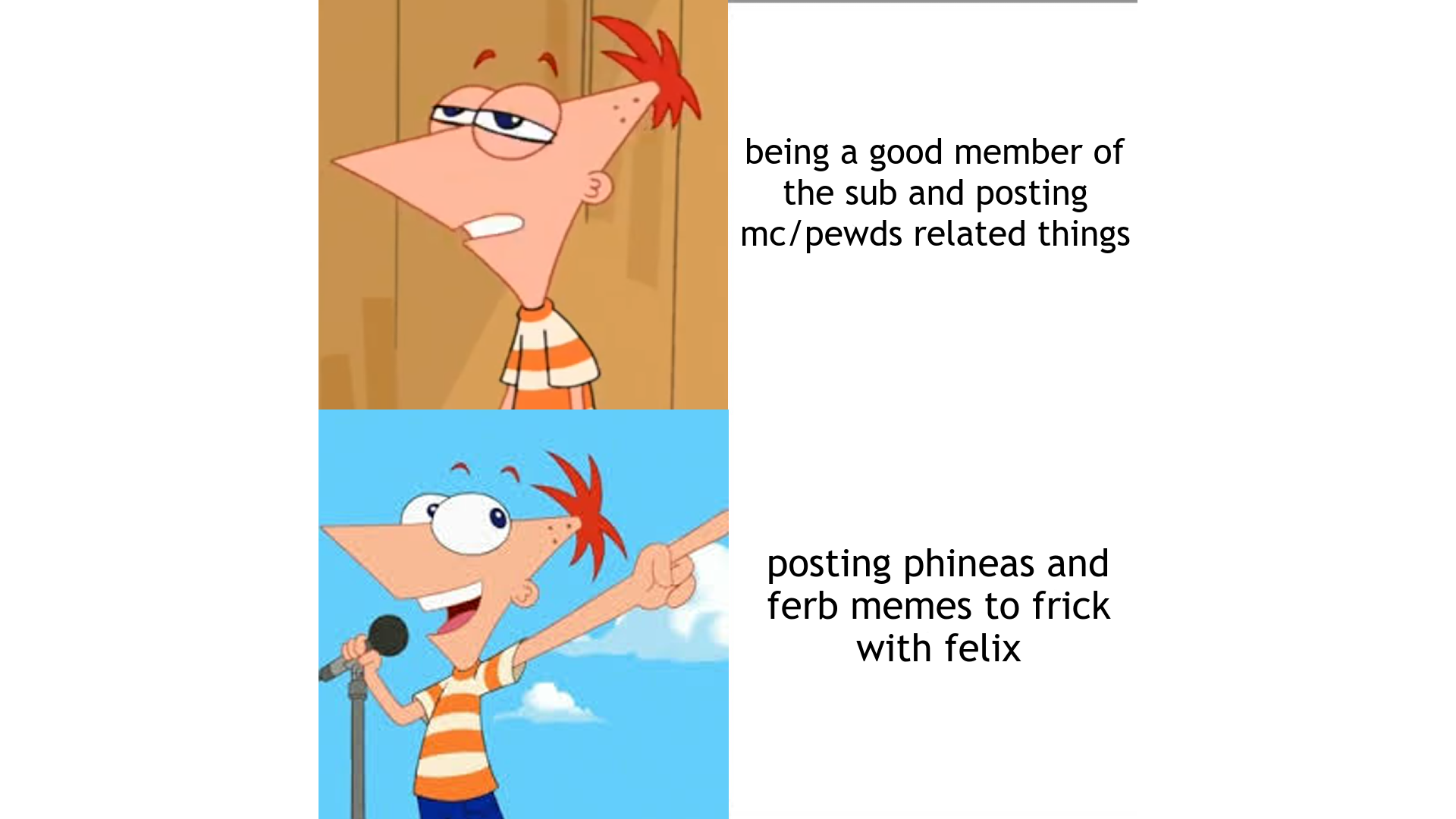
Honestly, it shouldn't have worked. A show about two stepbrothers building a roller coaster in their backyard while a platypus fights a pharmacist seems like a fever dream. Yet, here we are in 2026, and Phineas and Ferb memes are basically the backbone of internet culture. They aren't just nostalgic throwbacks for Gen Z. They’ve evolved. They are a universal language for describing everything from corporate incompetence to the absolute chaos of daily life.
You’ve seen them. The "Behold!" posters. The "A platypus? PERRY the platypus?!" reaction images. It’s a level of staying power that most modern sitcoms would kill for.
Why? Because Dan Povenmire and Jeff "Swampy" Marsh didn't just write a kids' show. They wrote a formulaic masterpiece that was practically designed to be chopped up into six-second clips and static images. The repetitive structure of the show—Candace trying to bust them, Doofenshmirtz’s tragic backstories, Phineas asking "Where’s Perry?"—created a set of "mental shortcuts." When you see a meme with Dr. Doofenshmirtz, you don’t need context. You already know there’s an "Inator" involved and it’s probably going to end in a self-destruct button.
The Doofenshmirtz Effect: Why We Relate to the Villain
If you look at the sheer volume of Phineas and Ferb memes, Dr. Heinz Doofenshmirtz is the undisputed king. He is the most human character in the show. He’s a guy who had a rough childhood (both his parents failed to show up for his birth, which is biologically impossible but comedically gold) and is just trying to make a name for himself in the Tri-State Area.
We relate to him because he is the personification of "trying your best and failing spectacularly."
Think about the "If I had a nickel for every time..." meme. It comes from Phineas and Ferb the Movie: Across the 2nd Dimension. Doofenshmirtz says, "If I had a nickel for every time I was doomed by a puppet, I'd have two nickels. Which isn't a lot, but it's weird that it happened twice."
That specific format exploded because it perfectly captures those bizarre, recurring coincidences in real life. People use it to talk about everything from weirdly specific plot tropes in movies to the fact that two different tech billionaires decided to fight in a cage match. It’s versatile. It’s punchy. It’s short.
The Visual Comedy of Perry the Platypus
Then there’s Perry. The Perry vs. Agent P distinction is the peak of "hiding in plain sight" humor.
The meme usually follows a simple logic:
- Normal Object: (The Platypus)
- Object with a tiny hat: (PERRY THE PLATYPUS?!)
This has become the internet's favorite way to mock bad disguises or subtle shifts in personality. You change your Twitter display name and suddenly you’re a completely different person? That’s a Perry meme. You put on a blazer for a Zoom call while wearing pajama pants? Perry meme.
It works because the visual gag is so distinct. The transition from a mindless, wall-eyed pet to a suave secret agent is a physical transformation that translates perfectly to image macros. It’s clean. No messy context needed.
Why "Busting" Became a Relatable Struggle
Candace Flynn is arguably the most stressed-out teenager in animation history. Her entire existence is defined by the "Busted" song and her failed attempts to get her mom to look at the backyard.
In the world of Phineas and Ferb memes, Candace represents the whistleblower that nobody believes. She’s the person in the group project who sees the disaster coming while everyone else is off building a giant robot. When you see a meme of Candace pointing frantically at an empty backyard, it’s a vibe. It represents gaslighting, frustration, and the feeling of being the only sane person in a room full of chaos.
And let’s be real, the "S.I.M.P. (Squirrels In My Pants)" song from the episode "Comet Kermillian" is a masterpiece of early 2000s hip-hop parody. It’s a core memory for an entire generation. When that track hits the timeline, it’s an instant engagement magnet because the rhythm is genuinely good. It’s a "certified hood classic" in the meme world.
The Architecture of a Viral Phineas and Ferb Meme
What makes these specific memes "sticky"? It’s not just luck. The show used a technique called "iterative humor." They took a joke, repeated it until it wasn't funny, and then kept repeating it until it became the funniest thing you’ve ever heard.
- The Catchphrases: "Whatcha doin'?" "Ferb, I know what we're going to do today!" "Curse you, Perry the Platypus!" These are linguistic hooks. They act as anchors for the audience.
- The "Inator" Logic: You can add "-inator" to any word and it instantly becomes a Doofenshmirtz joke. This allows for endless user-generated content. You’re not just consuming a meme; you’re participating in the show’s logic.
- The Soundtrack: Unlike most cartoons where music is an afterthought, every episode of Phineas and Ferb had an original song. "Gitchee Gitchee Goo," "Aglet," and "F-Games" are baked into the cultural consciousness.
Memes as a Marketing Tool (Even if Unintentional)
When Disney+ launched, they didn't have to do much heavy lifting to promote the show’s library. The internet had already been doing it for years.
Even Dan Povenmire himself leaned into it. He’s incredibly active on TikTok, often voicing Doofenshmirtz to react to fan theories or memes. This bridges the gap between the creator and the consumer. It gives the memes "official" legitimacy. When the creator of a show acknowledges a meme, it doesn't die; it evolves into a "meta-meme."
Modern Variations: From 2007 to 2026
The memes have shifted over the years. In 2012, they were simple Impact font images. By 2019, they were deep-fried and surreal. By 2024, they were being used in political commentary and high-level social critiques. Now, in 2026, we see Phineas and Ferb being used to explain complex AI concepts or the absurdity of the "dead internet" theory.
There’s a specific nuance to how the "Phineas and Ferb" community operates. It’s wholesome but cynical. It’s smart but incredibly stupid.
The Aglet Phenomenon: Education via Meme
Remember the "Aglet" song? "A-G-L-E-T, don't forget it!"
That is perhaps the most successful educational meme in history. Ask any person between the ages of 18 and 30 what the plastic tip of a shoelace is called. They will know. Not because they read a dictionary, but because of a catchy 2-minute song about a "world-class" event.
This highlights the "utility" of Phineas and Ferb memes. They often contain actual information or clever wordplay that sticks in the brain far longer than anything you learned in a 10th-grade textbook.
Addressing the "Stale" Allegations
Some critics say that the show’s formula makes the memes predictable. They’re wrong.
The predictability is the joke.
The humor comes from the subversion of that formula. It’s why "Phineas and Ferb but Perry is a normal platypus" or "Doofenshmirtz actually wins" are such popular meme premises. We know the rules so well that breaking them is inherently funny. It’s like jazz. You have to know the notes to play the "wrong" ones effectively.
How to Use These Memes Today
If you’re trying to use these memes in a modern context, don't go for the obvious stuff. The "Whatcha doin'?" Isabella meme is a bit played out. Instead, look for the deep cuts.
- Baljeet’s stress levels: Great for finals week or tax season.
- Major Monogram’s awkward briefings: Perfect for corporate culture and pointless meetings.
- The "Balloony" backstory: Ideal for discussing lost friendships or irrational attachments.
The "Balloony" arc is a goldmine for "sad-posting." It’s a story about a man who lost his only friend—a balloon with a face drawn on it—to the vacuum of space. It’s ridiculous, but the show treats it with such operatic gravity that it becomes the perfect template for expressing dramatic loss over something trivial.
Actionable Insights for Content Creators and Fans
If you want to dive deeper into this subculture or even create your own content, there are a few things to keep in mind.
First, respect the timing. Phineas and Ferb humor relies on a very specific "beat." If a meme is too wordy, it loses the Doofenshmirtz snap.
Second, leverage the audio. If you’re making video content, the sound bites from this show are high-fidelity gold. Use the "Inator" sound effect or the Perry chatter to punctuate your points.
Third, look at the background characters. Some of the best memes come from characters like Norm the Robot or Pinky the Chihuahua. These "tier 2" characters have a cult following that often generates fresher humor than the main cast.
Finally, check out the Phineas and Ferb subreddit or specialized Discord servers. These communities are where the "new" formats are born before they hit the mainstream Twitter or Instagram feeds. They’re constantly dissecting frames of the show for new templates.
The show might have ended its original run years ago, but the cultural footprint is permanent. As long as there are people who feel like their "Inators" are being thwarted by a platypus (or just a bad day), these memes aren't going anywhere. They are the "aglet" of the internet—small, often overlooked, but they hold the whole thing together.
To stay ahead of the curve, start looking for high-resolution screengrabs from the "Across the 2nd Dimension" movie or the "Star Wars" and "Marvel" crossovers. These episodes have unique art styles and expressions that haven't been "over-memed" yet.
Keep an eye on Dan Povenmire’s social media for "lore drops" that can be turned into fresh content. Understanding the intent behind the characters makes for much better, more "human" memes than just slapping text on a random screenshot. Stay creative, keep it weird, and whatever you do, don't forget to put a self-destruct button on your Inators. It’s just good branding.
Next Steps for Enthusiasts:
- Browse the "Doofenshmirtz Daily" archives on social media to see how the "If I had a nickel" format has evolved into 2026.
- Experiment with "Reaction-Inators": Use specific Doofenshmirtz expressions to reply to corporate emails (internally, of course) to gauge the "vibe check" of your coworkers.
- Audit your nostalgia: Re-watch the "Dude, We're Getting the Band Back Together" episode. It’s a masterclass in comedic timing that explains why these memes still feel "fast" and modern.