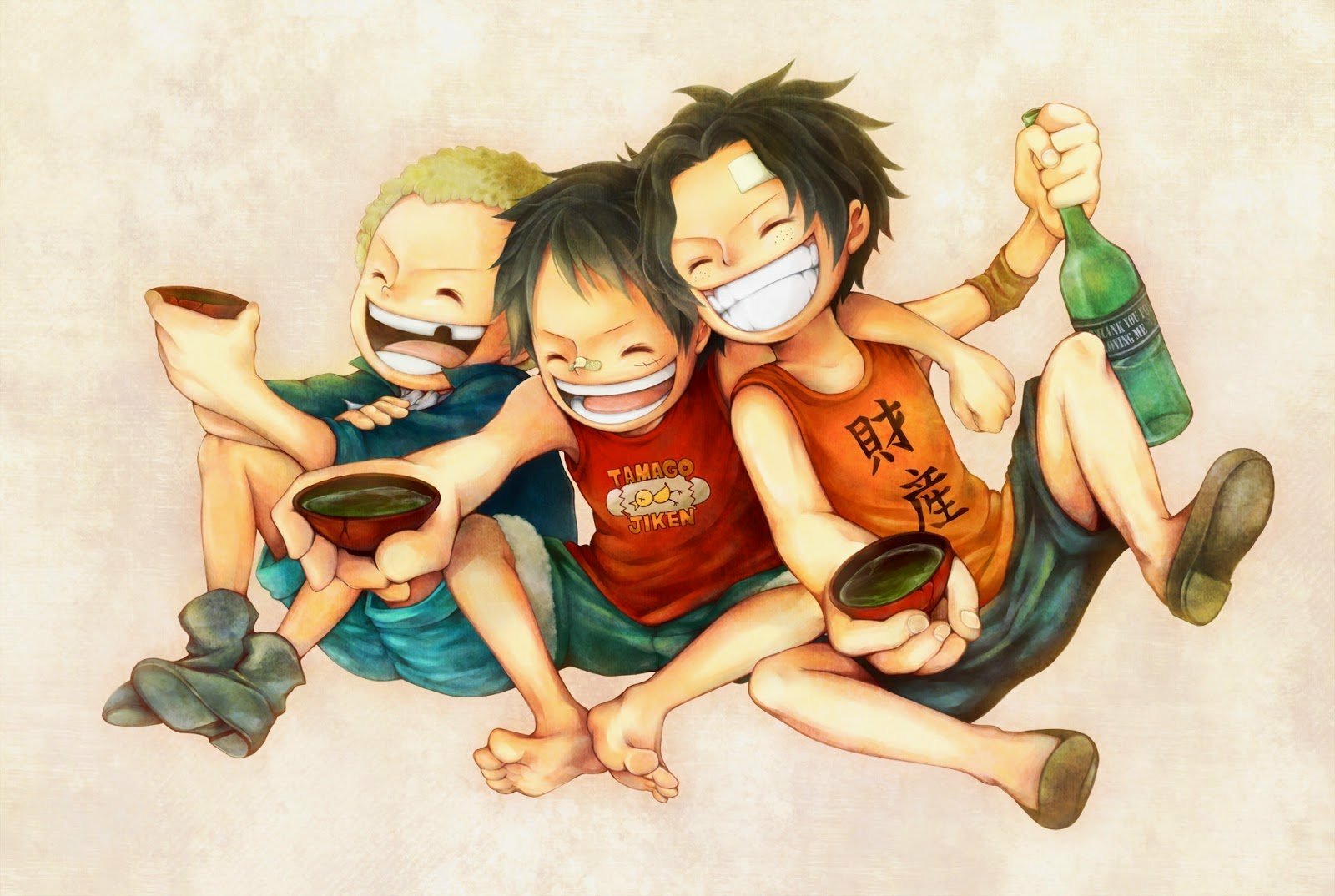
Eiichiro Oda is a master of the long game. You’ve seen it a thousand times if you've followed the journey from the East Blue to the Final Saga. But nothing hits quite as hard as the brotherhood between One Piece Sabo Luffy Ace. It’s not just a backstory. It’s the literal foundation of Luffy’s entire worldview. People call it the ASL trio, and honestly, without that small cup of sake shared in the trash heaps of Gray Terminal, the stakes of the current war in the manga wouldn't feel half as heavy as they do.
It’s about more than just some kids playing pirate in the woods.
Think about it. Most shonen protagonists have a "chosen one" vibe or a singular mentor. Luffy has a ghost and a revolutionary. The dynamic of One Piece Sabo Luffy Ace isn't just a plot device to explain why Luffy is strong; it's a look at how trauma, class warfare, and the desire for freedom create different types of leaders. You have a Noble who ran away, a son of the Pirate King who hated his own blood, and a rubber boy who just wanted to be with his friends. They weren't brothers by blood. They chose it. That’s why it hurts so much.
The Sake Cup and the Bond That Refused to Break
Grey Terminal was a dump. Literally. It’s where the trash of the Goa Kingdom ended up, and it’s where these three met. Most fans remember the iconic scene where they steal a cup of sake to become brothers. But have you ever looked at the subtext of that moment? At that point in the story, Ace was a ball of pure rage. He was a kid who asked strangers if Gold Roger should have had a son, only to be told the child should have been killed.
Then came Luffy.
Luffy was the first person who didn't care about Ace's "cursed" lineage. He just wanted a friend. When you look at the interactions between One Piece Sabo Luffy Ace, Sabo was always the mediator. He was the one with the manners, the one who tried to keep the peace when Ace and Luffy’s stubbornness threatened to boil over. Sabo’s "death" at the hands of the World Noble Saint Jalmack was the first time the series truly showed us how cruel the world was. We saw it through the eyes of two children who realized, for the first time, that being a pirate wasn't just a game. It was a struggle against a system that wanted them dead for existing.
Why Sabo’s Return Changed the Game
For years, we thought Sabo was gone. The fandom was split. Half of us knew Oda wouldn't just kill a character off-screen like that without a bigger payoff, while the other half thought his death was necessary for Luffy’s growth. Then Dressrosa happened.
Seeing Sabo alive was one of those "drop everything" moments in manga history. But it wasn't just fan service. Bringing him back served a functional narrative purpose. He didn't just replace Ace; he inherited his will. Literally. Eating the Mera Mera no Mi wasn't just about Sabo getting a power-up. It was about the fire of the One Piece Sabo Luffy Ace bond continuing to burn even after Marineford.
Sabo’s role in the Revolutionary Army adds a layer of political complexity that Ace never had. Ace wanted to make Whitebeard the King. Luffy wants to be the King himself. Sabo? Sabo wants to tear the whole building down. It creates this fascinating triad where the three brothers represent the three major forces of the One Piece world: the Emperors, the Revolutionaries, and the legacy of the Pirate King.
The Contrast in Their Fighting Styles
It's actually pretty wild how their powers reflect their personalities.
- Ace: Raw, explosive power. The fire was an extension of his burning desire to prove he belonged in the world. He was reckless, just like his father, and his Logia fruit allowed him to be as loud and flashy as possible.
- Luffy: Creativity and resilience. The Gomu Gomu no Mi (or the Hito Hito no Mi, Model: Nika, as we now know) is about freedom. It’s about being able to bounce back from anything. It suits a kid who spent his childhood getting beat up by mountain bandits and giant tigers.
- Sabo: Precision and discipline. Even before he got the fire fruit, Sabo was a beast with his Ryusoken (Dragon Claw) style. He’s the most "trained" of the three. His fighting is methodical. He breaks the core of things.
The Shadow of Marineford
We have to talk about the elephant in the room. Portgas D. Ace’s death is widely considered the most impactful death in anime history. Not because he was the strongest, but because of what it did to Luffy. It broke him. It was the first time the protagonist truly failed.
The tragedy of One Piece Sabo Luffy Ace is that they were never all together as adults. Not once. Sabo was "dead" during Marineford because he had amnesia. Imagine the guilt. Oda wrote Sabo’s reaction to the news of Ace’s death with such visceral detail—the scream, the fever, the literal mental breakdown—that it humanized the Revolutionary Army’s number two instantly. He wasn't just a cool guy with a pipe; he was a grieving brother who forgot his own heart.
Real-World Impact: Why We Care So Much
The fan community around One Piece Sabo Luffy Ace is massive. If you go to any major anime convention, you’ll see the cosplays. You’ll see the "ASL" tattoos. Why? Because the theme of "found family" is universal.
In a world that can feel increasingly isolating, the idea that you can choose your brothers—that a shared drink can mean more than shared DNA—resonates. It’s a core tenet of the series. Oda isn't just writing a story about pirates; he’s writing a story about the bonds that make life worth living. When Sabo says, "I'll be there for him, no matter where I am in the world," he’s speaking for every fan who has ever felt that protective urge for a friend.
Common Misconceptions About the Brothers
- Sabo is an Ace replacement. No. Sabo’s goals are entirely different. Ace was searching for a father figure; Sabo is searching for a way to change the world.
- Luffy is the "weakest" brother. Growing up, he definitely was. He lost almost every spar. But the current Luffy, the Gear 5 Luffy, has likely surpassed where Ace was at the time of his death. It’s a bitter-sweet realization.
- Garp hated them. This is just wrong. Garp loved those boys. His tears at Marineford while sitting next to Ace on the execution platform are proof. He wanted them to be Marines so they would be "safe" from the world, not because he wanted to control them.
The Final Saga and the Legacy of the Brothers
As we move toward the end of One Piece, the One Piece Sabo Luffy Ace connection is becoming more relevant than ever. The "Flame Emperor" Sabo is now a symbol of hope for the entire world. Luffy is a literal God of Liberation. And Ace? Ace is the spark that started the fire.
Every time Sabo uses a fire attack, he's honoring Ace. Every time Luffy stands up to a Celestial Dragon, he's finishing the fight Sabo started as a child. They are three parts of a single soul. The story cannot end without a final acknowledgement of what they built together in the mountains of the Goa Kingdom.
Next Steps for Every One Piece Fan
To truly appreciate the depth of the One Piece Sabo Luffy Ace storyline, you should revisit the Post-War Arc (Chapters 582-590). It’s often overshadowed by the chaos of Marineford, but it contains the most critical character work for the trio. Pay close attention to the dialogue between Dadan and Garp after the war; it’s some of the most emotionally honest writing in the series.
Additionally, if you haven't read the One Piece Novel A, do it. It provides a much deeper look into Ace's journey and his mindset before he met Whitebeard, which adds a layer of tragedy to his eventual fate and his relationship with his brothers. Understanding the "will of fire" is essential for predicting how Sabo and Luffy will interact when they finally reunite for the final battle against the World Government.