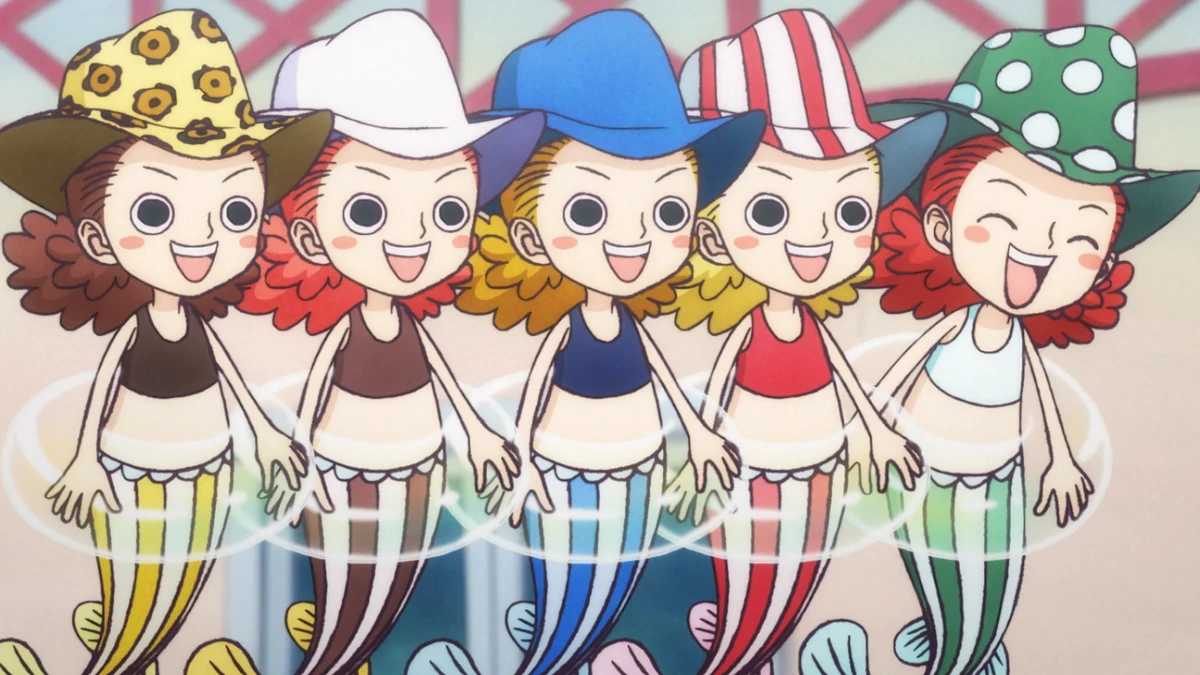
They are everywhere. If you’ve spent any time in the Grand Line, you know the deal. But One Piece mermaids are weirdly different from the stuff you see in Disney movies or old folklore. Eiichiro Oda didn't just give them tails and call it a day. He built a whole biological and social hierarchy that actually dictates how the world of One Piece functions.
It's kinda wild when you think about it. Most series treat aquatic races as background flavor. In One Piece, the merfolk—specifically the females—carry some of the heaviest lore in the entire franchise. We’re talking about ancient weapons, massive physiological shifts at age thirty, and a deep-seated racial tension that mirrors real-world history. It’s heavy stuff for a "cartoon."
The Biology of the One Piece Mermaid
Let’s get the anatomy out of the way first because it’s honestly one of the coolest world-building details Oda ever dropped.
Unlike the fishmen, who are basically humanoid fish with lungs and legs, a mermaid from One Piece starts life with a traditional tail. They are the fastest swimmers in the ocean. Even the fastest fishmen can't keep up with a young mermaid in a sprint. But there’s a catch. Or a split, rather.
Once a mermaid hits thirty, her tail splits into two legs.
This isn't some magical transformation. It's just puberty, part two. It’s why Kokoro at Water 7 looks the way she does, and why she can walk around on land while someone like Shirahoshi or Ishilly is stuck floating in a bubble or sitting in a carriage. This biological quirk allows older mermaids to integrate into surface society more easily, though "easily" is a relative term given the Sun Pirates' history and the Celestial Dragons' obsession with slavery.
Speed and Power
Don't let the "pretty" aesthetic fool you. These characters are powerhouses.
- Merveilleux Speed: Young mermaids can outpace almost any marine predator.
- Combat Prowess: While many are civilian characters, we see through the Fish-Man Island arc that they can hold their own.
- Talking to Fish: This is the big one. Mermaids can communicate with regular fish. It’s not a superpower; it’s just how they’re wired. However, talking to Sea Kings? That’s reserved for royalty.
The Princess and the Weapon
You can't talk about a mermaid from One Piece without mentioning Shirahoshi. She is the literal embodiment of Poseidon. That’s not a metaphor. She is one of the three Ancient Weapons capable of destroying the entire world.
Think about that for a second.
The World Government is terrified of a teenager who cries a lot. Why? Because she can command the Sea Kings. These aren't just big fish; they are island-sized monsters that live in the Calm Belt and can sink entire fleets without breaking a sweat. The bond between the Mermaid Princess and these creatures is the reason the Ryugu Kingdom holds so much geopolitical weight.
It’s also why Madam Shyarly’s visions are so ominous. The future of the merfolk isn't just about swimming around under a bubble; it’s tied to the "Great Cleansing" and the eventual move to the surface under the light of the true sun.
Life Under the Red Line
Fish-Man Island is located 10,000 meters below sea level. It’s dark. It’s pressurized. And yet, it’s beautiful because of the Sunlight Tree Eve. This tree transfers light from the surface down to the depths, allowing for a vibrant ecosystem.
Mermaids generally live in the Mermaid Cove. It’s a bit of a tourist trap for pirates who manage to make it down there, but it’s also a place of genuine community. Sanji almost died there from a nosebleed, sure, but the actual culture is built on hospitality.
There’s a darker side, though.
The slave trade at Sabaody Archipelago is the elephant in the room. A young mermaid from One Piece is worth a minimum of 70 million Berries on the black market. That’s higher than the starting bounties of most "worst generation" pirates. This constant threat of kidnapping has shaped their entire society into one that is understandably cautious, if not outright hostile, toward humans.
Breaking the "Pretty" Stereotype
Oda loves to mess with expectations. For every stunning mermaid like Camie, there’s a character that challenges what we think a "mermaid" should look like.
Take Kokoro. When she first revealed she was a mermaid during the Enies Lobby arc, the Straw Hats—especially Sanji and Zoro—were borderline traumatized. They had this idealized version of a mermaid in their heads, and Kokoro didn't fit it. But she saved their lives. She’s one of the most capable, brave, and loyal allies they’ve ever had.
Then you have the Twin Mermaids from the Franky Family, or the diverse designs seen in the Ryugu Palace. They aren't all "model-thin" shells with long hair. They are a diverse race with varied body types, colors, and fin shapes based on different fish species.
Common Misconceptions
- They are the same as Fishmen: Nope. Different species, though they can intermarry. If a mermaid and a fishman have a kid, it’s a coin toss which one the baby will be.
- They can't breathe air: They actually can, but they need to stay hydrated. They have both lungs and gills.
- They all hate humans: Most are actually curious. It’s the history of oppression that creates the barrier, not an innate hatred.
The Geopolitical Stakes of the Merfolk
The Ryugu Kingdom is currently trying to move to the surface. Queen Otohime died for this cause. She spent her life collecting signatures to prove that her people wanted to live under the real sun, not just the light from a tree.
This is where the story is heading. The Noah, that massive ship in the Fish-Man District, isn't just a relic. It’s meant to carry the entire race to the surface when the "Promised Day" arrives. This puts the mermaids at the center of the final conflict between Luffy and the World Government.
If Luffy truly is Joy Boy, his promise to the Mermaid Princess of 800 years ago still needs to be kept. That means the destruction of Fish-Man Island (as predicted by Shyarly) might actually be a good thing—a forced migration to a world where they don't have to hide 10,000 meters down.
What to Watch For in the Final Saga
As we move toward the end of One Piece, pay attention to the interactions between the Revolutionaries and the Ryugu Kingdom. Koala, a member of the Revolutionary Army, has a deep connection to the sun pirates. The bridge between humans and merfolk is being built by these side characters while Luffy does the heavy lifting.
- Shirahoshi’s Return: She will have to use her powers. It's inevitable.
- The Fate of the Noah: Watch for how the Sea Kings are utilized in the final war.
- The Surface Migration: This will likely be the "happy ending" for the race, but the path there is going to be violent.
The merfolk aren't just there to look pretty in the background of a panel. They are a ticking time bomb of narrative importance. Every time a mermaid from One Piece appears on screen, it’s a reminder of the broken world Luffy is trying to fix.
To really grasp the weight of their story, you have to look past the fins and the "kinda" cute designs. Look at the scars. Look at the fact that they’ve lived in a cage at the bottom of the sea for centuries. The story of the mermaid in One Piece is a story of liberation.
If you want to track this lore yourself, re-read the Fish-Man Island arc but focus specifically on the conversations about the "Sun." It changes how you view characters like Camie or even the goofy inhabitants of the cove. They aren't just hanging out; they are waiting.
Check the official Viz translations for the specific wording of the Otohime flashbacks. The nuance in how she describes "the true sun" vs. "the light of Eve" is a massive hint at the series' endgame involving the Red Line's destruction. Keep an eye on the cover stories too; Oda often hides the status of secondary merfolk characters there, showing how they’re slowly integrating with other races across the islands.