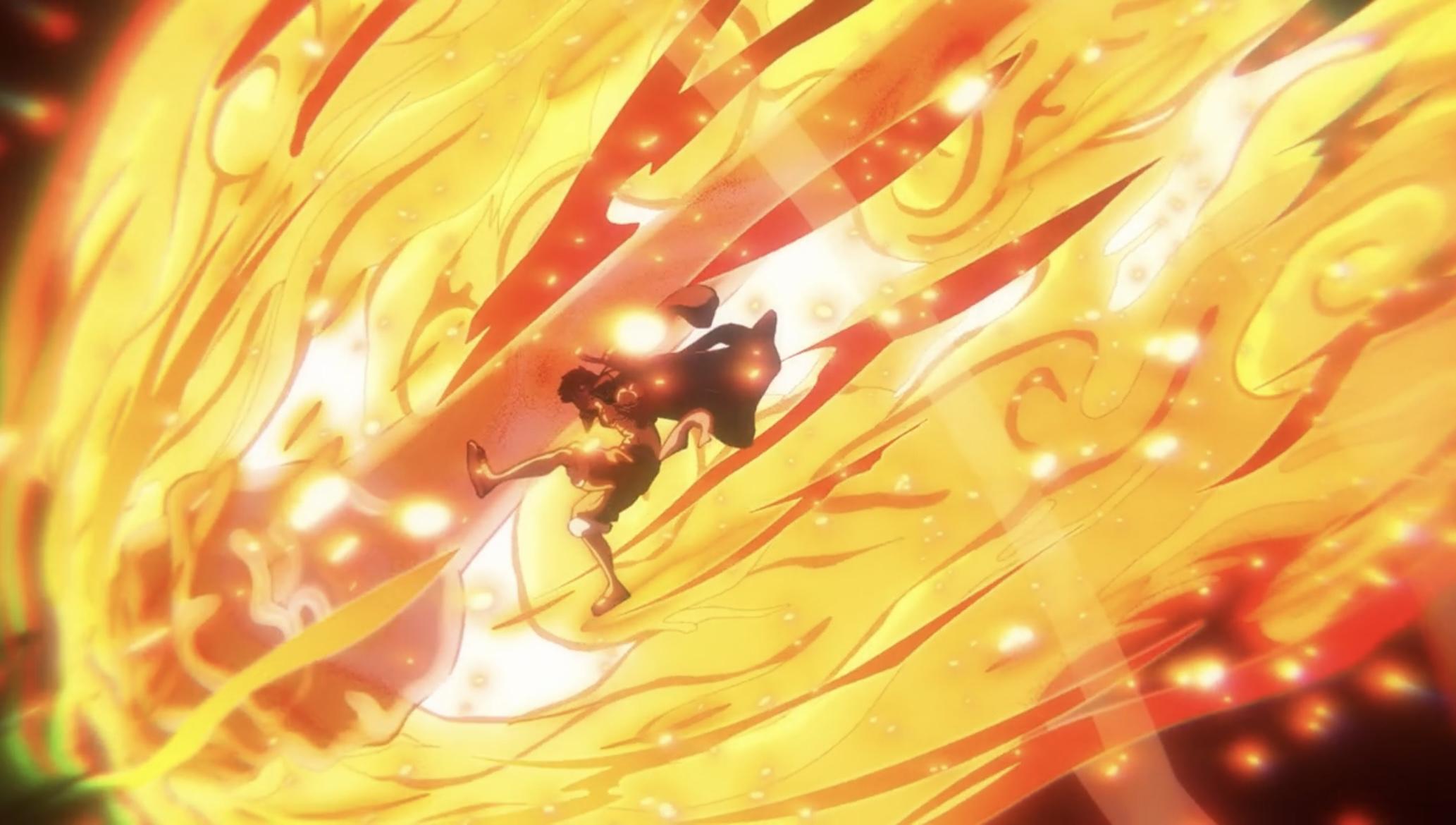
It happened. Finally. After decades of build-up and literal years of weekly anticipation, the Wano Country arc hit a peak that most shows never even dream of reaching. Honestly, if you haven't seen One Piece Episode 1015, you’re missing out on a piece of animation history. It isn't just another episode. It is a cinematic shift.
Megumi Ishitani. Remember that name. She directed this masterpiece, and frankly, she’s become a bit of a legend among the Straw Hat faithful. She also did episode 957 and 982, but this one? This hit differently. It adapted the landmark Chapter 1000 of the manga, titled "Straw Hat Luffy." That's a heavy title to live up to. Toei Animation didn't just meet the expectation; they blew the doors off the place.
The Visual Language of One Piece Episode 1015
Let’s talk about that opening scene with Yamato and Ace. It was gorgeous. The way the colors bled together and the lighting shifted to reflect the passing of time felt more like a high-budget movie than a weekly broadcast. It’s rare to see a show maintain this level of quality. Usually, long-running shonen series have to cut corners. They save the budget for the big fights. But here? The "quiet" moments were just as visually stunning as the Red Roc punch that ended the episode.
The transition from Yamato reading Oden’s journal to the current timeline was seamless. We see the dreams of the past literally fueling the fire of the present. It’s a recurring theme in Eiichiro Oda’s work—inherited will. But Ishitani’s direction made that abstract concept feel visceral. You could feel the weight of Roger's words as they echoed through Luffy.
People often complain about the pacing in the Wano arc. It’s a valid criticism. Sometimes the "reaction shots" drag on for an eternity. However, One Piece Episode 1015 avoided that trap entirely. Every frame served a purpose. When the Roof Piece gathering finally happened—Luffy, Zoro, Law, Kid, and Killer standing before Kaido and Big Mom—the tension was thick enough to cut with a kitchen knife.
The color palette shifted. It got darker, grittier. The scale of the Yonko compared to the "Worst Generation" felt oppressive. Yet, Luffy just walked right between them. He didn't care about the two strongest pirates in the world. He only cared about Kin'emon.
That Red Roc Moment and the Power of Sound
Sound design is the unsung hero of this episode. When Luffy walks past Kaido and Big Mom to tend to his fallen friend, the music drops out. It’s quiet. It’s respectful. Then, the build-up begins.
The "Red Roc" wasn't just a new move. It was a statement. It was a Gear 3rd version of Red Hawk, infused with Ryou (Advanced Armament Haki). The animation for this specific strike utilized a "smear" technique that made the impact feel devastating. You could see the ripple through Kaido’s face. This is a guy who jumped off a sky island and didn't have a scratch. Luffy made him bleed. He made him hit the dirt.
The score, composed by Kohei Tanaka and the team, used a remix of "We Are!" that absolutely shredded any lingering doubts about whether Luffy belongs on that rooftop. It’s nostalgic but updated. It’s the sound of a kid from a barrel becoming a contender for the Pirate King's throne.
Why the Fan Reaction Was So Intense
If you were on Twitter or Reddit the night this dropped, you saw the meltdown. It was universal praise. Usually, the One Piece community is divided over everything—powerscaling, shipping, animation styles. Not this time.
- The "Yamato's flashback" sequence fixed some of the manga's faster-paced transitions.
- The animation team used a 24-frames-per-second fluidity that is rarely sustained for 20 minutes.
- It gave gravitas to the "Chapter 1000" milestone that felt earned after 25 years.
Most people get it wrong when they say One Piece is "too long." Length is the strength here. Without the 1014 episodes that came before it, the Red Roc wouldn't have meant anything. We’ve seen Luffy lose. We’ve seen him cry over Ace. We’ve seen him train until his hands bled. One Piece Episode 1015 is the payoff for that investment. It’s the dividend of a quarter-century of storytelling.
The Technical Mastery of Megumi Ishitani
Ishitani’s use of "layers" is something you don't see often in TV anime. She uses foreground elements to create a sense of depth that makes the 2D world feel 3D. Look at the scenes where Yamato is talking about the "Sun God." The way the light filters through the clouds isn't just a filter; it's meticulously placed to guide your eyes.
She also understands silence. In an industry that often fills every second with screaming or explosions, she knows when to let the art speak. The moment where Luffy tells Kin'emon he's got this? Pure gold. No unnecessary dialogue. Just a look.
Real-World Impact and Ranking
Even now, years after its initial airing, this episode sits at the top of IMDb lists for a reason. It currently holds a near-perfect rating. It’s frequently used by critics to show that "The Big Three" style of anime can still innovate. It isn't just about flashy lights; it's about cinematic composition.
Some critics argue that the "auras" in Wano got a bit out of hand. You know, the Dragon Ball-style glowing effects. While that's a fair point for some episodes, 1015 used them effectively. The aura wasn't just "power." It was the visual representation of Haki flowing through the environment. It felt integrated, not tacked on.
What to Watch for Next
If you've just finished One Piece Episode 1015, you’re at the start of the "Roof Piece" saga. Things only get crazier from here. But don't expect every episode to look like this. This was a "prestige" episode. It’s the pinnacle.
You should pay close attention to the following:
- The evolution of Luffy’s Advanced Conqueror’s Haki.
- The specific choreography of Zoro vs. King (another visual powerhouse coming up).
- The way the music changes when the focus shifts to the lower floors of Onigashima.
Actionable insight? Go back and watch 1015 with a good pair of headphones. The spatial audio and the subtle wind noises during the rooftop confrontation are incredible. If you're a casual fan who dropped off during the Dressrosa or Whole Cake Island arcs because of the pacing, this is your signal to come back. The Wano production quality, specifically from 1015 onwards, is a different beast entirely.
The journey to Laugh Tale is entering its final stages. Seeing Luffy stand over a fallen Yonko is a milestone we weren't sure we'd ever see. Now that we have, there’s no going back. The stakes are officially at their peak.
For those looking to dive deeper into the production, look up the storyboards for this episode. They were leaked/shared shortly after the broadcast and show just how much planning went into the "memory" sequences. It proves that great anime isn't just about a big budget—it's about a clear, artistic vision.