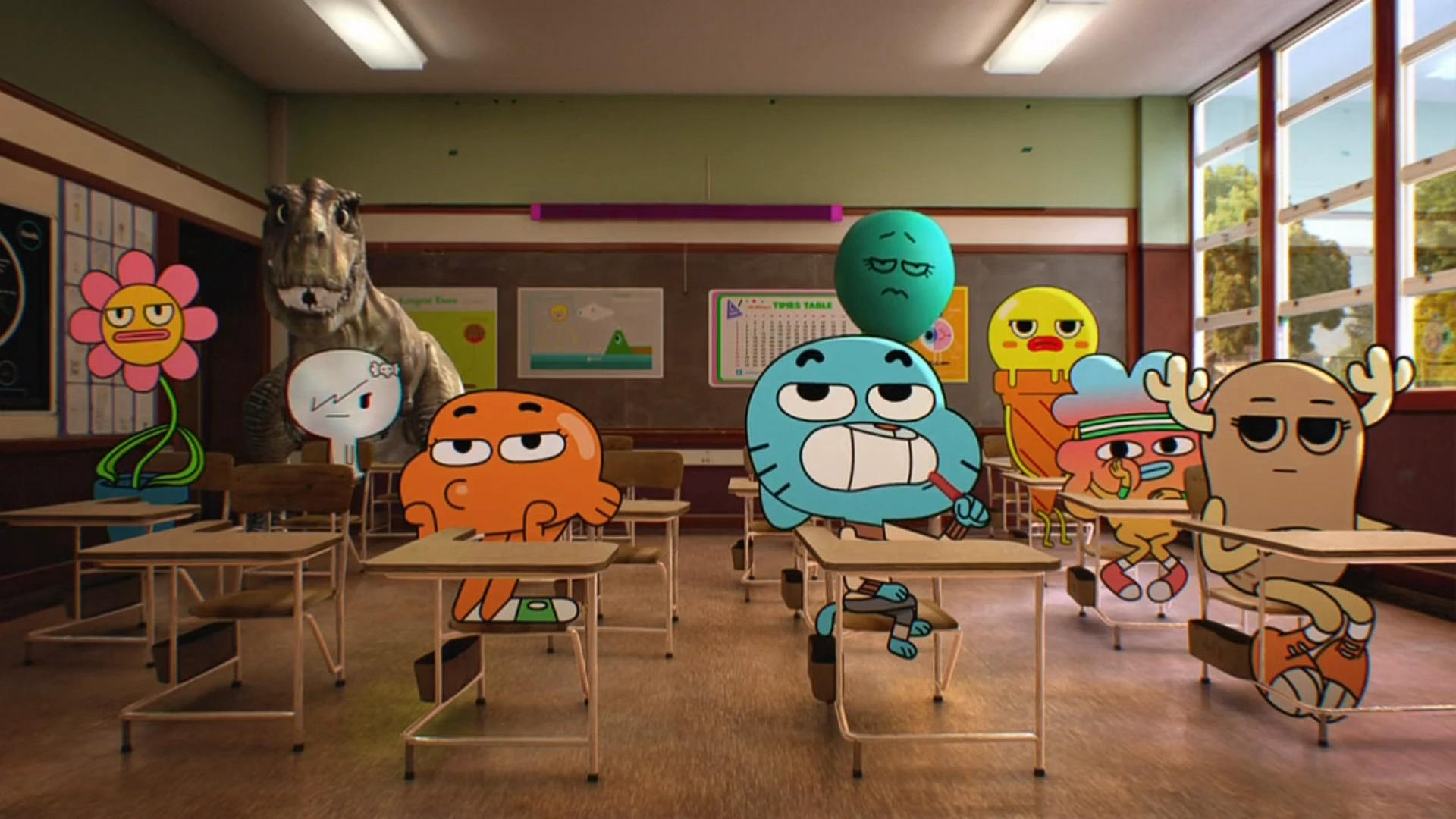
He’s a cloud. Well, sorta. Steve Small—better known to Elmore Junior High students as Mr. Small—is one of those characters that starts as a joke and ends up becoming a total existential crisis in a sweater vest. Most people watch The Amazing World of Gumball for the chaos of the Watterson family, but if you actually pay attention to the guidance counselor, you realize he’s carrying the entire thematic weight of the show on his fluffy, Peruvian-yarn-covered shoulders.
He's weird. Like, really weird.
But in a world where a T-Rex and a piece of toast are classmates, being a vegan, crystal-loving hippie who lives in a van shouldn't stand out that much. Except it does. Why? Because Mr. Small represents every well-meaning adult who has absolutely no idea what they’re doing. He’s the physical embodiment of a mid-life crisis that decided to take up herbal tea and "healing frequencies" instead of buying a sports car.
The Design Genius of Mr. Small in The Amazing World of Gumball
Ben Bocquelet, the creator of the show, did something brilliant with the character design. While Gumball is a 2D vector cat and Darwin is a shaded fish with legs, Mr. Small looks like he was plucked out of a stop-motion craft fair. He’s a textured, fuzzy puppet-like entity. This visual distinction isn't just for show. It highlights his role as an outsider. He’s trying to guide children through a reality he doesn't even seem to be a part of.
He’s tall. He’s lanky. His voice, provided originally by Adam Long, has this breathy, permanent state of "I just meditated for six hours and I might be seeing colors that don't exist" quality to it.
Honestly, his office is where the magic happens. It’s a shrine to every New Age trope you’ve ever seen. We’re talking dreamcatchers, incense that probably smells like old socks and lavender, and a "Feelings Chart" that Gumball and Darwin routinely ignore. There’s something deeply relatable about a man who genuinely wants to help people but is so disconnected from logic that his advice usually involves eating bark or listening to the "silence between the molecules."
The Darkness Behind the Tie-Dye
You’ve gotta look at the episode "The Void." That’s where things get real.
If you haven't seen it, "The Void" is one of the most famous episodes in The Amazing World of Gumball history. It reveals that the world of Elmore has a "trash bin" for all the mistakes the universe made. And who is the one obsessed with finding the truth? Mr. Small. He remembers things that shouldn't exist—like a previous version of a character or a lost classmate (Molly).
It turns out his tin-foil hat theories weren't actually theories. They were facts.
This shifts him from a "funny side character" to a tragic figure. He’s the only one who senses the simulation is glitching. He’s the guy screaming into the void, and the void is literally screaming back. He drives a van named "Janice" that runs on "good vibes" (and apparently a lot of fossil fuels, as revealed in "The Sale"). Janice is his sanctuary, his mobile base of operations, and occasionally, a death trap.
In "The Question," we see him try to explain the meaning of life. It’s a musical number. It’s psychedelic. It’s also completely useless. But that’s the point. Mr. Small doesn't have the answers, even though his job title says he should. He’s just as lost as the kids he’s supposed to be counseling. Maybe more.
Why We Should Stop Making Fun of His Diet
Everyone in Elmore treats Mr. Small like a joke because he’s a "level 7 vegan" or whatever he’s claiming to be this week. He drinks tea made of things that aren't meant to be liquid. He talks to his plants. He wears shoes made of recycled dreams.
But look at the alternatives in Elmore. Principal Brown is a hairy ball of stress who’s constantly terrified of losing his job. Miss Simian is a bitter, prehistoric ape who has hated children for two million years. Compared to them, Mr. Small is a saint. He actually cares. He wants the world to be better; he just thinks the way to do that is through "harmonic resonance" rather than, you know, actual discipline.
There’s a specific nuance to his failures.
When he tries to help Gumball and Darwin with their problems, he usually ends up making things worse by over-complicating the psychology. He’s the king of the "over-think." He represents that specific brand of modern anxiety where you have access to all the world's philosophy but none of the common sense required to make a sandwich.
The "Janice" Factor and the Reality of his Character
Janice isn't just a van. She’s a character.
There is a recurring gag that the van is actually a gas-guzzling monster despite Small's environmental posturing. It’s one of the few times the show gets cynical about him. It points out the hypocrisy often found in "hippie" culture—the idea that you can talk about the earth while driving a vehicle that emits enough smog to choke a dragon.
But even with that hypocrisy, he’s lovable.
You see him in "The Advice," trying to teach the kids how to be better people. It ends with him accidentally getting shoved into a locker or worse. He’s a punching bag for the universe. Yet, he keeps coming back with a smile and a new crystal. That’s resilience. It’s weirdly inspiring. He’s a man who has been broken by the absurdity of Elmore but refuses to become a cynic like Miss Simian.
Key Lessons from the Guidance Counselor’s Office
If you're looking to understand the "Mr. Small philosophy," it's basically a mix of:
- If it's broken, try chanting at it.
- If that fails, blame the cosmic alignment.
- Always keep a spare dreamcatcher in the glove box.
- Never underestimate the power of a really long, awkward silence.
Actually, the "silence" bit is a legit comedic tool the writers use. They let Mr. Small's jokes breathe. They linger on his confused face. Because he’s rendered in that specific fuzzy style, his micro-expressions are some of the best in the show. You can see the exact moment his brain short-circuits.
What Most People Get Wrong About Him
A lot of fans think Mr. Small is just a stoner caricature. He’s not.
The show is on Cartoon Network, so they obviously can't go there, but the "vibe" is definitely intentional. However, if you strip away the 1960s tropes, he’s actually a commentary on the "Self-Help" industry. He’s what happens when you read every book in the "Spirituality" section of a bookstore but forget to read the instructions on how to live in the real world.
He’s the most "adult" character because he’s the most confused. The Wattersons are driven by impulse. Mr. Small is driven by a desperate search for meaning in a town that literally doesn't make sense. Elmore is a place where physics is a suggestion. In that context, his "crazy" ideas are actually the most logical response to a chaotic environment.
Actionable Insights for Fans and Creators
If you’re a writer or an artist looking at Mr. Small for inspiration, there are three things he does perfectly:
- Contrast as Character: His fuzzy texture against a 2D/3D world makes him instantly memorable. Use medium-mixing to define personality.
- Sincere Absurdity: He never winks at the camera. He believes in his crystals. The comedy comes from his sincerity, not from him "being wacky."
- The Flawed Mentor: He’s the "wise man" who is actually a mess. This is a much more relatable trope than the perfect teacher.
To really appreciate him, go back and watch "The Void" and then "The Fraud." You’ll see the range. One minute he’s a cosmic investigator, the next he’s a guy who lied about his teaching credentials because he probably forgot where he actually went to school.
Next time you’re feeling overwhelmed, maybe don't drink bark tea. But maybe take a page from the Mr. Small playbook: stay kind, stay curious, and if the world starts glitching out, just assume it’s a cosmic misunderstanding that can be solved with a really loud gong.
Check the background of his office in future re-watches. The posters change. The artifacts move. It’s one of the most detailed sets in the series, reflecting a man who is constantly trying to find "the thing" that will finally make him feel whole. We’re all just Mr. Small in a slightly less fuzzy body.