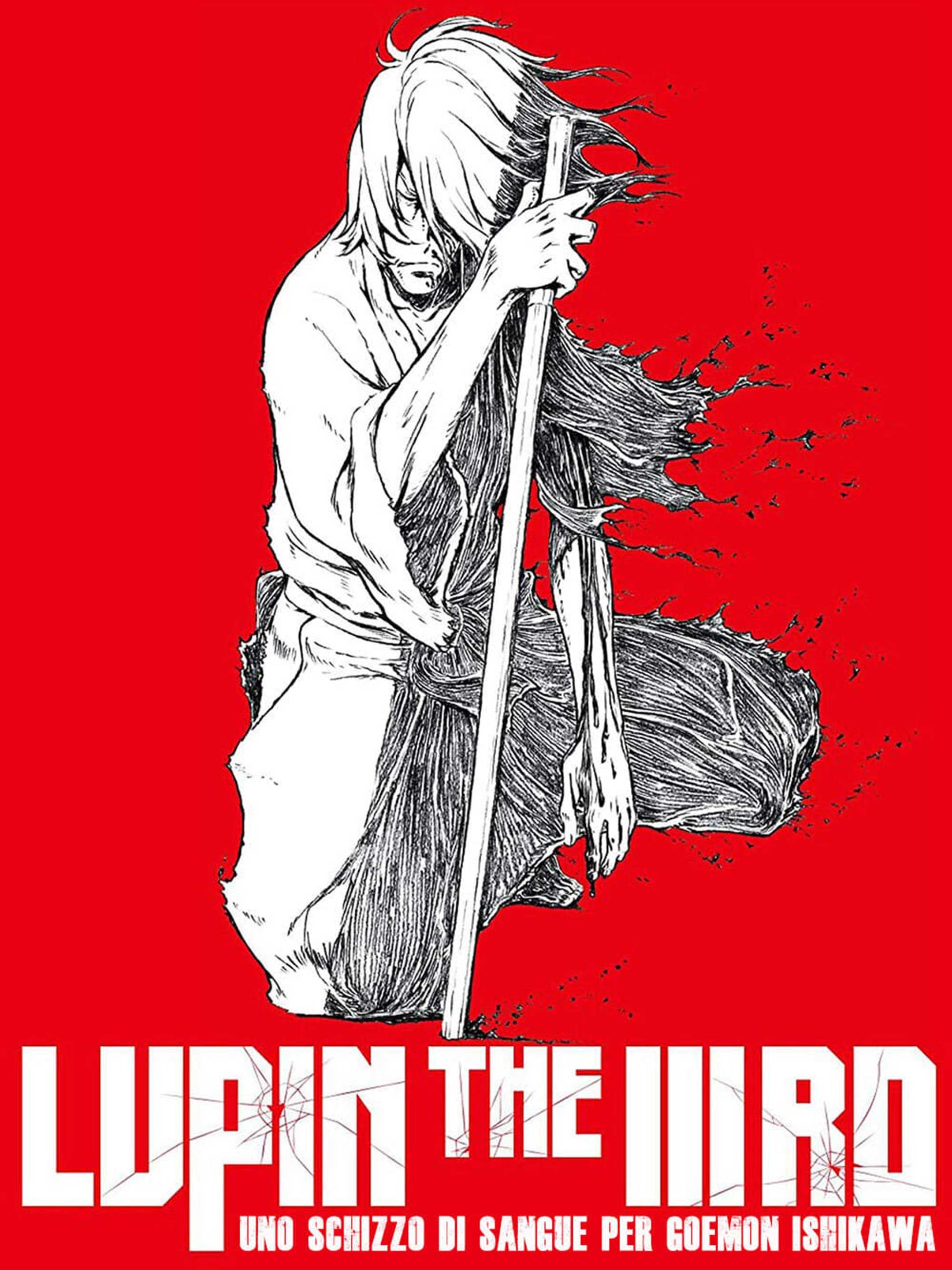
Lupin the Third: The Blood Spray of Goemon isn't your typical Sunday morning cartoon. Far from it. If you grew up watching the red-jacket adventures or the Miyazaki-led whimsy of The Castle of Cagliostro, this film—the second in Takeshi Koike’s gritty "LUPIN THE IIIRD" trilogy—will feel like a punch to the gut. It's mean. It's incredibly bloody. Honestly, it’s exactly what the franchise needed to remind everyone that these characters are, at their core, dangerous criminals.
Most people associate Goemon Ishikawa XIII with stoic silence and the ability to cut through tanks with a single swipe of his Zantetsuken. But here? Goemon gets absolutely wrecked. The film strips away his invincibility. It forces him to confront a level of violence that he isn't prepared for, and it does so with a visual style that looks like a moving woodblock print soaked in motor oil and crimson.
The Plot: Not Your Average Heist
The story starts with a gamble. Lupin and Jigen are trying to rob a yakuza-run offshore casino. Things go south because, well, they usually do. But the real problem isn't the yakuza; it's the man they've hired for protection: Hawk.
Hawk is a monster. He’s a massive, axe-wielding beast of a man who looks like he wandered out of a backwoods horror movie. He doesn't care about finesse. He just wants a body count. When Goemon, acting as a bodyguard for the yakuza boss, fails to stop Hawk from causing a massive explosion that kills his employer, his pride is shattered.
It's rare to see Goemon fail. Usually, he’s the "get out of jail free" card for the Lupin gang. If a door is locked or a helicopter is chasing them, Goemon clicks his hilt, and the problem is literally halved. In The Blood Spray of Goemon, Koike turns that trope on its head. Hawk doesn't just beat Goemon; he humiliates him. He breaks his spirit.
The middle act of the movie is surprisingly quiet. It's a meditation on failure. Goemon retreats to the mountains, subjecting himself to brutal physical penance. We see him sitting under freezing waterfalls and meditating while being swarmed by insects. It’s grueling to watch because the animation doesn't shy away from the physical toll. You can almost feel the cold.
Takeshi Koike’s Vision: The Anti-Cagliostro
Director Takeshi Koike is the man behind Redline, and you can see that DNA everywhere in this film. He worked as an animator on the Animatrix, and his style is defined by heavy shadows, jagged lines, and a sense of perpetual motion.
Lupin the Third: The Blood Spray of Goemon is the antithesis of the "Blue Jacket" or "Pink Jacket" eras. There is no slapstick here. When someone gets shot, they don't just fall over with a little "X" over their eyes. They lose limbs. They bleed out in high-contrast black and white.
The color palette is muted, dominated by grays, blacks, and that specific, jarring shade of red used for the blood. It feels like a seedy 1970s gekiga manga brought to life. Monkey Punch, the original creator of Lupin, always intended the series to have a darker, more adult edge, and Koike is perhaps the only director who has truly captured that original spirit without making it feel like edge-lord fanservice.
Why Hawk is the Perfect Antagonist
Hawk is terrifying because he has no motive. He isn't trying to steal a jewel or take over the world. He’s a professional killer who enjoys the "hunt." His design—the bushy beard, the suspenders, the constant snacking—makes him feel grounded and weirdly mundane, which makes his lethality even more unsettling.
He treats the Lupin gang like pests. In one sequence, he chases Lupin and Jigen through the woods, and it feels more like Friday the 13th than an action-adventure. He just keeps coming. You realize very quickly that Jigen’s magnum and Lupin’s gadgets are useless against a guy who can take a bullet and keep swinging an axe.
This sets the stage for the final confrontation. Goemon realizes that to defeat a beast, he has to stop thinking like a samurai and start thinking like a killer.
The Infamous Forest Duel
Let’s talk about the ending. If you’ve seen the film, you know exactly which scene I’m talking about. The final duel in the woods is a masterclass in tension and gore.
It’s not a long fight. In fact, most of the movie builds up to this single, explosive moment of violence. When Goemon finally finds his "center," the animation shifts. The frames become more fluid, almost ethereal. Then, the blood starts spraying.
The level of detail in the swordplay is insane. You see the physics of the blade, the way Goemon uses his entire body to generate the force needed to slice through Hawk’s bulk. It’s visceral. It’s the kind of scene that makes you lean back from the screen. By the time the dust settles, the forest floor is stained red, and Goemon stands there, transformed.
He’s no longer just the "cool samurai" of the group. He’s something much more dangerous.
Where Does This Fit in Lupin History?
To understand why this movie matters, you have to look at the timeline. For decades, Lupin was stuck in a rut of "TV Specials." Every year, a new 90-minute movie would come out. They were fine. Usually, there was a girl in distress, a mystical treasure, and Zenigata chasing them in a circle.
Then came The Woman Called Fujiko Mine (2012), directed by Sayo Yamamoto. It blew the doors off the franchise. It was psychedelic, erotic, and dark. Koike was the character designer for that series, and he took those designs and started his own series of films:
- The Gravestone of Daisuke Jigen (2014)
- The Blood Spray of Goemon (2017)
- Fujiko Mine’s Lie (2019)
The Blood Spray of Goemon is widely considered the peak of this trilogy. While Jigen’s Gravestone was a tight noir thriller, Goemon is a character study disguised as a slasher flick. It digs into the psyche of a man who lives by a code in a world that has no code.
A Note on the Animation Quality
Telecom Animation Film really outdid themselves here. Usually, theatrical spin-offs for long-running franchises cut corners. Not here. Every frame of the 54-minute runtime is packed with detail.
The way Goemon’s sword reflects the light.
The smoke from Jigen’s cigarette.
The sweat on Lupin’s brow.
It’s all intentional. The film is short—barely an hour—but it feels dense. There’s no filler. Every scene serves the purpose of breaking Goemon down or building him back up.
Is it Too Violent?
This is a common complaint from fans who prefer the Castle of Cagliostro version of Lupin. Yes, it is very violent. There is a scene involving a "blood spray" (hence the title) that is genuinely shocking.
But the violence isn't gratuitous just for the sake of being edgy. It’s there to show the stakes. In the "Standard" Lupin universe, the characters are invincible. They survive falls from planes and massive explosions with just a few soot marks on their faces. In the Koike-verse, they are human. They get hurt. They get scared.
By making the world more violent, Koike makes the characters more relatable. When Goemon is struggling to hold his sword because his hands are shaking from trauma, you feel for him in a way you never would in the more comedic iterations of the show.
How to Watch It (and What to Look For)
If you're going to watch Lupin the Third: The Blood Spray of Goemon, do yourself a favor and watch it on the biggest screen possible with the sound turned up. The foley work—the sound of the sword clashing, the heavy thud of Hawk’s axe—is half the experience.
It’s currently available on various streaming platforms, often bundled with the other "LUPIN THE IIIRD" films.
Pay attention to these specific details:
- The Soundtrack: James Shimoji’s score is incredible. It’s a mix of acid jazz, heavy metal, and traditional Japanese instruments. It perfectly captures the "East meets West" aesthetic of the series.
- The Visual Metaphors: Look at how Goemon is framed in the first half of the movie vs. the second half. He starts off framed by rigid structures and ends up blending into the natural chaos of the forest.
- Zenigata’s Role: Even Inspector Zenigata gets a darker makeover. He’s not a bumbling fool here; he’s a competent, weary detective who knows exactly how dangerous the people he’s chasing are.
Actionable Takeaways for Lupin Fans
If you've been on the fence about the darker Lupin entries, here is why you should dive in now.
First, understand that this isn't a "reboot" that replaces the old stuff. It’s a different lens. You can love the goofy Lupin and still appreciate the "Hardboiled" Lupin. Think of it like Batman: you can enjoy the 1966 Adam West show and still think The Dark Knight is a masterpiece.
Second, if you're a fan of samurai cinema (Chambara), this is a must-watch. It pays homage to classics like Lone Wolf and Cub and Harakiri. It treats the sword as a soul, not just a tool.
Finally, don't skip the other two movies in the trilogy. While The Blood Spray of Goemon works as a standalone piece, it hits harder if you see the growth of the characters across the three films.
Next Steps for the Viewer:
- Watch "The Gravestone of Daisuke Jigen" first to get used to the art style and tone.
- Move on to "The Blood Spray of Goemon" for the main event.
- Follow up with "Fujiko Mine’s Lie" to see how the group dynamic starts to solidify in this grittier universe.
- Check out the original manga by Monkey Punch if you want to see where this darker inspiration truly originated; it's much closer to these films than the 1980s cartoons.
Ultimately, this film is a reminder that even a 50-year-old franchise can still surprise you. It’s bold, it’s bloody, and it’s arguably the best Goemon story ever told. Just don't expect a happy-go-lucky ending where everyone laughs as they drive off into the sunset. This is the world of professional thieves and assassins, and in this world, someone always has to pay the price.
Technical Note: Most releases of the film are under an hour. It was originally released in Japanese theaters as a "mid-length" feature. Don't let the short runtime fool you; the pacing is perfect and never feels rushed. It's a lean, mean, killing machine of a movie.