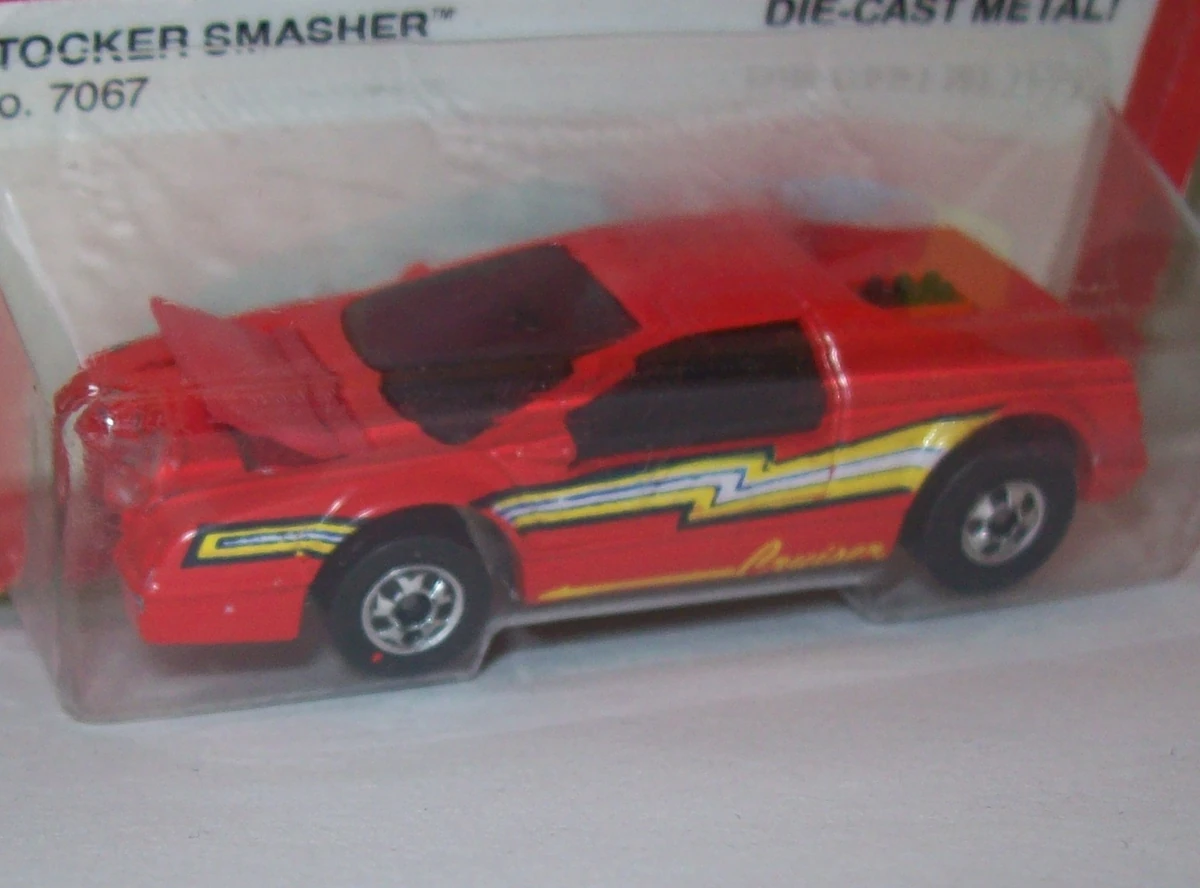
I still remember the first time I slammed a plastic car into a baseboard and didn't get grounded for it. In fact, that was the whole point. Back in the mid-1980s, Mattel did something sort of brilliant and a little bit unhinged. They realized kids didn't just want to race cars; they wanted to see the wreckage. They wanted the chaos. That’s how we got Hot Wheels Crack Ups. These weren't your standard die-cast collectibles that sat pristine on a shelf. No, these were built to be destroyed, or at least to look like it.
The gimmick was simple but honestly kind of revolutionary for the time. Each car had a spring-loaded panel—usually on the door, the hood, or the trunk—that would flip over upon impact. One side showed a shiny, factory-fresh paint job. The other? A twisted mess of "dented" metal and exposed engine parts. You’d crash them, "fix" them with a quick flick of the finger, and do it all over again. It was the peak of 80s tactile play.
The Mechanics of the Smash
If you look at the engineering, it’s actually pretty clever. Mattel didn't just make a flimsy door. They used a torsion spring mechanism. When the front bumper or a side sensor hit a hard surface, it triggered a latch. Pop. The panel flipped.
Most people remember the classic passenger cars, but the line was surprisingly diverse. You had the Bang-Up Buggy, the Crash-Up Chevy, and even some semi-trucks that looked like they’d survived a multi-car pileup on the I-95. Collectors today often hunt for the Stockar, which was a favorite because it actually felt like a demolition derby participant.
The weird thing is how much abuse these things took. Usually, when a toy has moving internal parts like springs and latches, it breaks after a week. But Hot Wheels Crack Ups were tanks. I’ve seen versions from 1985 that still flip perfectly today, even after forty years of being hammered against concrete driveways.
Why the 1980s Needed This Kind of Toy
Context matters here. We’re talking about an era of toy marketing dominated by "action features." If a toy didn't transform, glow in the dark, or have a "battle damage" feature, it was basically invisible on the shelf at Toys "R" Us.
Think about He-Man with the rotating chest plates that showed slashes. Or the Inhumanoids. Mattel was just bringing that same energy to the automotive world. They knew that realism was boring for a seven-year-old. What was exciting was the impact.
There was a specific joy in the "click" of resetting the car. It was satisfying. It was the original fidget toy, long before that was a term people used. You weren't just playing with a car; you were playing with a cycle of destruction and repair. It tapped into that weird human urge to see how things break, but with the safety net of knowing you could fix it in half a second.
Collecting Hot Wheels Crack Ups in 2026
If you’re trying to find these now, things get a little tricky. Because they were meant to be crashed, finding them in "Mint in Box" condition is like finding a needle in a haystack. Most of the ones surviving on eBay or at local swap meets are "play-worn."
- Look for the decals. The stickers on these cars tended to peel or get scratched during the "crashing" phase.
- Check the spring tension. A common issue with older Crack Ups is the spring losing its "snap," leaving the panel dangling halfway between damaged and fixed.
- Watch out for paint chips. Since these were literally designed to hit things, the edges of the flipping panels are almost always chipped.
Interestingly, the value has spiked recently. While a standard loose Hot Wheels car might go for a couple of bucks, a functional Hot Wheels Crack Ups vehicle in decent shape can easily fetch $20 to $50. If you find one of the rarer color variations or the larger gift sets, you're looking at much more. People are nostalgic for the physical feedback these toys provided.
The Evolution into Modern Crashing Toys
Mattel didn't just stop. The DNA of the Crack Ups line lives on. You can see it in the Monster Trucks line with the "re-crushable" cars, and certainly in the various Cars movie tie-ins that featured rotating eyes or changing expressions.
But honestly? Nothing quite matched the simplicity of that first wave. They didn't need batteries. They didn't need an app. They just needed a wall.
There was also a short-lived competitor called Slammers, and later, the Crashers line, but they never had that same heavy, die-cast feel. They felt like cheap imitations. The original Crack Ups had weight. When they hit the floor, you felt it in your wrist.
Spotting the Real Deals vs. Reissues
It's easy to get confused because Hot Wheels has released various "damage" themed cars over the years. However, the true Crack Ups are distinct because of that specific rotating panel. If the car just has painted-on scratches, it’s not a Crack Up. If it has a "color change" feature that shows damage when it gets wet, that’s a different line entirely (the Color Shifters).
The true series ran primarily from 1985 to about 1987. After that, the novelty started to wear off for the general public, but for a hardcore group of collectors, the obsession never ended.
Common Models to Keep an Eye Out For:
- The Firebird: Usually red or black, this is the quintessential Crack Up.
- The Pick-up Truck: These were great because the damage was often on the side of the bed.
- The Blind-Sider: A car where the side doors would flip.
- The Rear-Ender: As the name suggests, the trunk area was the "fail point."
Maintenance and Care for Vintage Die-Cast
If you happen to dig one of these out of your parents' attic, don't just start slamming it. The plastic parts have become brittle over the last few decades.
Kinda like us, right?
A small drop of silicone-based lubricant on the hinge can work wonders. Avoid using WD-40, as it can actually gunk up the mechanism over time or damage the vintage paint. Just a tiny bit of TLC and that 1985 Chevy will be ready for one more (gentle) wreck.
It’s funny how something so simple—a flipping piece of plastic—could define a whole segment of childhood. We weren't worried about aerodynamics or collectibility. We just wanted to see the "smoke" on the engine and the dent in the door.
Actionable Steps for the Aspiring Collector
If you're ready to dive back into the world of Hot Wheels Crack Ups, start by scouting local toy shows rather than just hitting the big auction sites. You want to feel the mechanism. Test the snap.
- Verify the Latch: Open and close the panel five times. If it sticks, the internal plastic tab might be worn down.
- Paint Matching: Look for "sun fading." If the car sat in a window, the "clean" side and the "damaged" side might have faded at different rates, making the effect look weird when it flips.
- Focus on a Series: Don't try to buy them all at once. Start with the "Workhorses" or the "Stock Cars" sub-series to keep your collection cohesive.
- Storage: Keep them in a temperature-controlled environment. Drastic heat changes are the enemy of vintage springs and plastic hinges.
There's something incredibly honest about a toy that embraces its own destruction. These cars weren't meant to be perfect; they were meant to be used. That’s probably why we remember them so fondly today. They were the only toys that encouraged us to be a little bit messy.