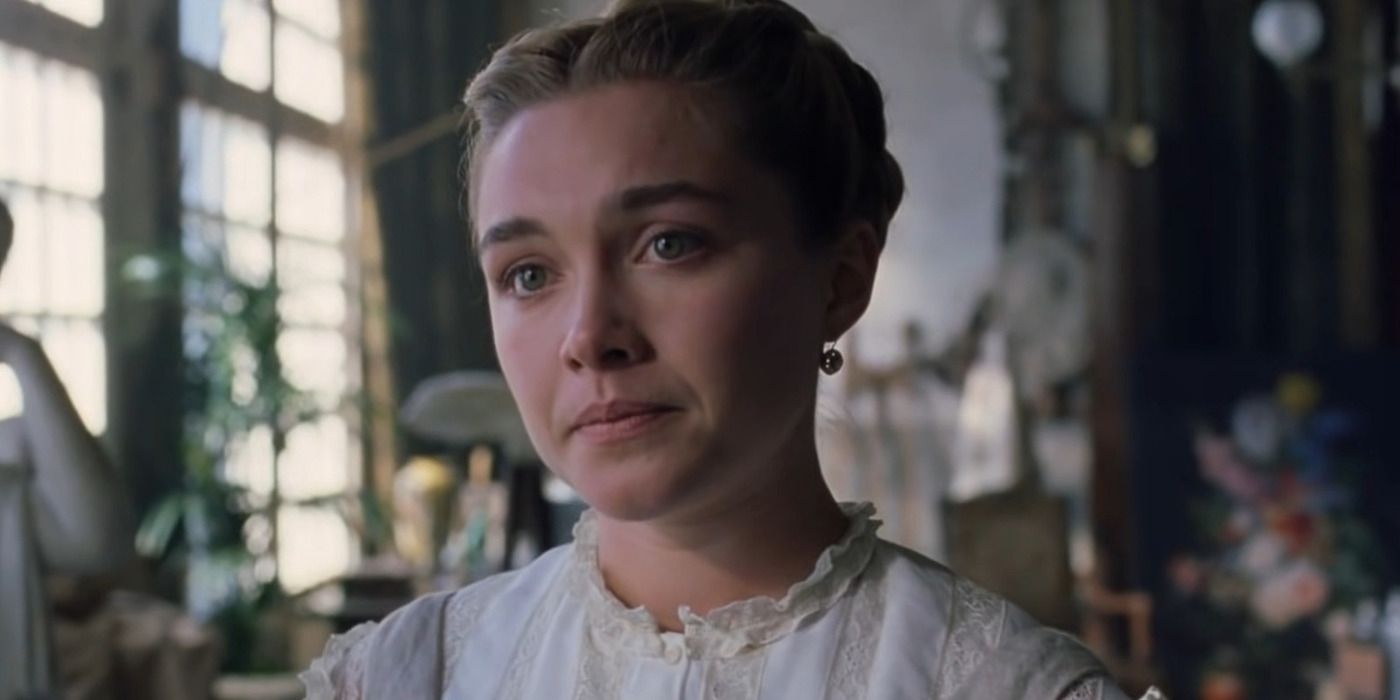
Everyone used to hate Amy March. For decades, the youngest March sister was the girl who burnt Jo’s manuscript, the spoiled brat who whined about limes, and the social climber who "stole" Laurie. Then Greta Gerwig’s 2019 adaptation happened. Specifically, Florence Pugh in Little Women happened.
It changed everything.
Suddenly, Amy wasn't just a villain in a hoop skirt. She became the most relatable person in the room. Pugh took a character written in 1868 and made her feel like a woman navigating 2024 (or 2026, for that matter). She didn't do it by making Amy "nice." She did it by making her honest.
The Problem with the "Brat" Narrative
Growing up with Louisa May Alcott’s novel usually meant picking a side. You were either a Jo—the fiery writer—or you were "one of the others." Amy was almost always the least favorite. Kirsten Dunst played her beautifully in 1894, but the narrative structure of previous films often left Amy looking like a foil to Jo’s integrity.
Florence Pugh didn't play a foil. She played a realist.
Think about the sheer physical presence Pugh brings to the role. She was 22 when they filmed this, yet she convincingly plays Amy at twelve. How? By leaning into the absurdity of being a child. She uses her voice—that signature raspy low register—to stomp through the March household with a sense of entitlement that feels earned because she’s the baby of the family.
But then, the movie jumps.
We see Amy in Paris. She’s older. She’s sophisticated. She’s failing. And that failure is where Pugh finds the heart of the character. Amy realizes she isn't a genius painter. In a world that only rewards women for being exceptional or married, she chooses a path that ensures her family’s survival. It's pragmatic. It’s almost cold. It’s also incredibly brave.
That "Economic Proposition" Speech
If you want to know why Florence Pugh in Little Women became a viral sensation, you have to look at the scene in the carriage. Or rather, the scene in the painting studio with Laurie (Timothée Chalamet).
Laurie is lounging around being a rich, moping alcoholic. He’s judging Amy for considering a marriage to Fred Vaughn, a man she doesn't love but who has money.
Pugh delivers a monologue that should be taught in every acting school. She explains that she has no way to make her own money. She doesn't own her future children. She doesn't even own her own "mind" in the eyes of the law.
"So don't sit there and tell me that marriage isn't an economic proposition, because it is."
She doesn't scream it. She doesn't cry. She says it with the weary patience of someone explaining basic math to a toddler. It’s a moment where the audience stops seeing a "social climber" and starts seeing a woman playing a rigged game with total clarity.
Gerwig reportedly wrote that speech after a conversation with Pugh about the reality of women’s lives in the 19th century. It wasn't in the original script. It was born from the collaboration between a director who understood the themes and an actress who understood the stakes.
The Chemistry with Timothée Chalamet
Let’s be real: the Jo and Laurie shippers were devastated. They always are. But for the first time in the history of Little Women adaptations, the Amy and Laurie pairing actually made sense.
Pugh and Chalamet have this weird, electric friction.
In the scenes where they are children, they fight like siblings. In Paris, the dynamic shifts into something much more dangerous. Pugh plays Amy as the only person who actually holds Laurie accountable. While Jo humored him or rejected him, Amy demands he be better.
She tells him he’s "a lazy person."
She says it to his face while wearing a massive white gown. It’s a power move. Pugh’s physicality—the way she stands her ground and refuses to be charmed by his "lonely rich boy" routine—makes the eventual romance feel like a partnership of equals rather than a consolation prize.
Dealing with the Manuscript Incident
We have to talk about the fire.
Yes, Amy burnt Jo’s book. It was a petty, horrific act of revenge. Most versions of this story make Amy look like a monster in this moment.
Pugh plays it differently. She plays it with the raw, unpolished rage of a child who has been excluded. She doesn't look "cool" doing it. She looks small and spiteful. But because Pugh allows Amy to be genuinely unlikeable in that moment, the later redemption feels authentic.
When Amy falls through the ice later that day, the terror in Pugh’s eyes isn't just about the cold water. It’s about the realization that her anger almost cost her everything. The performance bridges the gap between the impulsive child and the disciplined adult.
Why the Costumes Mattered
You might think the clothes are just background noise. They aren't.
Jacqueline Durran, the costume designer, gave Amy a very specific "look." While Jo is dressed in loose, masculine waistcoats and Beth is in soft, fading pinks, Amy is always structured. Even when they are poor, Amy finds a way to look intentional.
Florence Pugh uses those costumes. She handles the heavy fabrics and the restrictive corsets like armor. In the scenes where she’s trying to impress the upper class in Europe, you can see the effort it takes to maintain the posture. It’s a performance within a performance. She’s playing Amy, and Amy is playing a "Lady."
The Oscar Nomination was No Accident
When the 2020 Academy Award nominations came out, Pugh snagged a nod for Best Supporting Actress. She didn't win (Laura Dern took it for Marriage Story), but the nomination solidified Pugh’s status as a powerhouse.
It’s rare for a "period piece" performance to feel this visceral. Usually, there’s a stiffness to the acting. People talk in "thee" and "thou" cadences (metaphorically) and hold their breath.
Pugh breathed. She ate. She yelled. She was messy.
She brought the same "unhinged" energy she used in Midsommar—which, fun fact, she filmed right before Little Women—and channeled it into the domestic sphere. That’s her superpower. She makes internal struggles look like external wars.
A Different Kind of Feminism
Jo March is the traditional feminist icon. She wants to be a writer, she wants to be independent, and she hates the rules.
Amy, as played by Pugh, represents a different kind of strength. She knows she can't change the rules, so she masters them. She uses her art to get to Europe. She uses her charm to secure a future for her mother and sisters.
There is a scene toward the end of the film where Amy talks about her desire to be "great or nothing."
Most of us aren't Jo March. Most of us aren't geniuses who can change the world through a single novel. Most of us are Amys. We have talent, but maybe not enough to be the best in the world. We have ambitions, but we also have bills. Pugh’s performance is a love letter to the people who have to find a way to be "great" within the limits of their reality.
Practical Takeaways for Your Next Rewatch
If you’re going back to watch the film again—which you should—keep an eye on these specific details. They’re easy to miss but they explain why the performance works so well:
- Watch her hands. In the Paris scenes, Pugh often clenches her fists or fidgets with her rings when she’s around Laurie. It’s the only sign that she’s nervous.
- Listen to the silence. In the scene where Beth dies (off-screen for Amy), watch the way Pugh receives the news. The shift from the excitement of being abroad to the crushing weight of grief happens entirely in her eyes before she even speaks.
- Note the "Amy-isms." Pugh added little character quirks, like the way she talks with her mouth full or the specific way she sighs when she’s annoyed with her sisters. It makes the Marches feel like a real family, not a painting.
The Legacy of the Performance
Florence Pugh didn't just play Amy March; she rehabilitated her.
She took a character who had been a punchline for a century and turned her into a symbol of pragmatic ambition. It’s why you see "Amy March Apologist" hoodies on Etsy. It’s why TikTok is full of edits of that carriage monologue.
She reminded us that it’s okay to want things. It’s okay to be ambitious. It’s even okay to be a bit of a brat sometimes, as long as you’re willing to grow up and take care of the people you love.
What to Watch Next
If you loved Pugh in this, you should check out her work in Lady Macbeth (2016) to see a much darker version of a woman trapped by 19th-century society. Or, for a total 180, watch her as Yelena Belova in the Marvel Cinematic Universe, where she brings that same "younger sister" energy but with more knives.
Next Steps for Fans:
- Compare the 2019 film to the 1994 version to see how much the character's "agency" changed based on the acting choices.
- Read Louisa May Alcott's journals to see how much of the "economic proposition" speech was actually based on the author's real-life financial struggles.
- Follow the career of casting director Kathy Driscoll-Mohler, who has a knack for pairing actors like Pugh and Chalamet who possess high-intensity chemistry.