Rain. Not just a drizzle, but that bone-chilling kind of rain that soaks through a denim jacket in seconds. That’s how the song starts. You can almost feel the dampness. When Charlie Pride released "Is Anybody Goin' to San Antone" in early 1970, it wasn't just another track on a country record. It was a mood.
Most people think of Charley Pride (and yeah, he usually spelled it Charley, but everyone searches for Charlie Pride) and they immediately hum "Kiss an Angel Good Mornin'." That’s the big one. The wedding song. The happy one. But honestly? "Is Anybody Goin' to San Antone" is the superior record. It’s grittier. It’s about a man who has reached his absolute limit, standing on the side of Route 66, hitchhiking into a storm because anywhere—literally anywhere—is better than the home he just left.
It’s a heartbreak song that doesn’t wallow. It moves.
The Story Behind the Song
Success in Nashville is rarely a straight line. Glenn Martin and Dave Kirby, two legendary songwriters, actually wrote this thing in a car. They were driving to Atlanta, probably bored out of their minds, and started piecing together the story of a guy who’d rather sleep under a park table than in a king-size bed with a woman who doesn't love him anymore.
When you listen to the lyrics, they’re pretty dark.
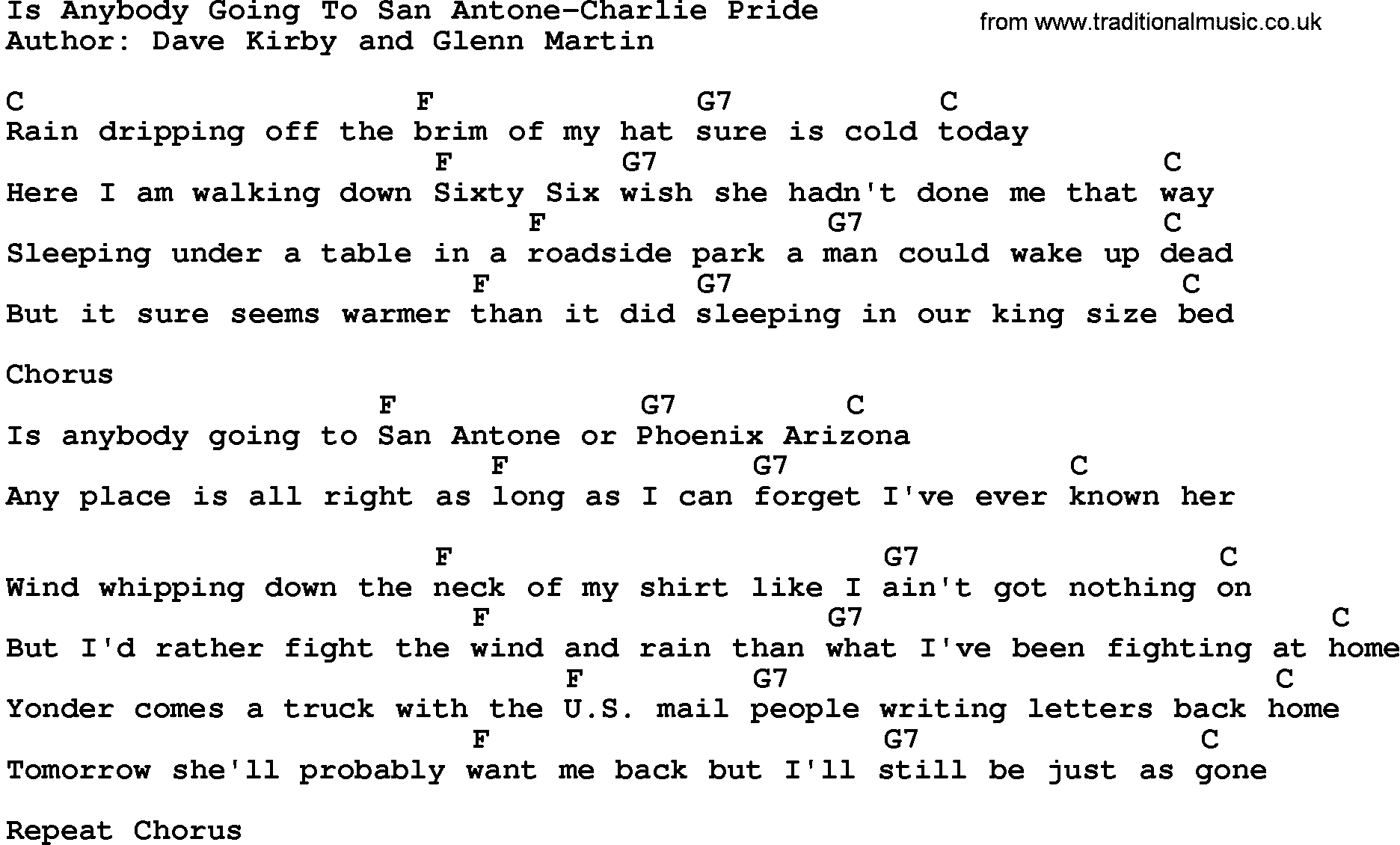
"Sleeping under a table in a roadside park, a man could wake up dead."
That’s a heavy line for a song that reached Number One on the Billboard Hot Country Singles chart in April 1970. But that was the magic of the "Pride" sound. He had this rich, smooth baritone that could make a desperate situation sound like a warm invitation. He didn't sound like he was crying; he sounded like he was surviving.
Jack Clement, Pride's producer, knew exactly what to do with the arrangement. He added that signature fiddle and a driving beat that feels like tires humming on wet pavement. It’s got that "walking" tempo. You can feel the forward motion.
Why the "San Antone" Connection Matters
San Antonio has always been a hub for country and Tex-Mex music. The song mentions two destinations: San Antone or Phoenix, Arizona.
Basically, the narrator is saying, "Take me east or take me west, just get me out of here."
Interestingly, Doug Sahm (of the Sir Douglas Quintet) covered the song in 1973. His version is legendary among Texas music nerds because he had Bob Dylan singing backup vocals on it. But even with Dylan’s star power, it’s the Charlie Pride version that everyone remembers. It’s the definitive one. It’s the one that stayed at the top of the charts for two weeks and helped Pride win the CMA Entertainer of the Year award in 1971.
Breaking Barriers with a "Permanent Tan"
We can't talk about this song without talking about the man himself. Charlie Pride was a pioneer. Period. He was the first Black superstar in country music, and for a long time, he was RCA Records’ best-selling artist behind only Elvis Presley.
Think about that for a second.
In 1970, America was a powder keg. Racial tensions were high. Yet, here was Charlie Pride, singing about lonesome highways and heartbreak to an audience that was almost entirely white. He used to joke about his "permanent tan" when he walked out on stage. He knew the elephant was in the room, so he acknowledged it, then he sang his heart out.
"Is Anybody Goin' to San Antone" worked because it was relatable. Heartbreak doesn't have a color. Being broke and cold on the side of a highway is a universal fear. By the time he hit the chorus, nobody cared what he looked like—they just cared that he was telling their story.
The Anatomy of a Hit
What makes this specific track so sticky?
- The Rhyme Scheme: The way Pride rhymes "Arizona" with "ever known her" is clever. It shouldn't work, but his phrasing makes it feel natural.
- The Contrast: The music is upbeat, almost jaunty. The lyrics are miserable. That’s the "country music formula" at its peak.
- The Voice: His baritone was incredibly clean. Unlike many of his contemporaries who used a lot of "twang" or "growl," Pride’s voice was pure.
The Legacy in 2026
It is wild to think that over 50 years later, this song still pops up in movies and TV shows. It’s been covered by everyone from Kevin Fowler to George Strait. Strait actually performed it as a tribute to Pride after he passed away in late 2020.
If you look at the charts today, country music is going through another "traditionalist" phase. Artists like Luke Combs and Chris Stapleton are bringing back that stripped-down, story-first vibe. They owe a massive debt to the way Charlie Pride handled "Is Anybody Goin' to San Antone." He proved that you don't need gimmicks. You need a fiddle, a steel guitar, and a story about a guy who just wants to forget a girl.
What Most People Get Wrong
There’s a common misconception that Charlie Pride only sang "safe" songs. People look at his success and assume he was a "pop-country" guy who didn't have any edge.
"San Antone" proves that’s wrong.
It’s a song about a man who is essentially homeless for the night. He's hitchhiking. He's "fighting the wind and rain." It’s as "outlaw" as anything Waylon or Willie were doing at the time, just delivered with more polish. It’s a song about the absolute failure of a marriage.
If you really want to appreciate the depth of this track, listen to the second verse again. He talks about a U.S. Mail truck passing him by. He knows his wife will probably want him back tomorrow, but he’ll "still be just as gone." That’s cold. That’s finality.
Actionable Insights for Music Lovers
If you’re just discovering Charlie Pride’s catalog through this song, here is how to dive deeper without getting overwhelmed by his 50+ albums:
- Listen to the "10th Album": That’s where "San Antone" lives. It’s a gold-certified record and arguably the peak of his early-70s sound.
- Compare the Covers: Go listen to the Doug Sahm version. It’s much more "Tex-Mex" and loose. It helps you see how tight and professional Charlie’s version really was.
- Watch the Live Performances: Look for his 1970s TV appearances. The way he interacts with the band while playing his own guitar parts is a masterclass in stage presence.
- Check the Lyrics: Pay attention to the "Arizona/known her" rhyme. It’s one of those songwriting "rules" that they tell you not to do, yet it’s the most memorable part of the song.
Charley Pride didn't just sing songs; he built bridges. "Is Anybody Goin' to San Antone" was one of the strongest planks in that bridge. It’s a timeless piece of Americana that feels just as lonesome and just as necessary today as it did when it was first cut in a Nashville studio.