You're staring out the window at a wall of white. The wind is howling, the driveway is gone, and you’re wondering if you even have a job to go to today. Most people start scrambling for the TV remote or scrolling frantically through Twitter (or X, whatever) asking the same thing: what level snow emergency are we on? It’s a simple question with a surprisingly localized answer.
Snow emergencies aren't a federal thing.
The President doesn't declare a Level 2 for your specific cul-de-sac. Instead, these calls are made by sheriffs, mayors, or county commissioners who are looking at salt reserves and black ice reports while you're still in pajamas. If you’re in Ohio, you’re looking at a numbered system. If you’re in Minnesota or Michigan, you might just be looking for a "Snow Emergency" declaration that dictates where you can park. It varies. A lot.
Finding Your Specific Snow Emergency Level
Basically, your best bet is always the local Sheriff’s Office. In states like Ohio, the law actually gives the Sheriff the power to tell you to stay off the road. They usually post these updates on their official Facebook pages or dedicated county websites faster than the local news can update their ticker.
Why Facebook? Honestly, it’s because it’s the easiest way for a small-town government to reach people instantly without waiting for a webmaster to update a clunky .gov portal. Check your county’s name plus "Sheriff" or "Emergency Management Agency" (EMA).
If you live in a major city like Chicago or Minneapolis, the "level" usually refers to parking. You’ll hear things like "Phase 1" or "Permanent Snow Route" rules. In these spots, it’s less about whether it’s legal to drive and more about whether your car is about to be towed to a lot five miles away because a plow couldn't get through.
Understanding the Levels: 1, 2, and 3
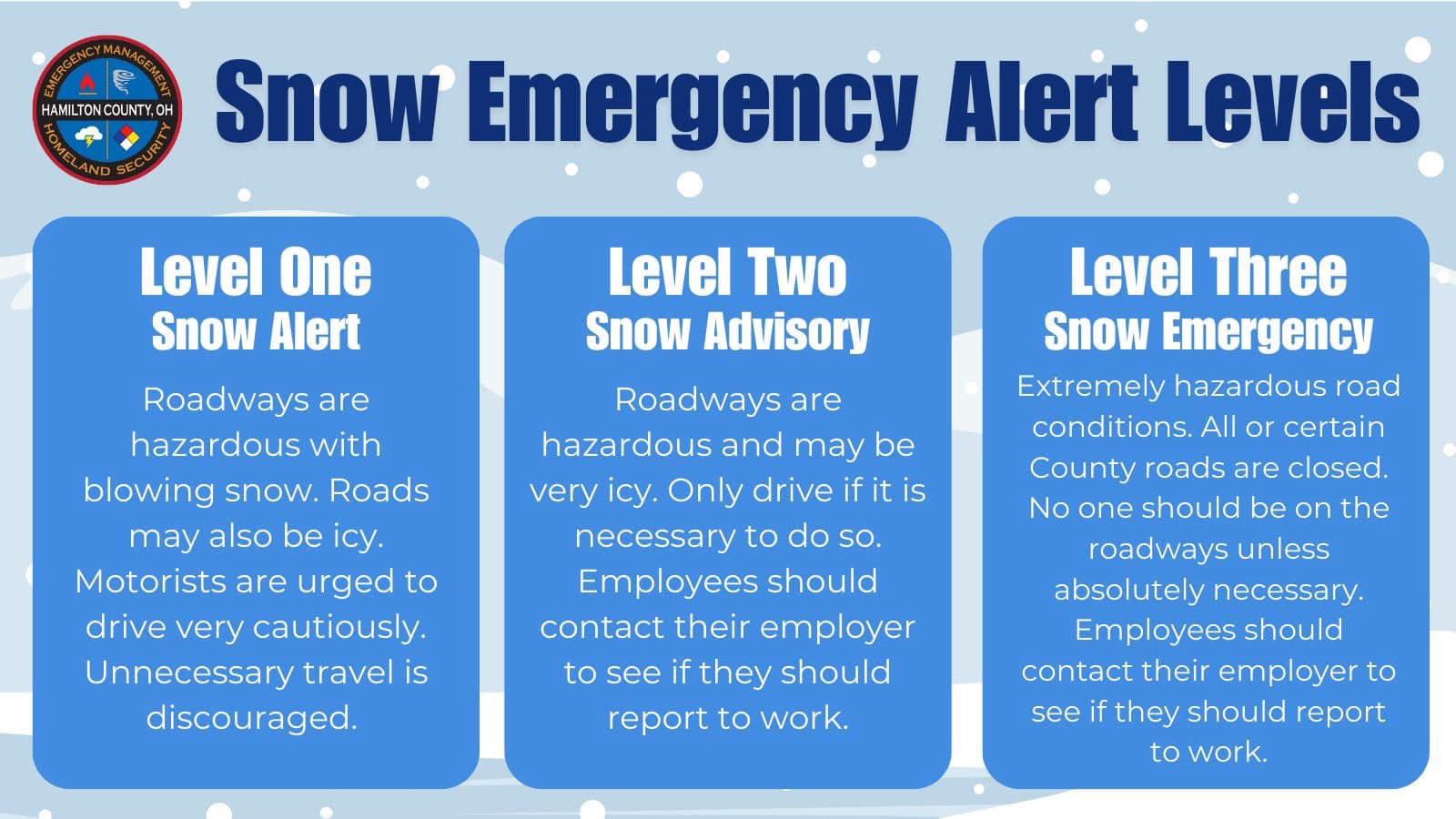
Not every state uses the 1-2-3 system, but it’s the most common shorthand in the Midwest and Northeast. It’s a hierarchy of "how much trouble am I in if I get stuck?"
Level 1 Snow Emergency
This is the "be careful" stage. Roadways are hazardous. There's ice, blowing snow, or just enough slush to make your anti-lock brakes kick in at every stoplight. You can drive, but you should probably slow down. Most people treat this as a suggestion, but it's actually an official warning that the salt trucks haven't won the battle yet.
Level 2 Snow Emergency
Now things are getting hairy. At Level 2, only "necessary" travel is recommended. What does necessary mean? Well, that’s the gray area. It usually means work, medical emergencies, or getting food. You should contact your employer before heading out. Many offices will close at this stage, and if you’re fishtailing into a ditch, the responding officer might give you a look that says, "I told you so."
Level 3 Snow Emergency
This is the big one. All roadways are closed to non-emergency personnel. In many jurisdictions, if you are out driving for a non-essential reason, you can actually be arrested or cited. It’s not just about your safety; it’s about the fact that if you get stuck, you’re blocking the plow that needs to clear the way for an ambulance. When someone asks what level snow emergency are we on and the answer is 3, you stay home. Period.
Why the Levels Shift So Fast
The weather doesn't care about your commute. A Level 1 can jump to a Level 3 in sixty minutes if a "snow squall" hits. This happened famously in 2024 across parts of Pennsylvania and New York, where visibility dropped to zero in seconds.
The National Weather Service (NWS) issues the warnings, but the local government issues the levels. That distinction matters. A "Blizzard Warning" from the NWS is a meteorological fact. A "Level 3 Emergency" is a legal directive.
The Parking Nightmare: City-Specific Rules
Let’s talk about the "Winter Parking Ban." This is the city version of a snow emergency.
In places like Boston or Milwaukee, a snow emergency declaration triggers specific side-of-the-street parking rules. If you’re on a "Snow Route," move your car. If you don't, the city sees your vehicle as an obstacle to public safety. They won't just ticket you; they will drag your car away.
I’ve seen people spend $300 on towing fees for a 4-inch snowstorm because they didn't check the local "Snow Emergency" status before going to bed.
- The Odd-Even Rule: You park on the side of the street that matches the date. On January 18th, you park on the side with even-numbered addresses.
- The 2-Inch Rule: In some cities, the emergency is automatic the moment two inches of snow hits the ground. No one has to call you. You just have to know.
Real-World Examples of Recent Declarations
Back in the massive "Christmas Blizzard" of 2022 in Buffalo, New York, the emergency levels weren't just bureaucracy—they were life-saving measures. Mark Poloncarz, the Erie County Executive, had to implement a driving ban (essentially a Level 3) that lasted for days.
People who ignored the "what level snow emergency are we on" updates found themselves trapped in their cars for 24+ hours. It sounds dramatic, but in heavy lake-effect snow, the "Level" is the difference between a clear road and a death trap.
Contrast that with a place like Denver. Denver doesn't really do "levels" the same way. They expect you to have 4-wheel drive or at least decent tires. They rarely close roads unless there’s a literal mountain slide or a massive pileup on I-70. It shows how much regional culture dictates what an "emergency" actually is.
Does Your Employer Have to Listen?
This is the question everyone actually wants to know. "If it's a Level 2, do I have to go to work?"
Technically, in most "at-will" employment states, an employer can still ask you to come in. However, if a Level 3 is declared and the roads are legally closed, your boss asking you to drive is essentially asking you to break the law. Most HR departments have policies that align with the Sheriff's declarations to avoid liability.
If you're a nurse, a firefighter, or a power line worker, you're "essential." You’re the reason the rest of us are told to stay off the road.
How to Prepare Before the Level Hits 3
Don't be the person at the grocery store buying five gallons of milk when the flakes start falling. That's a meme for a reason.
- Check the "Snow Map": Most states (like Ohio or Indiana) have a real-time map. Search for "State DOT Snow Map" to see color-coded road conditions.
- Wiper Blades Up: If you’re parked outside, flip them up. It prevents the rubber from freezing to the glass and saves your wiper motor from burning out when you try to clear the ice.
- The Half-Tank Rule: Never let your gas tank drop below half in the winter. If you get stuck in a Level 3 situation and have to wait for a rescue, that gas is your heater. It’s your lifeline.
Determining Your Current Status
If you are reading this while the sky is gray and the wind is picking up, do these three things immediately:
First, check the website of your local County Sheriff. They are the ultimate authority on road levels. Second, look at your city's public works page to see if a parking ban is in effect. Third, sign up for "Nixle" or your local county's "Alert" system. They will send a text directly to your phone the second the level changes.
Kinda sucks to stay inside, but it beats a tow bill or a ditch.
Actionable Next Steps for Right Now
- Bookmark your local Sheriff’s Office social media page. It's the most reliable source for "levels" compared to national weather apps.
- Verify your "Snow Route" status. Look for red and white signs on your street. If they exist, find a garage or a side street that isn't a designated plow route.
- Download the "511" app for your state. This is the official Department of Transportation app that shows plow locations and camera feeds of the highways.
- Check your car's emergency kit. You need a blanket, a portable shovel, and a bag of sand or kitty litter for traction. If you're currently in a Level 2 or 3, don't go out to buy these—just remember them for next time.