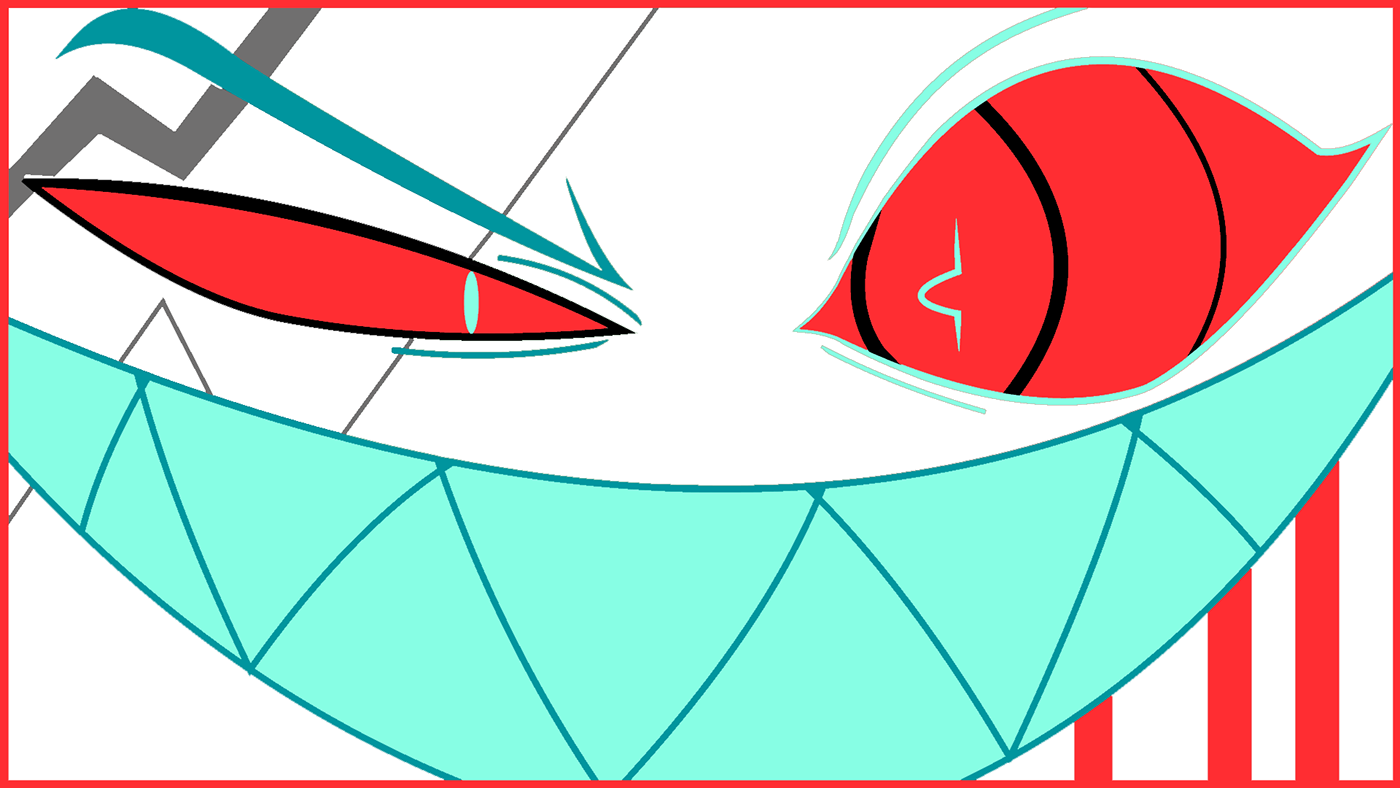
He’s loud. He’s neurotic. He’s literally a walking flat-screen television. Vox from Hazbin Hotel isn't just another Overlord in a suit; he is the personification of our modern, screen-addicted anxiety. While Alastor represents the "good old days" of radio and mystery, Vox is the frantic, high-definition chaos of right now. Honestly, it’s why people love him.
He isn't some untouchable, god-like entity who never breaks a sweat. He’s a mess. A powerful, billionaire, electric-blue mess who spends way too much time obsessing over his ex-rival and his social media engagement.
If you’ve watched the first season on Prime Video, you know the vibe. Created by Vivienne "VivziePop" Medrano, Vox stands out because his villainy feels weirdly corporate. It’s not just about souls; it’s about market share. It's about the "Vees" brand. It's about being the loudest voice in the room, even if that voice is flickering because your WiFi is spotty.
The Tech Demon’s Origins and What He Actually Does
Vox is one-third of the Vees. This triumvirate—consisting of himself, Valentino, and Velvette—basically runs the commercial soul of Pentagram City. While Valentino handles the "adult" industry and Velvette manages social media and fashion, Vox is the backbone. He’s the infrastructure. He’s the guy who puts a TV in every home and a camera on every corner.
In the lore, he’s a sinner who died in the 1950s. That’s a detail a lot of people miss. You see it in his design—the bowtie, the showman energy. But unlike Alastor, who refused to move past his era, Vox adapted. He upgraded. He went from black-and-white to color to 4K. He represents the terrifying speed of technological progress.
His powers are actually pretty terrifying if you think about them. He can travel through electrical grids. He can manipulate screens. He can literally brainwash the masses through "hypnovis" (those hypnotic eyes aren't just for show). In the episode "Radio Killed the Video Star," we see him use his entire network to spy on the hotel. He’s a literal surveillance state with a grin.
Why the Rivalry With Alastor is So Personal
Everything with Vox from Hazbin Hotel eventually circles back to the Radio Demon. It’s a classic "Old Media vs. New Media" trope, but with way more spite.
Why does Vox hate him so much? It’s not just that Alastor is powerful. It’s that Alastor doesn’t care about him. For a guy like Vox, who thrives on attention, being ignored is a fate worse than death. There’s a widely accepted theory—backed by the "Stayed Gone" lyrics—that Vox actually asked Alastor to join his team years ago. Alastor said no. Probably in a very insulting way.
Vox’s insecurity is his most human trait. Despite having thousands of employees and total control over Hell’s media, he still loses his mind when a guy with a deer carcass on his head shows up after a seven-year hiatus.
- Vox needs validation.
- Alastor feeds on mystery.
- Vox wants to be "the future."
- Alastor thinks the future is a boring joke.
Their duet in the premiere episode is a masterpiece of characterization. You can hear the desperation in Christian Borle’s voice (who voices Vox). He’s trying so hard to prove he’s moved on, while literally singing a whole song about the guy he’s supposedly over. We’ve all been there. Maybe not with a magical radio demon, but definitely with a "rival" we check up on way too often.
The Power Dynamics of the Vees
The Vees aren't friends. Not really. They are a "poly-business-partnership," as fans like to call it. They rely on each other to maintain their grip on Hell, but the cracks are visible.
Valentino is a loose cannon. He’s violent, impulsive, and constantly threatens the brand's stability. Vox is the one who has to calm him down. Think about that—the most powerful media mogul in Hell has to spend his Friday nights acting as a therapist for a moth demon with anger issues.
Velvette, on the other hand, is the "backbone" in terms of cultural relevance. She keeps the Vees trendy. Without her, Vox would just be an old man in a TV body. This dynamic makes Vox more than a one-dimensional villain. He’s a middle-manager with a god complex. He’s stressed. He’s constantly one PR disaster away from a literal meltdown—which we see happen when he short-circuits the entire city’s power grid.
Vox’s Design: More Than Just a TV Head
If you look closely at his design throughout the show and the pilot (where he looked a bit different), the evolution is intentional. Modern Vox is sleek. He has a flat screen. His suit is sharp, neon, and professional.
But his face... it’s digital. It’s a projection. When he gets angry, the pixels break. The "blue screen of death" isn't just a funny visual gag; it’s a metaphor for how fragile his ego is. He is a high-performance machine that overheats the second things don't go his way.
His eyes are the key to his "Hypno" abilities. In the Hazbin universe, eyes are everything. Alastor has radio dials. Vox has concentric circles that pulsate. It’s a direct nod to the hypnotic nature of television. We don't watch Vox; we're programmed by him.
What Most People Get Wrong About His Strength
There is a common misconception that because Alastor "won" the song battle in Season 1, Vox is weak. That’s a mistake.
Alastor won the verbal battle. He won the psychological war because he knows exactly how to push Vox’s buttons. But in terms of raw, modern influence? Vox is winning. He controls the information. He controls the narrative. In a world where souls are currency, Vox owns the bank and the ATM.
The show hints that Vox actually came very close to defeating Alastor in the past. Valentino even mentions it. Alastor barely escaped. Vox isn't a joke; he’s a predator who just happens to have some very loud insecurities.
The Impact of Christian Borle’s Performance
You can't talk about Vox from Hazbin Hotel without mentioning the Broadway energy. Christian Borle brings a manic, theatrical intensity to the role that makes Vox terrifying and hilarious at the same time.
His background in theater allows him to transition from "cool corporate CEO" to "screaming lunatic" in a single breath. It gives Vox a layer of charisma that makes you almost want to root for him, or at least watch him fail spectacularly.
Practical Takeaways for Fans and Theory Crafters
If you’re trying to keep up with where Vox’s character is going in Season 2, here is what you need to focus on.
First, watch the background characters. Vox’s "VoxTek" brand is everywhere. He is slowly building a monopoly that might even challenge the biological royalty of Hell (like Lucifer).
Second, pay attention to the blue electricity. Whenever you see it, he’s watching. He’s the eyes and ears of the show’s antagonists.
Third, understand his relationship with Sir Pentious. In the beginning, Vox used him as a pawn. Now that Pentious has "ascended" (no spoilers, but if you know, you know), Vox has a serious problem. If people find out they can leave Hell, his entire business model—which relies on a captive audience—dies.
To stay ahead of the curve on Hazbin lore, keep an eye on the official "SpindleHorse" social media updates. The production team often drops small hints about character designs and background details that explain why Vox is making certain moves.
Actually, just look at your own phone. Notice how hard it is to put down? That’s the real-world version of Vox. He’s not just a character; he’s a commentary on the fact that we’re all a little bit brainwashed by the screens in front of us. And honestly? He’s doing a great job of it.
What to do next
If you want to dive deeper into Vox’s influence, re-watch the "Stayed Gone" sequence and count how many times his face appears on screens other than his own head. It’s a direct indicator of his power level. Then, compare his technology to the tech used in the Pride Ring's lower levels. You’ll see that he isn't just a resident; he is the architect of Hell’s modern era. Monitor the official Prime Video trailers for Season 2, as the "Vees" are confirmed to be the primary focus moving forward. This is where we will likely see Vox’s true "endgame" for the Hazbin Hotel.
---