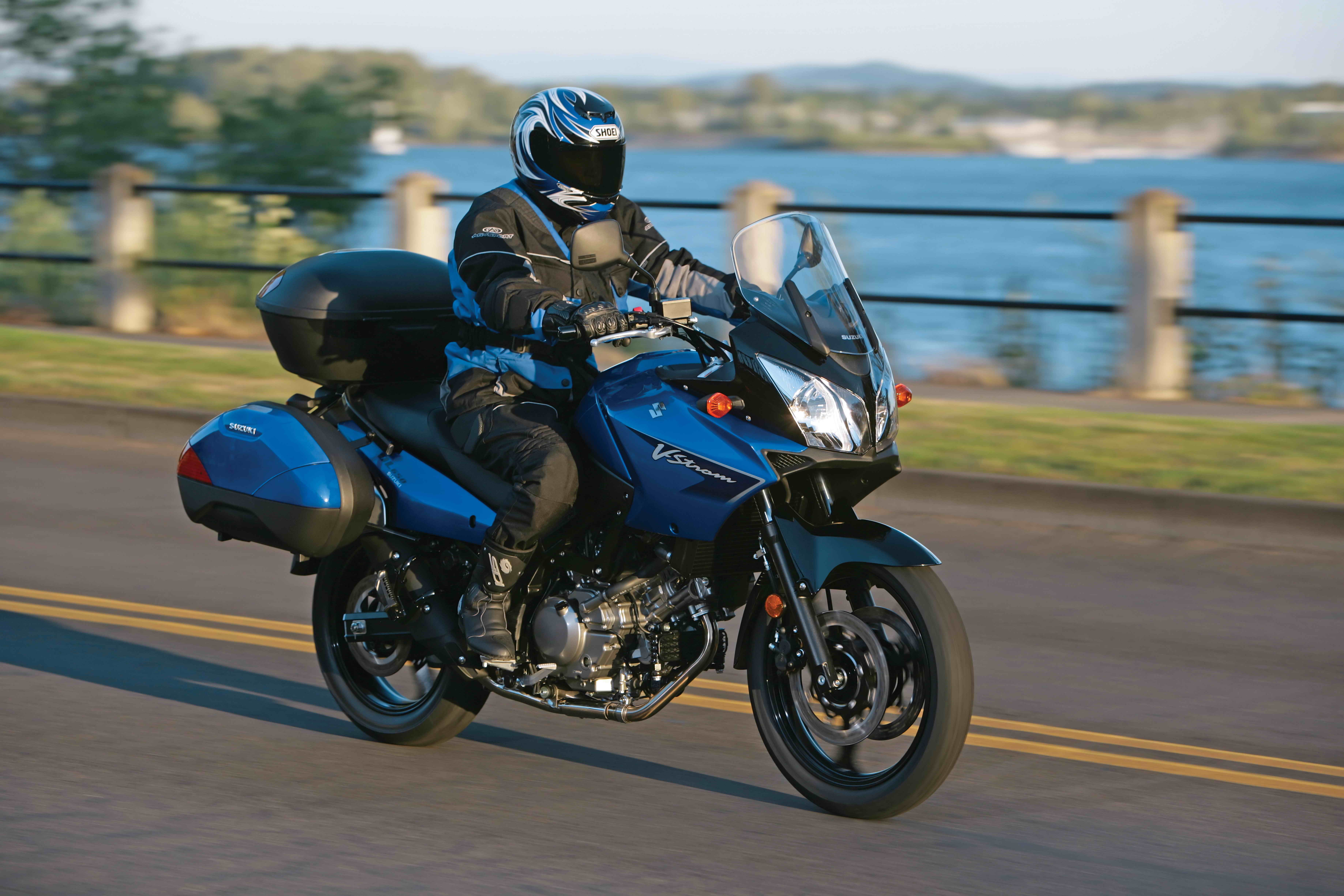
You’ve seen the numbers on the spec sheets. You’ve probably seen some guy on a forum claiming he hit 135 mph while tucked behind a barn-door windshield. But if you’re looking at a Suzuki V-Strom 650, you aren't exactly buying a Hayabusa. You’re buying a bike that people affectionately call the "Wee-Strom" because it’s the reliable, over-achieving middle child of the adventure world.
Still, the question of v strom 650 top speed matters. Not because you’re going to be racing Ducatis on the autobahn, but because you need to know if this 645cc V-twin has enough "poke" to get you past a triple-trailer semi-truck on a windy Wyoming interstate without feeling like you’re bringing a knife to a gunfight.
Honestly, the real-world performance of this bike is a bit of a mixed bag, and the speedometer is a notorious liar.
The Gap Between the Dash and Reality
Let's get the "official" numbers out of the way first. Most factory data and expert tests, like those from RoadRUNNER Magazine, peg the v strom 650 top speed at approximately 110 mph (180 km/h). However, if you pin the throttle on a flat stretch of pavement, your dashboard will likely scream 120 mph or even 125 mph at you.
Don't believe it.
Suzuki speedometers are famously optimistic. It's a "feel-good" error that usually sits around 7-10% higher than your actual ground speed. If you’re seeing 115 mph on the clock, a GPS unit like a Garmin or even your phone would likely show you’re doing closer to 104 or 105 mph.
Why the discrepancy?
Manufacturers do this for a variety of reasons—safety margins, tire wear compensation, or just making the bike feel faster than it is. On a bike like the V-Strom 650, which produces roughly 70 horsepower and 46 lb-ft of torque, pushing through the air at triple-digit speeds is a massive aerodynamic struggle.
The bike is basically a sail.
When you get above 90 mph, the acceleration slows down significantly. It’s "zippy" up to about 85 mph, which is perfect for most US highway limits. After that? It's a slow crawl to the finish line.
Highway Manners and the 80 MPH Wall
Cruising is where the Wee-Strom lives. Most owners find that the bike is incredibly happy sitting at 5,000 to 6,000 RPM in 6th gear, which translates to a smooth 75-85 mph.
It’s comfortable. It doesn't vibrate your teeth out like an old Sportster. But there is a literal and figurative wall you hit once you start pushing for that v strom 650 top speed.
- Wind Buffeting: The stock windshield is "fine," but at 100 mph, the air pressure becomes a physical opponent. Many riders switch to an Givi Airflow or a MadStad bracket to stop their head from being tossed around like a bobblehead.
- The "Sail" Effect: Because the V-Strom has a high center of gravity and a large front profile, a sudden gust of wind at 100 mph can move you two feet to the left before you can blink. It gets spooky.
- Fuel Economy: If you ride at 60 mph, you might see 55 mpg. If you try to maintain 100 mph, expect that to drop into the high 30s. Physics is a jerk like that.
Can You Make it Faster?
If you're obsessed with the v strom 650 top speed, you can mess with the gearing, but it’s a game of trade-offs.
Some riders swap the front sprocket for one with an extra tooth (going from 15 to 16). This drops the RPMs at highway speeds, making the bike feel "calmer" at 80 mph. It might technically increase your theoretical top speed if you have enough road and a tailwind, but you’ll lose some of that punchy acceleration in 1st and 2nd gear.
Conversely, dropping a tooth on the front (going to 14) makes it a wheelie machine in the city but kills your top end. You'd be screaming at 7,000 RPM just to keep up with traffic. Most people who actually tour on these bikes stick to the stock gearing because Suzuki actually got the balance pretty right for a 650.
Real World vs. The Track
I’ve seen videos of guys on "private roads" (you know the ones) getting the V-Strom 650 up to an indicated 122 mph while tucked flat against the tank with their elbows in. It takes a long time to get there. It isn't a "power" thing as much as it is an "aerodynamic endurance" thing.
The bike is rock steady for most people until about 105 mph. Beyond that, the front end can start to feel a little "light" or "loose." This is especially true if you have a massive top box or panniers loaded down. In fact, Suzuki’s own manual for the Adventure trim suggests not exceeding 80 mph when the hard cases are attached.
Does anyone follow that? No. But the warning exists because of how those boxes change the airflow and stability at high speeds.
Actionable Insights for V-Strom Owners
If you're worried that the 650 isn't "fast enough," stop worrying. It's more than enough for 99% of riders. Here is how to handle the speed reality of this bike:
- Trust GPS, Not the Dash: If you really want to know your v strom 650 top speed, mount a phone and use a GPS speed app. It will humble you.
- Adjust the Suspension: These bikes are often undersprung from the factory. If you’re a bigger rider (over 200 lbs) and you’re carrying gear, the rear will sag, which makes the front end light and "wobbly" at high speeds. Cranking the preload helps stabilize the bike.
- Mind the Tires: If you’re running aggressive 50/50 dirt tires like Shinko 804/805s, they aren't rated for the bike's top speed. Stick to 90/10 tires like the Michelin Road 6 or the stock Bridgestone Battlax if you plan on doing high-speed slab work.
- The 800 Factor: If you find yourself constantly wishing for more "grunt" at 90 mph, it might be time to look at the new V-Strom 800DE. It has about 15 more horsepower and handles the high-speed overtakes with much less drama.
Basically, the V-Strom 650 is a mule that thinks it’s a stallion. It’ll do the ton (100 mph) all day long, but it doesn't really want to go much faster than that. And honestly? On a bike built for seeing the world, 85 mph is plenty.
Before your next long trip, check your tire pressure and sag settings. A properly set up suspension is the difference between a terrifying 100 mph wobble and a smooth, confident cruise to your next destination.