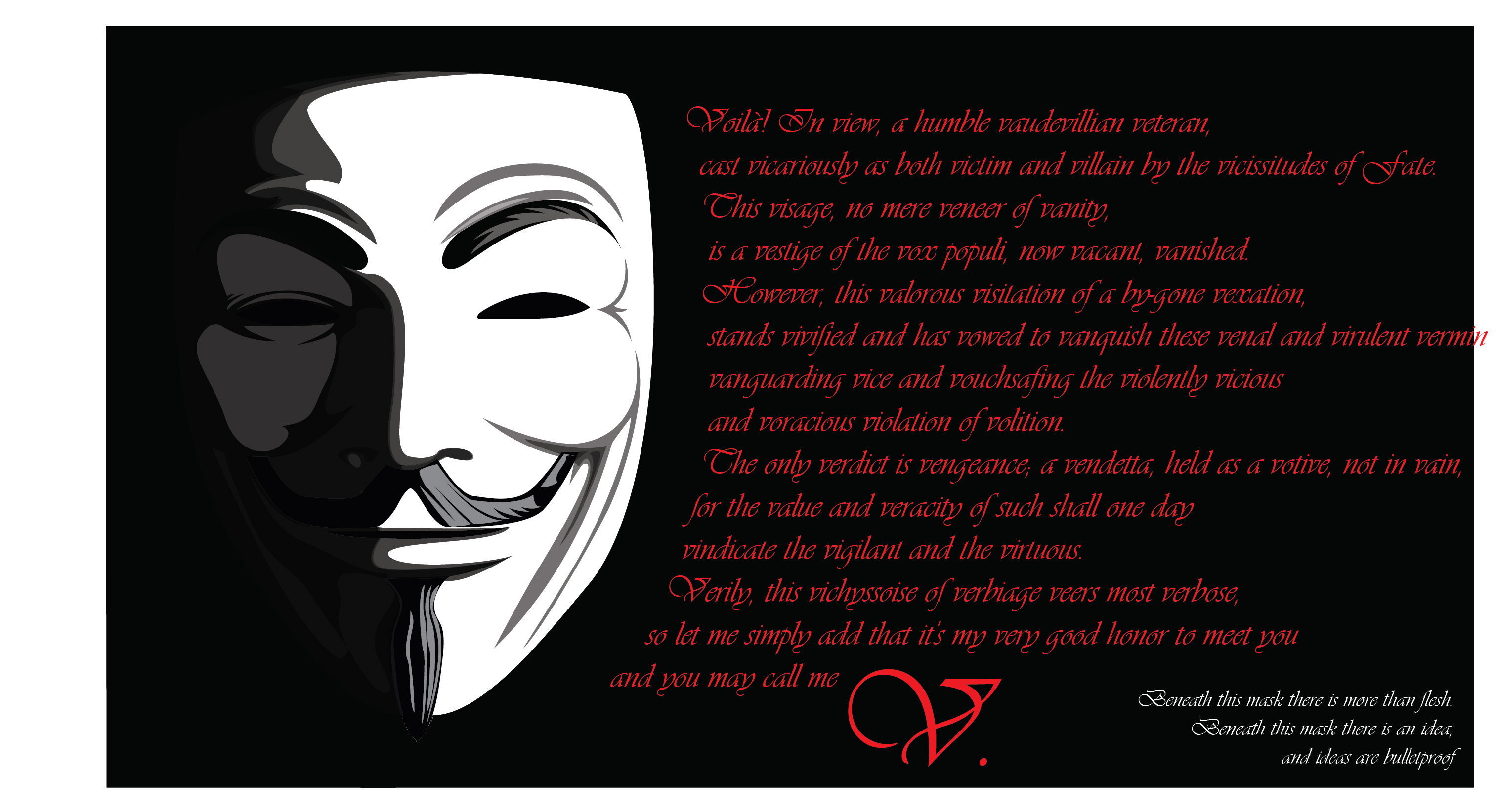
You've probably spent the better part of two decades wondering what’s actually under that grinning Guy Fawkes porcelain. It’s a natural itch. Humans are wired to want a face to attach to a name, especially when that name belongs to a charismatic revolutionary who quotes Shakespeare while blowing up government buildings. But if you're looking for a grainy screenshot or a "leaked" set photo of V for Vendetta without mask, you're going to be disappointed for all the right reasons.
The mask isn't just a costume. It's the character.
Honestly, the most fascinating thing about the 2005 film—and the original graphic novel by Alan Moore and David Lloyd—is the absolute, unwavering commitment to keeping V anonymous. Most Hollywood productions would have buckled. You don't hire a talent like Hugo Weaving just to hide him behind a stationary piece of plastic for two hours, right? Usually, there's a "contractual obligation" scene where the hero takes off the mask to show the leading lady his rugged features. Not here. V remains a total enigma from the first frame to the last.
Why the Face Stays Hidden
When people search for V for Vendetta without mask, they’re usually looking for one of two things: what V looks like in the story’s lore, or what the actor Hugo Weaving looked like during filming.
Let's talk about the lore first. V is a byproduct of the Larkhill resettlement camp. He was "Room V." He was subjected to horrific hormonal experimentation that killed every other test subject but somehow granted him enhanced physical and mental capabilities. But there was a side effect. A massive explosion at the camp, which V himself orchestrated to escape, left his body utterly ravaged.
We actually get a glimpse of this in the film’s flashback sequences. If you watch closely during the fire scene, you see a dark, charred silhouette stumbling through the flames. That’s him. That’s V. He is a mass of third-degree burns and scar tissue. There is no "handsome" face underneath because the fire took everything. He didn't just lose his identity; he lost his skin.
David Lloyd, the illustrator of the comic, was very intentional about this. In the book, there are moments where V is seen from behind or in deep shadow without the mask, but his features are never rendered. He is a void. This serves a massive thematic purpose. If V has a face, he’s just a guy. He’s a man named Edward or John who’s angry at the government. If he’s faceless, he becomes an idea. And as the movie famously reminds us, ideas are bulletproof.
Hugo Weaving’s Invisible Performance
If you want to see the "real" V for Vendetta without mask, you have to look at the production history. Originally, Hugo Weaving wasn't even the guy in the suit.
James Purefoy was actually cast as V and filmed for several weeks. However, the challenges of acting behind a mask are immense. Purefoy reportedly struggled with the claustrophobia and the difficulty of conveying emotion without facial expressions. He eventually left the project (though some of his physical performance remains in the film, dubbed over by Weaving).
Enter Hugo Weaving.
Weaving had to learn a completely new way of acting. Think about it. No eyes. No mouth movement. No micro-expressions. He had to use his voice—which is iconic, let's be real—and exaggerated physical theater techniques. He tilted his head to catch the light. He moved his body like a stage actor. He transformed a static piece of plastic into a living, breathing, emotive face.
The "mask" we see on screen actually changed. The lighting crew used different versions of the mask with slight variations in paint and gloss to make it look sad, angry, or mocking depending on the scene. But Hugo’s face? It stayed tucked away. There are no "unmasked" deleted scenes. Director James McTeigue stayed remarkably loyal to the source material's refusal to humanize V through his appearance.
The Graphic Novel vs. The Movie
In the original comic, Evey Hammond actually sees V’s face. Sort of.
There’s a moment where she looks at him while he’s unmasked, but the reader is never shown what she sees. Her reaction is telling. She doesn't scream in horror, nor does she swoon. She sees a man who has been through hell. This version of V for Vendetta without mask is even more philosophical than the movie. Alan Moore wanted V to be a personification of anarchy. Anarchy doesn't have a face. It’s a state of being.
The Larkhill Connection
- The Batch 5 Survivors: V was the only one who didn't develop grotesque mutations or die.
- The Fire: The explosion wasn't just an escape; it was a purification. V viewed the fire as his rebirth.
- The Identity: In the comics, there’s a theory that V might have been a former inmate named "The Man in Room Five," but even his journals are written in a way that obscures his past life.
The lack of a face is what allowed the Guy Fawkes mask to be co-opted by real-world movements like Anonymous. Because V could be anyone, anyone can be V. If the movie had shown a blonde-haired, blue-eyed Hugo Weaving at the end, that universal appeal would have vanished instantly. It would have been a story about that guy's revenge, not a symbol for the masses.
The Artistic Choice of Permanent Anonymity
It’s rare to see a big-budget film commit this hard. Think about The Mandalorian. Even Pedro Pascal eventually showed his face. Think about Spider-Man. Peter Parker’s mask is off every twenty minutes. The creators of V for Vendetta understood that the mystery is more powerful than the reveal.
If you're still dying to see the man behind the curtain, the closest you'll get is looking at Hugo Weaving's filmography from 2005. He was sporting a very different look back then compared to his Matrix days. But within the world of the movie, the "maskless" V is a ghost. He is the smoke in the tunnels, the shadow in the Shadow Gallery, and the voice in the ear of the Chancellor.
When Evey finally takes the mask off his body at the very end, the camera stays behind her. We see her face reacting to his. We see her grief and her respect. But the audience is kept at a distance. We are denied the reveal because we don't need it. We already know who V is. He's the guy who liked 1140s jazz, Tchaikovsky, and "The Count of Monte Cristo." He’s the guy who wanted to remind people that they shouldn't be afraid of their governments.
How to Appreciate the Mystery
Instead of hunting for a face that doesn't exist, look at the craftsmanship of the mask itself.
- Watch the shadows: Notice how the mask looks like it’s frowning when V is in the rainy street, but looks like it’s laughing during the sword fight. That’s pure cinematography.
- Listen to the breathing: Hugo Weaving used specific breathing patterns to signal V’s physical state, since you couldn't see him panting or grimacing.
- Read the comic: If you haven't read the Moore/Lloyd original, do it. It adds layers of grit that the movie smoothed over.
The search for V for Vendetta without mask usually ends in a deeper appreciation for the character's sacrifice. He gave up his face, his name, and his life so that a symbol could live on. If you want to honor that, stop looking for the man and start looking at the message.
Next time you watch the film, pay attention to the scene where V is cooking "Egg in a Basket" for Evey. He’s wearing an apron over his suit. He’s wearing the mask while he flips toast. It’s absurd, it’s theatrical, and it’s perfectly V. He is never "off the clock." The mask is his skin now. There is no going back.
To truly understand the impact of the character, consider how the mask has transitioned from a movie prop to a global icon of protest. This wouldn't have happened if the film had compromised on its anonymity. The power lies in the fact that there is no "real" face to disappoint us. There is only the idea, and the idea is exactly what we need it to be.
Explore the history of the Guy Fawkes mask in modern protest movements to see how this cinematic choice changed real-world political imagery. Study the lighting techniques used by cinematographer Adrian Biddle to understand how they made a static mask "act" alongside the actors.