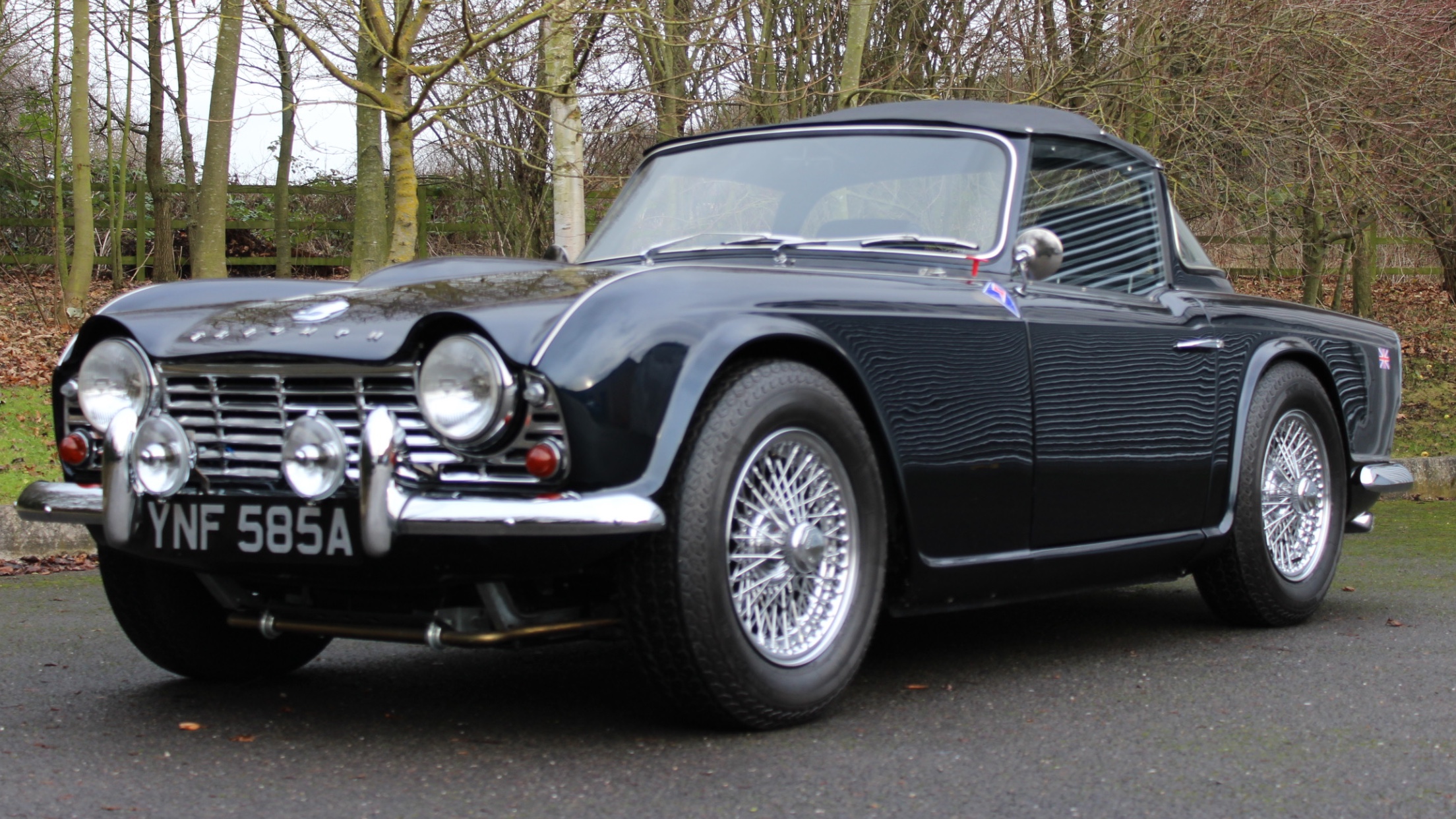
It’s loud. It’s shaky. If you drive it through a puddle, your left foot might get a little damp. Yet, there is something about the Triumph TR4 that makes modern, insulated sports cars feel like sensory deprivation chambers.
Most people look at a 1960s British roadster and see a delicate weekend toy. They’re wrong. The TR4 wasn't delicate; it was basically a tractor in a tuxedo.
The Italian Connection Nobody Expected
By 1961, the Triumph TR3 was looking old. Really old. It had those "cut-down" doors that made you feel like you were falling out of the car in a sharp turn. Standard-Triumph knew they needed a change, but they didn't have the cash to reinvent the wheel.
They called Giovanni Michelotti.
Michelotti was a wizard. He took the rugged, somewhat agricultural chassis of the TR3 and draped it in a sharp, modern Italian suit. He added wind-up windows—a massive luxury at the time—and a wider track. The result was a car that looked fast standing still but still had the heart of a British workhorse.
The "power bulge" on the bonnet isn't just for show, by the way. It’s actually there because the engine sat so high that the carburetors wouldn't clear the hood without it. It’s an asymmetric quirk that makes every TR4 recognizable from a block away.
That "Tractor" Engine
You’ll hear purists joke that the TR4 has a tractor engine. They aren’t lying. The 2,138cc inline-four was a descendant of the wet-liner engine used in the Ferguson TE20 tractor.
It’s a "wet-sleeve" design. Basically, the cylinder liners are replaceable. This is a dream for restorers because you can essentially rebuild the engine's core without needing a machine shop to bore out the block.
It produces about 100-105 horsepower. That doesn't sound like much today when a Honda Civic has 150, but in a car that weighs barely 2,100 lbs (around 966 kg), it’s plenty. It’s all about the torque. It pulls hard from low RPMs with a guttural, throaty rasp that no modern turbo-four can replicate.
TR4 vs. TR4A: The Great IRS Debate
In 1965, Triumph updated the car to the TR4A. Visually, they look almost identical, save for some extra chrome and a different grille. But underneath? Massive drama.
The TR4A introduced Independent Rear Suspension (IRS).
Triumph thought this would make the car ride like a dream. In reality, it made the chassis more complex and, some argue, a bit "squishier" in the corners. Interestingly, the American market was so skeptical of IRS that Triumph actually kept making a live-axle version of the TR4A specifically for the U.S.
If you’re hunting for one today, the IRS models usually command a premium, but don't sleep on a solid live-axle TR4. They’re simpler to maintain and feel more "connected" to the road.
What Most People Get Wrong About Reliability
"Lucas, Prince of Darkness."
We've all heard the jokes about British electronics. And yeah, a 60-year-old wiring harness is going to have some moods. But the TR4 is actually remarkably robust.
Because it was built on a separate ladder chassis rather than a unibody, it’s tough. You can fix most things with a basic wrench set and a hammer. The biggest enemy isn't the alternator; it’s the rust.
Watch out for these specific rot spots:
- The Sills: These are structural. If they’re soft, the car’s spine is weak.
- The "Hogging" Effect: Stand back and look at the door gaps. If they’re wider at the top than the bottom, the frame is likely sagging from corrosion.
- The Windscreen Frame: These are notorious for rotting at the base, and finding a replacement frame is like hunting for a unicorn.
Honestly, if you find a TR4 with a straight, rust-free frame, you’ve won 90% of the battle. The mechanical stuff is easy.
The Surrey Top: The Original Targa
Five years before Porsche "invented" the Targa top with the 911, Triumph was already doing it.
The TR4 offered an optional "Surrey Top." It featured a fixed rear glass window and a removable center section (either a hard metal panel or a soft vinyl one). It’s arguably the coolest feature of the car. It gives you the open-air feel without the buffeting wind that usually ruins your hair in a full convertible.
Finding an original Surrey Top car is getting harder. Many owners are retrofitting them now because they just look so much better than the standard folding roof.
Practical Insights for the Aspiring Owner
If you’re thinking about putting a Triumph TR4 in your garage in 2026, here is the reality of the market. Prices have stabilized but they aren't "cheap" anymore.
A decent, drivable TR4 will run you between $22,000 and $30,000. If you want a concours-level restoration or a rare Surrey Top model, expect to push toward $45,000+.
But here’s the thing: they don't lose value. They are "blue chip" entry-level classics.
Actionable Next Steps
- Check the Thrust Washers: This is the TR4’s Achilles' heel. If the crankshaft thrust washers wear out, the engine can basically eat itself. Have a mechanic check the crankshaft "end-float" before you buy.
- Join the VTR: The Vintage Triumph Register is an incredible resource. These cars have a massive community. If you get stuck on a repair, someone on a forum has already solved it three times.
- Drive one first: It’s a physical experience. The steering is heavy at low speeds. The brakes (discs at the front, which was high-tech for 1961!) require a firm leg. It’s not a Miata. It’s a machine that requires you to be an active participant.
The Triumph TR4 isn't for everyone. It’s for the person who wants to feel the heat of the engine, smell the unburnt fuel, and actually drive a car rather than just operating a computer. It’s a piece of history that you can still use to go get groceries.
Just make sure it’s not raining.
Next Step for You:
Check the frame rails and outriggers of any potential purchase with a high-strength magnet. If the magnet doesn't stick, you're looking at body filler, which usually means there is a "rusty worm" hiding underneath that needs your attention.