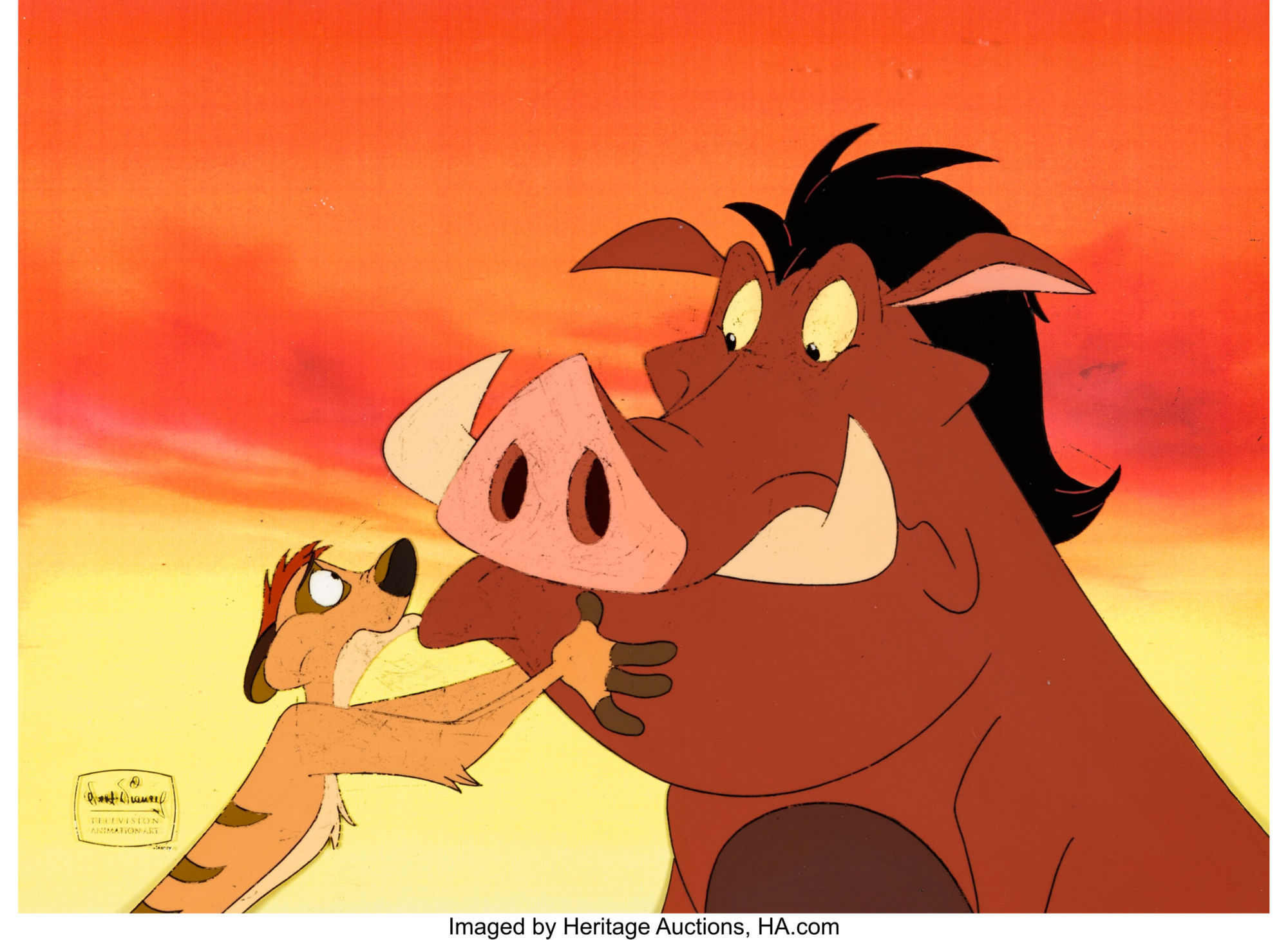
When people talk about The Lion King, they usually start with the Shakespearean tragedy of it all. You’ve got the regicide, the heavy "Circle of Life" philosophy, and that traumatic stampede scene that basically raised a generation of kids to expect sudden heartbreak. But honestly? The movie would be a total slog without the comic relief. Specifically, Timon and Pumbaa aren’t just the "funny sidekicks" tucked into the second act to sell plush toys. They are the emotional pivot point of the entire franchise.
Think about it. Simba is a wreck. He’s wandering the desert, literally waiting to die from heatstroke and guilt, and then these two weirdos show up. One’s a meerkat with a Napoleon complex; the other’s a warthog who’s been socially ostracized because of a scent issue. It’s a strange pairing. Yet, they managed to define an entire lifestyle—Hakuna Matata—that became more famous than the movie’s actual plot.
The Weird Origin of Timon and Pumbaa
Believe it or not, these two weren't always the stars of the show. In the early development phases of the 1994 film, the characters were barely there. Nathan Lane and Ernie Sabella actually went in to audition for the roles of the hyenas. Imagine that. They were so funny together that the directors, Rob Minkoff and Roger Allers, realized they had something way better on their hands. They moved them into the roles of the meerkat and warthog, and the rest is history.
Nathan Lane’s frantic, fast-talking energy perfectly balanced Sabella’s warm, slightly dim-witted delivery. It’s a classic vaudeville dynamic. You see bits of Laurel and Hardy or Abbott and Costello in how they interact. They argue. They bicker. They've got this weird, codependent domesticity that feels more "real" than the regal, stiff dialogue happening back at Pride Rock.
The names themselves have actual roots, too. "Pumbaa" comes from the Swahili word for "silly," "foolish," or "careless." It’s incredibly literal. "Timon" is a bit more of a deep cut, likely referencing the Shakespearean play Timon of Athens, which is about a man who turns his back on society—exactly what Timon does.
Hakuna Matata: Philosophy or Coping Mechanism?
Everyone knows the song. It’s catchy. It’s upbeat. But if you look at the lyrics, it’s kinda dark. Timon and Pumbaa aren’t just teaching Simba how to relax; they’re teaching him how to ignore his problems. It’s "no worries" to the point of total apathy.
For Simba, this was a survival strategy. He was a child soldier of his own guilt. If he hadn't met them, he’d have been vulture food within twenty-four hours. Instead, they fed him bugs and told him the past doesn't matter. It’s interesting because they are essentially the antithesis of Mufasa. Mufasa is all about responsibility, the stars, and the "Kings of the Past." Timon, on the other hand, famously tells Simba that the stars are just "fireflies that got stuck in that big bluish-black thing."
He's wrong, obviously. But his cynicism provides the necessary levity that keeps the movie from feeling like a funeral.
The "Lion King 1 1/2" Perspective
If you really want to understand the depth of these characters, you have to look at The Lion King 1 1/2 (or The Lion King 3: Hakuna Matata depending on where you live). It’s basically Rosencrantz and Guildenstern Are Dead but with meerkats. It shows Timon’s backstory—his struggle with his colony, his inability to fit in, and his meeting with Rafiki.
It reveals that Timon was a social outcast. He wasn't just a lazy guy; he was someone who broke everything he touched and was forced into exile. Pumbaa was in the same boat. Their bond is built on mutual rejection. When they find Simba, they aren't just adopting a pet; they’re forming a "found family" of losers who have nowhere else to go.
That’s why their eventual decision to help Simba fight Scar is so impactful. They hate Pride Rock. They hate responsibility. They're terrified of hyenas. But they go anyway. When Timon does the hula dance as a distraction, he’s literally risking being eaten alive for a friend. That’s not just comic relief; that’s character growth.
Breaking Down the Ecosystem (Literally)
Let's get nerdy for a second. In real life, a meerkat and a warthog hanging out is... well, it’s not entirely impossible, but it wouldn't look like this. Warthogs and meerkats actually have a symbiotic relationship in the wild. Meerkats (and mongooses) are known to groom warthogs, eating the ticks and parasites off their skin. The warthog gets a cleaning, and the meerkat gets a high-protein snack.
Disney leaned into this by making them "bug eaters." It’s a clever way to keep the "predator" aspect of Simba at bay. If Simba had to kill a gazelle every morning, the friendship wouldn't work. By shifting the diet to grubs and "slimy yet satisfying" insects, the writers created a neutral ground where a lion could coexist with a warthog without it becoming a nature documentary.
Why People Still Care in 2026
It’s been decades since the original movie came out. We’ve had the 2019 "photorealistic" remake (where Seth Rogen and Billy Eichner took over the roles), various TV spinoffs, and endless merchandise. So why do Timon and Pumbaa still resonate?
It’s the authenticity of their friendship. They aren't perfect. Timon is often selfish and takes credit for Pumbaa’s ideas. Pumbaa is sensitive and sometimes too naive for his own good. They argue about whether the stars are gas or bugs. But at the end of the day, they are the only characters in the franchise who don't want anything from Simba. They don't want him to be King. They don't want him to fulfill a prophecy. They just want him to be their buddy.
In a world full of high-stakes drama and "destiny," having two friends who just want to eat bugs and nap is incredibly relatable.
Key Takeaways for Lion King Fans
If you're looking to dive deeper into the lore of these two, here is how you should approach it. Don't just watch the first movie and stop.
- Watch Lion King 1 1/2: This is the definitive "character study" for Timon. It explains his anxiety and why he’s so protective of his lifestyle.
- Listen to the 2019 Soundtrack: Even if you prefer the original animation, Billy Eichner’s delivery of "The Lion Sleeps Tonight" and the updated "Hakuna Matata" brings a modern, cynical wit to the characters that feels very fresh.
- Look for the Broadway version: The stage play handles Timon through puppetry that is genuinely groundbreaking. It emphasizes the "outsider" nature of the duo in a way film sometimes misses.
- Study the Swahili: Understanding that their names and catchphrases aren't just gibberish adds a layer of respect to the cultural backdrop of the film.
The legacy of Timon and Pumbaa isn't just about the laughs. It's about the idea that even when the world turns its back on you, you can find a corner of the jungle, a couple of weird friends, and a way to survive. They represent the "found family" trope long before it was a common buzzword in cinema.
Next time you watch the film, pay attention to the moment Simba returns to the Pride Lands. Timon and Pumbaa follow him into a literal wasteland. There’s no food there for them. There are no bugs. There’s only fire and death. They leave their paradise because their friend needs them. That’s the real "Hakuna Matata"—not having no worries, but having friends who make the worries bearable.
To get the most out of your next rewatch, try to spot the subtle ways Pumbaa is actually the "smart" one of the duo. He’s the one who correctly identifies the stars as balls of gas burning billions of miles away, while Timon dismisses him. It changes the whole dynamic when you realize the warthog is a secret genius.