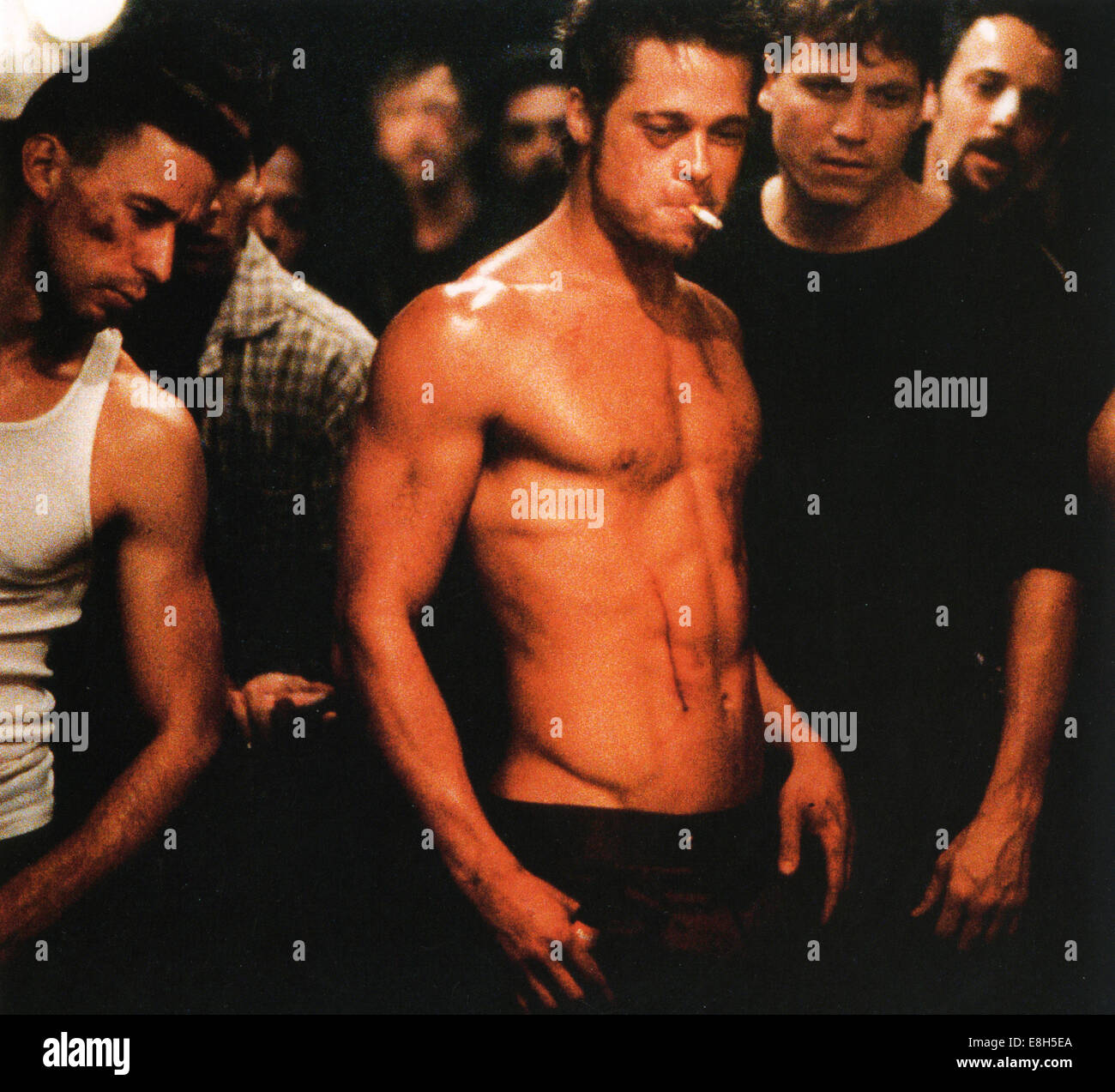
Let’s be real for a second. If you walked into any gym in the early 2000s and asked a guy what his "dream physique" was, he wouldn't point to a massive bodybuilder. He’d point to a grainy poster of Tyler Durden. Even now, decades after the movie dropped, Brad Pitt Fight Club abs remain the gold standard for what people call "the lean look." It wasn’t about being huge. It was about being shredded to the point of looking like a Greek statue carved out of granite.
He looked dangerous.
But there is a massive amount of misinformation floating around the internet about how he actually achieved that look. Some people claim he lived on nothing but cigarettes and coffee. Others sell "secret" workout programs that promise those exact results in six weeks. Honestly? Both are mostly wrong. Achieving that specific level of vascularity and muscle definition required a brutal, boring, and highly disciplined approach to both training and nutrition that most people would find incredibly difficult to maintain.
The Physics of the Durden Look
To understand how he did it, you have to look at the numbers. Brad Pitt was reportedly around 155 to 160 pounds during filming. Stand him next to a modern superhero actor and he’d look tiny. But on camera? He looked like a giant. This is because of his body fat percentage. Experts and fitness historians generally agree that Pitt was sitting at roughly 5% to 6% body fat during the peak of production.
That is incredibly low.
For context, most "fit" guys you see at the beach are probably around 12% or 15%. Getting down to 6% means your skin becomes paper-thin. Every muscle fiber is visible. Every vein is on display. It’s why those Brad Pitt Fight Club abs looked so deep—there was literally no padding between the muscle and the surface of the skin. He didn't just have a six-pack; he had the serratus anterior and the obliques popping in a way that defined his entire torso.
The Actual Workout Split
Pitt’s trainer at the time, Joe Goossen, and the production team utilized a very specific bodybuilding-style split. They weren't trying to build massive power. They were trying to fatigue specific muscle groups to the point of failure to create hypertrophy without adding "bulk."
The routine followed a one-muscle-group-per-day philosophy. On Monday, it was chest. Tuesday was all about the back. Wednesday? Shoulders. Thursday was arms (biceps and triceps). Friday and Saturday were dedicated to cardio, and Sunday was the only real day off.
Think about that. He was hitting high repetitions—usually in the 15 to 25 range per set. This wasn't about benching 400 pounds. It was about the pump and the burn.
- Chest Day: He’d do basic stuff. Push-ups, incline bench, chest press, and cable flyes.
- Back Day: Pull-ups until failure, seated rows, and lat pulldowns.
- Shoulders: Arnold presses, lateral raises, and front raises.
He didn't skip legs entirely, but because the role required a "top-heavy," wiry brawler look, the focus was overwhelmingly on the upper body. It’s a classic Hollywood trick. Focus on the "show muscles" and then lean out until the muscles you do have look twice as large as they actually are.
The Cardio Component (Where the Magic Happened)
You can do a million crunches and never see your stomach if there’s a layer of fat over it. Pitt knew this. Toward the end of his prep, he ramped up the steady-state cardio. We’re talking an hour on the treadmill at a high incline or consistent sessions on the elliptical.
The goal wasn't to become a marathon runner. It was purely about burning enough calories to stay in a deficit while preserving the muscle he’d spent the week building. This is the part most people fail at. They do the lifting but skip the boring 45 minutes of walking at the end. Pitt didn’t.
Why Diet Was 90% of the Battle
If you want to know the "secret" to those Brad Pitt Fight Club abs, look at his plate. It wasn't exciting. In fact, it sounds miserable to most people who enjoy food.
He followed a very strict "clean eating" protocol. Low carbs, high protein, and almost zero sugar or alcohol. His meals were basically variations of chicken, broccoli, brown rice, and tilapia.
- Breakfast: Eggs (usually just the whites) and oatmeal.
- Snack: Tinned tuna or a protein shake.
- Lunch: Two chicken breasts and brown rice.
- Dinner: Grilled fish or chicken with green vegetables.
The total calorie count was surprisingly low—some reports suggest he was eating fewer than 2,000 calories a day while training like an athlete. That’s how you get to 5% body fat. You essentially starve the fat off your body while giving the muscles just enough protein to keep from wasting away. It’s a precarious balance. If he had eaten any less, he would have looked sickly. Any more, and the "shredded" look would have vanished.
The Myth of the "Ab Workout"
Here is a truth that might hurt: Brad Pitt didn't get those abs by doing thousands of sit-ups.
Sure, he did core work. He did leg raises and planks. But the reason his abs are legendary isn't because the muscles were huge; it's because his body fat was non-existent. You already have abs. Everyone does. They are the muscles that keep your guts from falling out. They are just hidden.
Pitt’s "ab workout" was actually his diet and his cardio. When people search for his routine, they usually want a specific exercise that will give them that "V-taper." The V-taper is actually a combination of wide lats, a thin waist, and low body fat. There is no single "magic" crunch that creates that.
Is This Look Sustainable?
Honestly? No.
Even Brad Pitt didn't stay that lean for long. If you look at him in Snatch, which came out shortly after, he’s still in great shape, but he’s carrying a bit more "functional" weight. Staying at 5% body fat is hard on the brain. You feel tired. Your hormones can take a hit. Your strength usually plateaus or drops.
For a movie star getting paid millions to look a certain way for a three-month filming window, it’s a job. For a regular person with a 9-to-5, it’s a grueling lifestyle that usually leads to burnout. Most fitness experts suggest that a more "walk-around" sustainable lean look is closer to 10% or 12% body fat. You still look fit, you still have definition, but you can actually eat a slice of pizza without ruining your week.
Lessons from the Fight Club Physique
What can we actually learn from this?
First, the importance of the "pump." Pitt’s muscles looked full on camera because they filmed right after he worked out. In the industry, they call it "fluffing." Before a shirtless scene, an actor will do a bunch of push-ups and curls to drive blood into the muscles.
Second, lighting is everything. The cinematography in Fight Club used high-contrast, "gritty" lighting. This creates deep shadows. When you have deep shadows, every small ripple in the muscle looks like a canyon. If you saw him in a brightly lit grocery store at the time, he probably just looked like a very skinny guy in a t-shirt.
How to Actually Get Close to the Look
If you’re serious about chasing that aesthetic, you have to prioritize fat loss over muscle gain. That’s the hard truth. You need to lift weights 4-5 times a week using high reps to maintain muscle density, but the "heavy lifting" happens in the kitchen.
- Calculate your TDEE: Find out how many calories you burn.
- Eat in a deficit: Subtract 300 to 500 calories from that number.
- Protein is king: Aim for about 1 gram of protein per pound of body weight.
- Consistency over intensity: Walking 10,000 steps a day is more effective for long-term fat loss than one crazy HIIT session that leaves you exhausted for three days.
It’s also worth noting that genetics play a role. Everyone’s abdominal muscles are shaped differently. Some people have a symmetrical six-pack, while others have a four-pack or staggered "ab tiles." Pitt happens to have very symmetrical abdominal insertions, which is just luck of the draw.
The Psychological Cost
We don't talk enough about the mental side of getting "Durden lean." When your body fat gets that low, your irritability goes up. You're hungry. You're thinking about food constantly. In Fight Club, Tyler Durden is a nihilistic, high-energy projection of the narrator’s subconscious. In reality, someone with 5% body fat would likely want to take a nap, not start an underground revolution.
It's a look designed for the screen. It's an iconic piece of pop culture history that changed how men looked at fitness. Before this, the goal was to be Arnold. After this, the goal was to be Brad.
Actionable Steps for Your Own Transformation
Don't try to replicate his 1999 routine exactly; you'll probably just end up overtrained. Instead, focus on the principles. Start by cleaning up the diet—cutting out liquid calories is the easiest first step. Move into a resistance training program that hits every muscle group at least twice a week.
Monitor your progress not just by the scale, but by how you look in the mirror and how your clothes fit. The scale doesn't account for muscle density or water retention. Most importantly, give it time. Pitt didn't get in that shape in a month; he had been training for years and then spent months specifically "cutting" for the role.
Achieving a high level of definition is a marathon of discipline. If you want those lines to show, you have to be willing to do the boring work when nobody is watching. Turn off the TV, prep your meals, and get to the gym. Consistency is the only "supplement" that actually works.