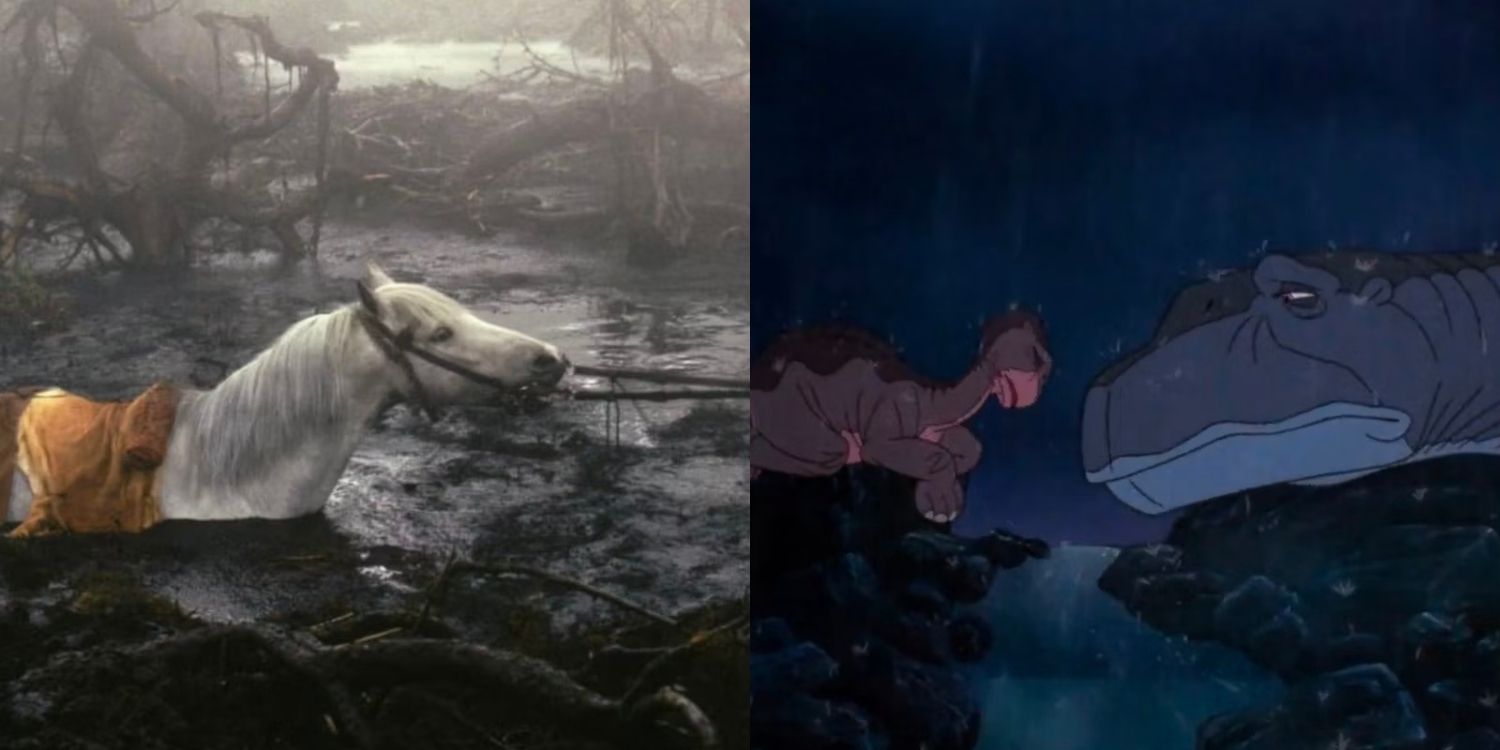
If you grew up in the eighties or nineties, you probably have a specific kind of emotional scar. It’s shaped like a white horse and a patch of dark, bubbling mud. For many of us, the Artax scene in The NeverEnding Story wasn’t just a sad movie moment; it was a foundational trauma. It was the first time we realized that being "good" or "pure" wasn't enough to save you from sadness.
Honesty is important here. Most people remember the horse sinking, but they forget the actual mechanics of why it happened. It wasn’t a physical trap. It was a psychological one. That distinction is exactly why the scene remains so devastating decades later.
What Really Happened to Artax in the Swamps of Sadness
The Swamps of Sadness function as a metaphor for clinical depression, though the film doesn't use that medical term. In the world of Fantastica (or Fantasia, depending on which version you’re watching), the swamp consumes those who let sadness overtake them. You don't drown because the mud is deep; you drown because you stop caring about staying afloat.
Artax, Atreyu’s loyal stallion, succumbed to the "Heavy-and-Hollows."
It’s a brutal concept. Atreyu, being a hero protected by the AURYN, is magically shielded from the emotional weight of the swamp. Artax is just a horse. He’s a magical horse, sure, but he lacks the divine protection of the Childlike Empress.
When you watch the scene today, the pacing is what stands out. Modern movies are fast. They cut away. Director Wolfgang Petersen did the opposite. He let the camera linger on Noah Hathaway (Atreyu) screaming and pulling at the reins. It’s a long, agonizing sequence. There’s no sudden jump scare or monster. It’s just a slow, inevitable descent into the muck.
The Urban Legend of the Real Horse
We have to address the elephant in the room—or rather, the horse in the mud. For years, a dark rumor circulated that the real horse used for Artax actually died during the filming of the swamp scene.
This is completely false.
People love a tragedy, and the scene was so convincing that audiences assumed the worst. In reality, the production used a sophisticated hydraulic platform to lower the horse into the water. The horse, a gray stallion named Nashua, was meticulously trained for weeks to stand still while being lowered.
According to various interviews with the crew and Noah Hathaway himself, the "mud" was actually a mixture of water and peat. It was safe, though I imagine it was incredibly cold. After filming wrapped, the production actually gifted the horse to Hathaway. He lived out his days on a ranch, far away from any cinematic swamps. The fact that we still believe the horse died is a testament to the practical effects and the raw, unpolished acting of a young Hathaway.
Why the Book Version is Actually Darker
Michael Ende, the author of the original 1979 novel, famously hated the movie. He called it a "humongous melodrama of kitsch, commerce, plush, and plastic."
If you think the movie was hard to watch, the book is a different beast entirely. In the film, Artax is a silent animal. In the novel, Artax can talk.
Imagine being a child reading that. Not only is the horse sinking, but he is actively explaining to Atreyu how the sadness is taking over his mind. He tells Atreyu to leave him behind. He says his heart has become too heavy to move. The dialogue makes the betrayal of the swamp feel much more personal. In the movie, it’s a tragedy of nature; in the book, it’s a tragedy of the soul.
Ende’s writing focused on the concept of "The Nothing" as a loss of imagination and belief. Artax sinking wasn't just a plot point to make Atreyu sad. it was a demonstration of what happens when "The Nothing" starts to win. It starts with the loss of hope. Once the hope is gone, the physical body follows.
The Practical Effects That Fooled a Generation
How did they do it without CGI? This was 1984. Everything was physical.
The Swamps of Sadness were built on a massive soundstage at Bavaria Studios in Germany. They used huge tanks filled with dyed water and silt. To get the horse to sink, they used a "sink elevator" hidden beneath the surface.
- The horse had to be trained to stay calm while its legs were submerged.
- The scene took two months to film. Two months.
- Multiple horses were used for different shots, but Nashua did the heavy lifting for the "sinking" sequences.
The lighting played a huge role too. By using muted greens, grays, and browns, the cinematographers created a sense of claustrophobia even in an open space. You feel like the air is thick. You feel like the characters are breathing in the very despair that's killing the horse.
Honestly, if they remade this today with Marvel-style CGI, it wouldn't work. We can tell when pixels are "sad." We can't always tell when a real animal is acting versus just being a real animal in a weird situation. That ambiguity is where the horror lives.
The Psychological Impact on Gen X and Millennials
Psychologists have actually looked at scenes like Artax’s death to understand how children process grief through media. Unlike Disney deaths—which are often sudden (Bambi’s mother) or heroic (Mufasa)—Artax’s death is quiet. It is a surrender.
For a child, the idea that you can just "give up" and disappear is terrifying. It introduces the concept of nihilism before kids even know what the word means.
Atreyu’s reaction is also a masterclass in realistic grief. He goes through all the stages in about three minutes. He starts with encouragement ("Come on, Artax!"), moves to anger ("You're letting the sadness of the swamps get to you!"), then to desperate pleading, and finally to a hollow, shell-shocked silence.
Does the Scene Hold Up?
Yes. It holds up because it’s a universal fear.
We’ve all felt that "heavy" feeling. Maybe not in a literal swamp, but in life. The scene resonates because it’s the ultimate "unfair" moment. Artax didn't do anything wrong. He was a good horse. He was a loyal friend. But the swamp doesn't care about your resume or your moral standing.
That’s a tough lesson for an eight-year-old. It’s also a tough lesson for a forty-year-old.
What Most People Miss About the "Rescue"
Wait, did Artax actually come back?
If you haven't seen the movie in twenty years, your brain might have blocked out the ending. After Bastian saves Fantastica by giving the Childlike Empress a new name (Moonchild), the world is restored.
We see Atreyu riding through a lush, green forest. He whistles, and Artax comes galloping toward him, vibrant and healthy.
Technically, it’s a happy ending. But for many viewers, it doesn't "fix" the trauma. The image of the horse sinking is so much more powerful than the image of the horse returning. It’s a phenomenon in psychology called the "peak-end rule," where we judge an experience largely on how we felt at its most intense point. The "peak" of Artax’s story is the swamp. The "end" is a quick montage. The swamp wins the memory battle every time.
How to Revisit The NeverEnding Story Today
If you’re planning on showing this to your kids, be prepared for the questions. It’s not a movie you can just put on in the background while you fold laundry.
- Watch the 4K restoration. The colors in the swamp are even more oppressive, and you can see the detail in the animatronics (like Morla the Ancient One) much better.
- Read the book first. It provides the context that makes the movie’s logic make more sense. You’ll understand why the swamp exists and why Artax couldn't just "be stronger."
- Talk about the horse. Tell them the horse was fine. Tell them he got a carrot and a ranch. It helps.
The NeverEnding Story is a film about the power of stories, but Artax is a reminder that stories have consequences. They can hurt. They can stay with us for a lifetime.
If you're feeling nostalgic, or perhaps just want to face that old fear, go back and watch the sequence again. Look at the way the light hits the water. Listen to the desperation in Atreyu’s voice. It’s a perfect piece of filmmaking that dared to be honest with children about the nature of sadness.
To really appreciate the depth of the film, look into the production history of Bavaria Studios. Seeing the physical sets and the scale of the puppets (like Falkor, who was 43 feet long) gives you a new appreciation for the era of practical effects. You can even visit the studio in Munich and see the original props. Standing next to the actual characters makes the "magic" feel a lot more grounded in reality.
Next time you find yourself stuck in a metaphorical swamp, just remember: don't let the sadness take you. Keep moving, even if you don't have an AURYN to protect you.