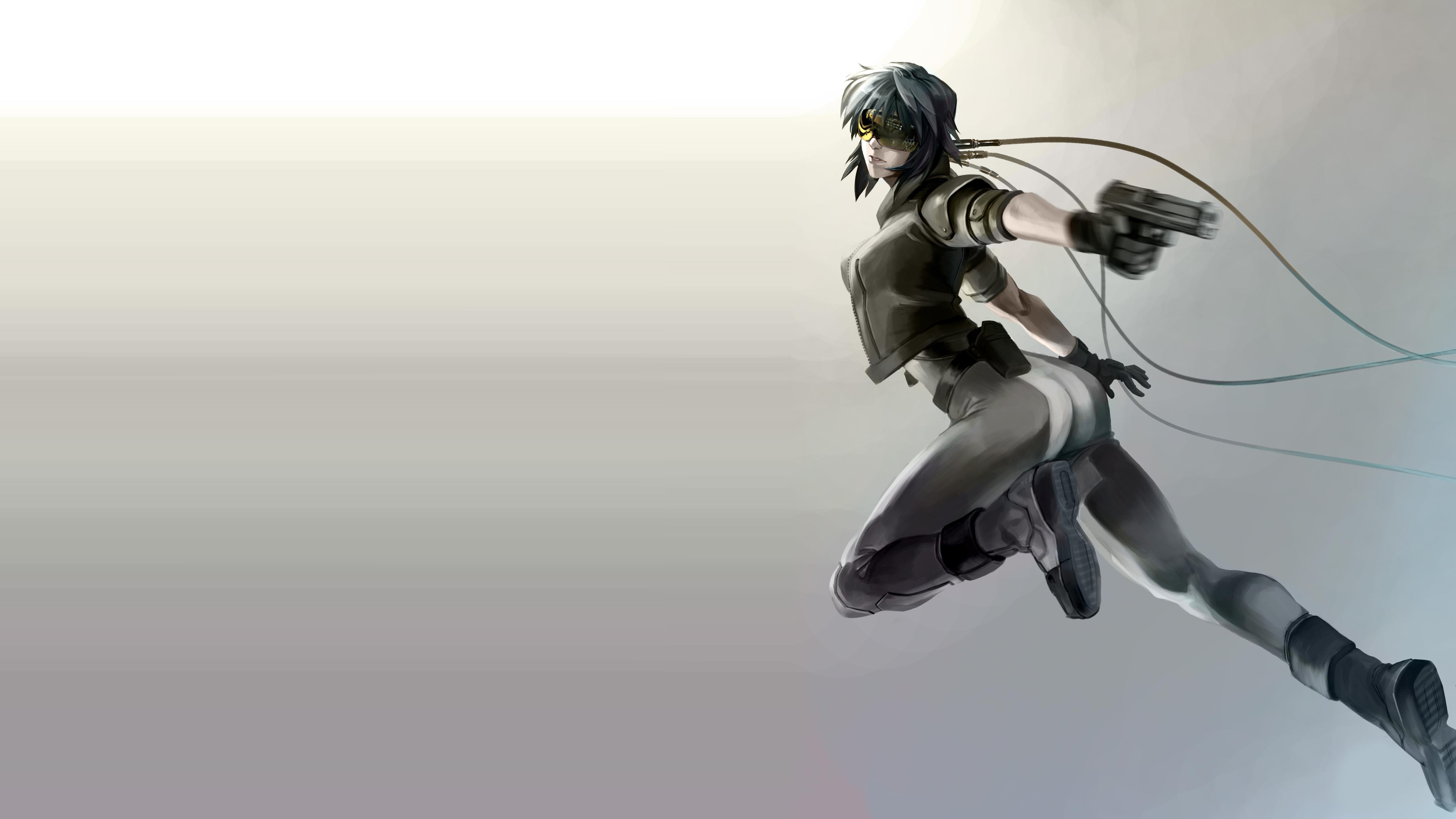
She isn't really a "she." Not in the way we usually think about it. If you’ve spent any time watching Major Motoko Kusanagi in Ghost in the Shell, you know she’s less of a person and more of a philosophical crisis wrapped in a high-performance cyborg chassis.
Most protagonists have a "soul" or a "heart." Motoko just has a ghost.
Honestly, it’s wild how relevant this character remains. We’re currently living through the exact technological anxiety that Masamune Shirow hallucinated back in 1989. We have Neuralink trials. We have LLMs that mimic consciousness. Yet, the Major remains the gold standard for what it actually feels like to lose your humanity to the machine—or perhaps, to find something better on the other side.
The Identity Crisis of a Full-Body Cyborg
Most people get the Major wrong. They see the purple hair and the tactical gear and think "sci-fi action hero." But that's just the surface.
The core of Ghost in the Shell is the existential dread of being "manufactured." Motoko Kusanagi is a full-body prosthetic user. Aside from her brain and a segment of her spinal cord, everything about her—her strength, her appearance, her very sensations—is property of Section 9. She’s government hardware.
Think about that for a second. Imagine if your body was literally leased to you by your employer.
Because her physical form is interchangeable, the Major constantly grapples with whether her thoughts are actually hers or just a byproduct of her cybernetic brain’s programming. In the 1995 film directed by Mamoru Oshii, she famously stares at her own reflection and wonders if she ever actually existed as a human child. There’s a specific scene where she goes scuba diving—a dangerous hobby for a cyborg who could sink like a stone if her floatation fails—just to feel a "sense of hope, anxiety, and isolation."
It’s not just cool visuals. It’s a study in depersonalization.
Why the "Ghost" Matters More Than the Shell
The term "Ghost" in this universe is basically a stand-in for the soul, but it’s more technical than religious. It’s the spark of individuality that separates an AI from a human.
The Major is obsessed with this distinction. In the Stand Alone Complex series, we see her interact with the Tachikomas—spider-like tanks that start developing their own "Ghosts" through shared experience. This flips the script. If a tank can develop a soul through data and camaraderie, what does that say about a human who is slowly replacing their organic parts with silicon?
The Major isn’t just a cop. She’s a pioneer of a new species.
Variations of the Major: From Manga to Hollywood
If you’re confused about her personality, it’s probably because you’ve seen different versions of her. They aren't the same.
- The Manga Major: In Masamune Shirow’s original work, she’s surprisingly goofy. She makes faces, gets angry, and cracks jokes. She’s highly sexualized but also highly cynical.
- The 1995 Movie Major: This is the stoic, philosophical version most people know. She rarely blinks. She speaks in monologues about the vastness of the net. This version influenced The Matrix more than almost any other piece of media.
- Stand Alone Complex (SAC) Major: This is the "middle ground." She’s a brilliant commander, fiercely loyal to her team (Batou and Togusa), and a tactical genius. This version feels the most like a real person working a high-stakes job.
- The 2017 Live-Action Major: Scarlett Johansson’s portrayal focused heavily on the "stolen identity" trope. While controversial, it highlighted the "Shell" aspect—the body as a cage.
Critics like Susan J. Napier have pointed out that Kusanagi represents the "liminality" of the modern era. She exists on the threshold. She’s both male and female (having used male cyborg bodies in the manga), both human and machine, both an individual and a node in a massive network.
The Politics of Section 9
We can’t talk about Kusanagi in Ghost in the Shell without talking about her job. Public Security Section 9 is a "black ops" unit. They do the dirty work the Japanese government can’t admit to.
Motoko is a master of "Cyborg Maze" warfare. She doesn't just shoot people; she hacks their eyes. She makes herself invisible using thermoptic camouflage.
But here’s the kicker: she’s often fighting people who are just like her. Whether it’s the Puppet Master or the Laughing Man, her antagonists are usually "ghosts" who have transcended their physical limits. The Laughing Man arc in Stand Alone Complex is particularly haunting because it deals with "copycat" behavior in a digital age. It predicted meme culture before memes were a thing.
The Major has to navigate a world where a "Stand Alone Complex" occurs—where people independently mimic a behavior without a central leader, simply because they are all connected to the same stream of information.
The Evolution of the Major’s "Birth"
Depending on which timeline you follow, Motoko’s origin story shifts.
In most iterations, she was involved in a horrific accident as a child (often a plane or maglev crash). Her transition to a full-body cyborg was a life-saving necessity. This is crucial. She didn't choose to be a machine because she wanted to be a superhero; she became a machine to survive.
This creates a weird power dynamic. She is incredibly powerful, capable of ripping apart a tank with her bare hands (at the cost of her own limbs), but she is also a ward of the state. If she leaves Section 9, she has to give the body back.
It’s the ultimate "golden handcuffs" scenario.
Technical Mastery and Cyberbrain Warfare
When we talk about the Major’s abilities, we’re talking about "Cyberbrain" hacking. In this world, everyone’s brain is networked.
- Ghost-hacking: Taking over someone's memories or senses.
- External Memory: Using outboard servers to process thoughts.
- Synchronized Attack: Controlling multiple bodies or drones simultaneously.
The Major is an "S-Class" hacker. She can dive into a sea of data and find a single grain of truth. But every time she dives, she risks losing herself. The "Net" is infinite. Her physical body is a tether, and she’s constantly tempted to cut the cord.
Why She Still Matters in 2026
We are getting closer to the "Kusanagi Point" every day.
We aren't swapping limbs for titanium yet, but we are offloading our memories to the cloud. We are curating digital personas that have more "Ghost" than our physical selves. The Major’s struggle isn't a fantasy anymore; it’s a roadmap for the digital age.
When she eventually merges with the Puppet Master at the end of the original film, she doesn't die. She evolves. She becomes a "vast and infinite" entity existing within the wires. It’s a terrifying and beautiful concept: the idea that humanity isn't a biological state, but a pattern of information.
Actionable Insights for Fans and Creators
If you want to truly understand the depth of Ghost in the Shell and the character of Motoko Kusanagi, you should approach the franchise with a specific lens.
- Watch in "Thematic Order": Start with the 1995 movie for the vibe, then move to Stand Alone Complex for the world-building and character dynamics. Skip the "Arise" series until you’ve mastered the core lore, as it’s a bit of a departure.
- Look for the "Reflections": Pay attention to how many times the Major is shown through glass, water, or monitors. The directors use this to show her fragmented identity.
- Read the Essays: Look up the work of Toshiya Ueno or the "Cyborg Manifesto" by Donna Haraway. These texts explain the feminist and post-humanist theories that the Major embodies.
- Observe the Silence: Some of the most important moments for Kusanagi happen when she isn't talking. Her "staring into the abyss" isn't a trope; it's her literally communicating with the network.
The Major isn't a character you "finish" learning about. She’s a mirror. The more we integrate with our technology, the more we see ourselves in her chrome-plated reflection. She challenges the idea that being human requires a biological heart.
Maybe being human is just the courage to keep your "Ghost" intact while the rest of the world tries to rewrite your code.
To dive deeper into this world, focus on the "Solid State Society" film after you've finished the series. It tackles the aging population and the automation of society—issues that are no longer science fiction but current news headlines. Understanding the Major means understanding that the "Shell" is temporary, but the "Ghost" is whatever you have the strength to protect.