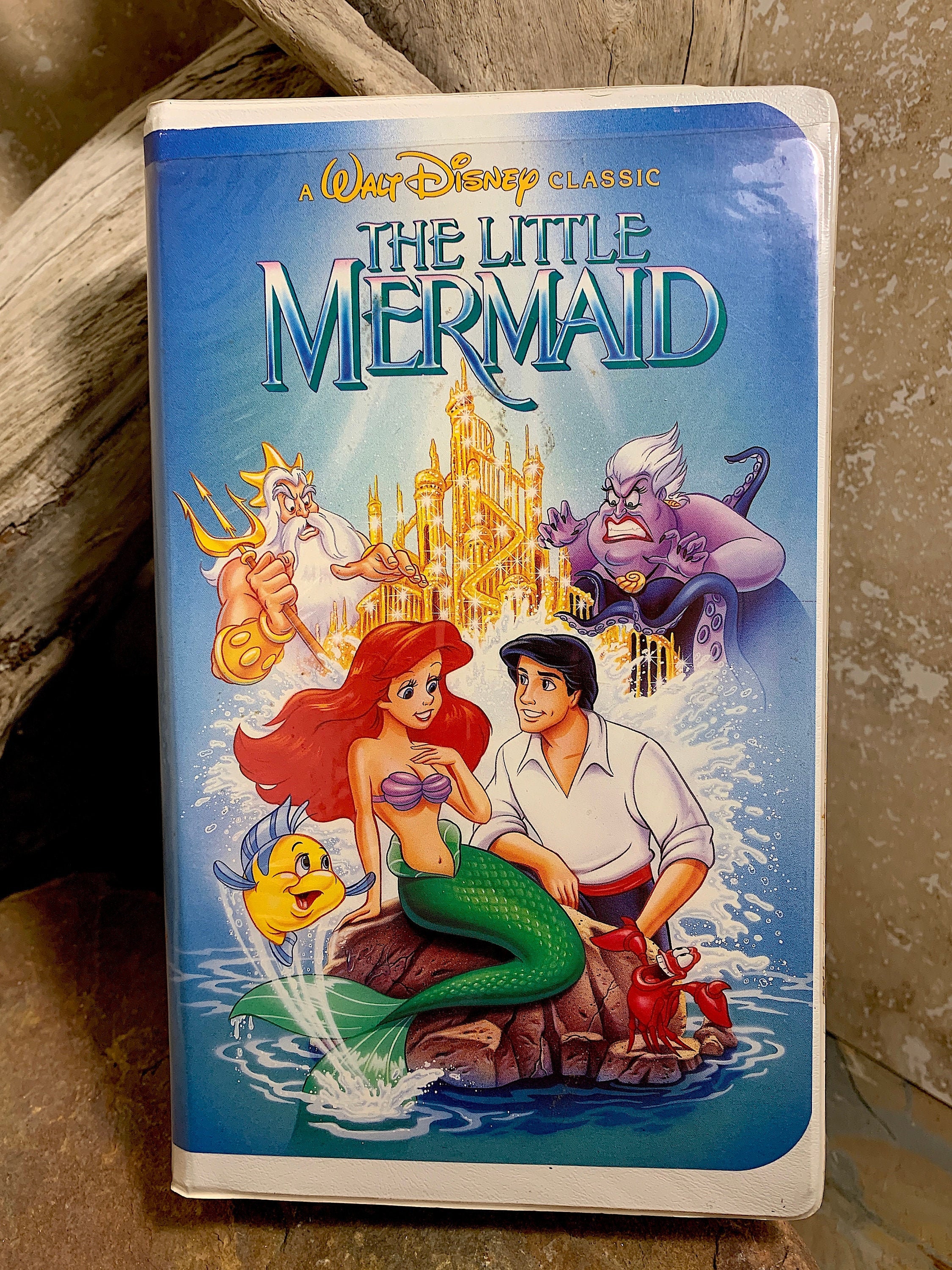
You probably remember the plastic smell of the clamshell case. If you grew up in the late eighties or early nineties, the original cover of Little Mermaid VHS was likely a permanent fixture in your living room, tucked between Cinderella and The Fox and the Hound. It was 1990. Disney was entering its Renaissance era. But while the film was winning Oscars, the box art was accidentally creating one of the most persistent urban legends in pop culture history.
It’s a weird story. Honestly, it’s a mix of genuine artistic oversight and the kind of collective "dirty mind" hysteria that only the pre-internet era could truly foster.
The image itself seemed innocent enough: Ariel and Eric sitting on a rock, King Triton looming in the background, and the golden spires of Atlantica rising behind them. But if you looked just a little too closely at the center spire of the castle, things got... awkward. People claimed a disgruntled Disney artist had hidden a phallic image right in the middle of the palace. It wasn't just a rumor; it became a full-blown cultural moment that forced Disney to change the art entirely.
The Anatomy of a Controversy
Let's get into the weeds of why this happened. The artist responsible wasn't some rogue employee trying to get fired. His name is Dan Haskett. He’s a legendary character designer who worked on The Simpsons, Toy Story, and yes, The Little Mermaid.
Haskett has spoken about this before. He wasn't even a Disney employee at the time; he was a freelancer. He was rushing. It was late at night. He was trying to draw glowing, ethereal underwater towers. When you’re staring at a drawing for eighteen hours straight, sometimes you stop seeing the "shapes" and just see the work. He didn't realize that one specific golden tower looked exactly like, well, a piece of male anatomy.
"I was just trying to make it look like a castle," he’s essentially said in various retrospectives.
It’s easy to look back now and think, "How did nobody catch this?" But you have to remember the workflow of 1989. There were no high-resolution digital scans being passed around on Slack. It was physical art, color-corrected for a low-resolution VHS format. On a small TV screen in 1990, it mostly just looked like a blurry golden castle. But when people started looking at the physical boxes in the bright light of a Blockbuster Video, the whispers started.
Snopes, Rumors, and the Satanic Panic Context
Context is everything here. The early nineties were a weird time for Disney. There was this bubbling undercurrent of "Satanic Panic" and moral guardianship. People were looking for reasons to be offended.
Rumors started flying that Disney was "corrupting the youth." If it wasn't the original cover of Little Mermaid VHS, it was the supposed "dust" cloud in The Lion King that spelled out a certain three-letter word (it actually spelled SFX, a nod to the special effects team). Or it was the priest in the wedding scene of The Little Mermaid having a "physical reaction" (it was actually just his knobby knees).
The VHS cover was the only one with actual merit, though. Unlike the priest’s knees, the castle spire was undeniably... shaped that way.
By the time the movie was slated for a second home video release, Disney quietly swapped the art. They moved the characters around and replaced the "scandalous" castle with a much more generic, less detailed version. If you have a copy of the "Banned" cover today, you’re basically holding a piece of marketing failure history.
Is Your Copy Actually Worth a Fortune?
Basically, no.
This is the biggest misconception about the original cover of Little Mermaid VHS. If you go on eBay right now, you will see listings for $5,000, $10,000, or even $25,000. People label them as "RARE BLACK DIAMOND EDITION" or "BANNED COVER."
It’s a total myth.
Disney sold nearly nine million copies of that VHS on its first release. Nine million. In the world of collectibles, something with nine million copies in circulation is about as rare as a blade of grass. Most of those high-priced eBay listings are either money laundering schemes or people who have no idea what they’re doing.
The "Black Diamond" logo—that little diamond on the spine of the case—just means it was part of the "Walt Disney Classics" collection released between 1984 and 1994. It doesn't mean it’s made of gold. Honestly, you can find the "banned" version at most thrift stores for about three bucks if you look hard enough.
The only way a VHS copy of The Little Mermaid is worth real money is if it’s factory sealed, graded by a professional company like VGA or IGS, and in absolutely pristine condition. Even then, you’re looking at maybe a few hundred dollars, not a down payment on a house.
Why We Still Care Decades Later
There is something deeply nostalgic about these "errors." It reminds us of a time when media felt more tactile and less sterile. Today, if a digital movie poster had a mistake, Disney would patch it on Disney+ within an hour. It would be scrubbed from the internet.
But in 1990, once those nine million tapes were out there, they were out there.
The original cover of Little Mermaid VHS represents a specific era of production. It’s a reminder that even massive corporations like Disney are run by tired humans who make mistakes. It’s also a testament to how urban legends can outlive the facts. Ask ten people about this cover, and five of them will still tell you the artist was fired or that it was a deliberate prank. Neither is true, but the myth is way more fun than the reality of a tired freelancer drawing a tower.
Spotting the Real Deal vs. The Redesign
If you’re digging through your attic, here is how you tell the difference.
The original, controversial artwork features a very specific layout. Ariel is on the left, Eric is on the right, and their hands are almost touching. Directly between them, in the background, is the castle. Look at the tallest, most central spire. If it has a rounded top and a very distinct "anatomical" look, that's the one.
The redesigned cover is much busier. They added more sea creatures, moved King Triton, and the castle in the background is far more stylized and "pointy." It looks like a fairytale castle should—lots of sharp triangles, no confusing curves.
Interestingly, the "banned" art actually stayed on some international releases for a little longer than it did in the States. Collectors sometimes hunt for the Japanese or European versions, but again, the value is mostly sentimental.
Moving Beyond the Myth
If you actually want to collect Disney memorabilia, don't focus on the "banned" VHS tapes. Instead, look for original production cels. Those are the actual hand-painted clear sheets used to make the movie. The Little Mermaid was one of the last Disney films to use traditional cel animation before they switched to the CAPS (Computer Animation Production System).
An original cel of Ariel will always be worth more than a piece of plastic with a drawing of a phallic castle.
The original cover of Little Mermaid VHS serves as a great "did you know?" fact at parties, but it’s mostly just a funny footnote in the history of animation. It’s a story about human error, the power of rumors, and the way we project our own thoughts onto art.
Actionable Steps for Collectors and Fans
If you have a copy of this VHS and you're wondering what to do with it, follow these steps:
- Check the Condition: If the plastic clamshell is cracked or the "Black Diamond" logo is faded, it’s just a nostalgia piece. Enjoy it for what it is.
- Ignore eBay "Asking" Prices: Never look at what people are asking for. Filter your search by "Sold Items" to see what people are actually paying. You’ll see the price drop from $10,000 to about $15 real quick.
- Verify the Spire: Take a magnifying glass to that center tower. It’s a fun piece of history to show friends. It’s a physical artifact of a time before digital perfection.
- Storage Matters: If you really want to keep it, store it in a cool, dry place. VHS tapes are magnetic media; they degrade over time. Heat and humidity will ruin the tape and the paper cover.
Ultimately, the original cover of Little Mermaid VHS isn't a winning lottery ticket. It’s better than that. It’s a weird, slightly embarrassing, and totally human moment from the "Happiest Place on Earth."