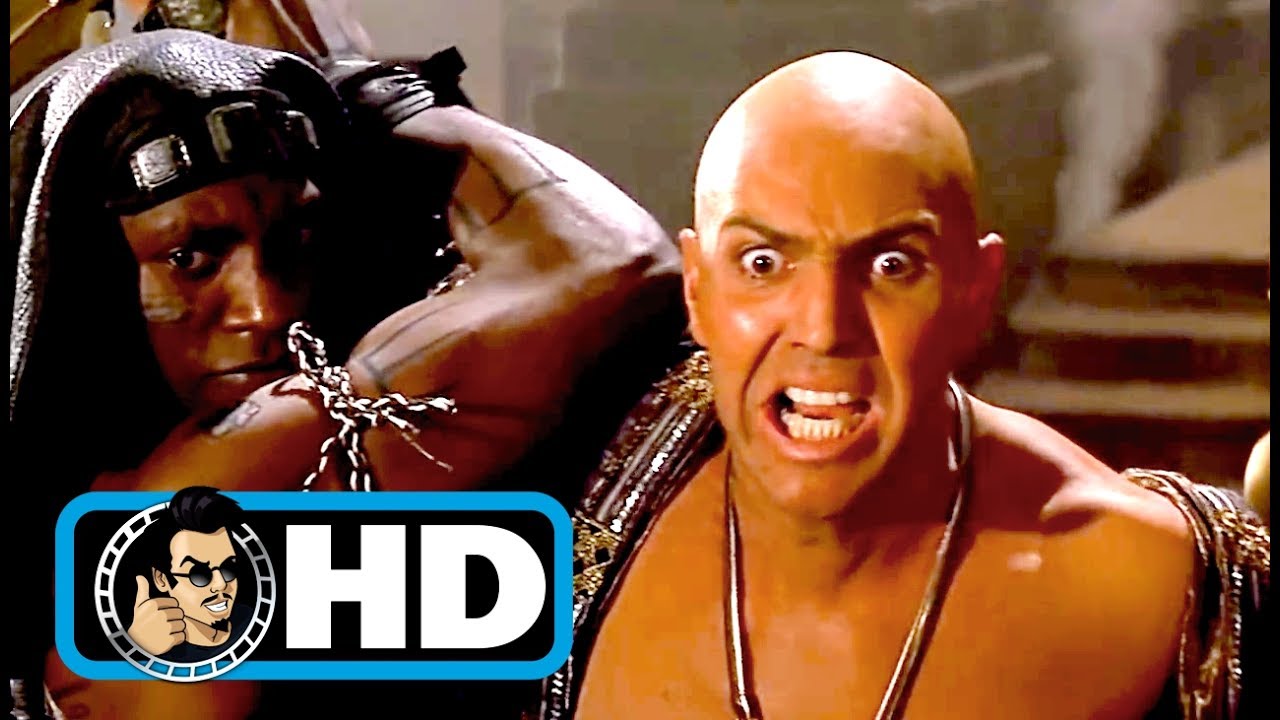
Honestly, if you grew up in the early 2000s, you probably have a very specific image of The Mummy Returns Anck Su Namun burned into your brain. Maybe it’s the gold body paint. Maybe it’s that incredibly sharp, dual-sai fight in the throne room. Or maybe, like the rest of us, it’s that moment at the end of the movie where she looks the most powerful man in the world in the eye and basically says, "Good luck with that," before running for her life.
It’s a brutal scene. For two movies, we were told that Imhotep and Anck-Su-Namun were the ultimate star-crossed lovers. He literally endured thousands of years of the Hom-Dai—a curse so nasty it involved being eaten alive by scarabs for eternity—just to see her face again. And yet, when the chips were down at the Oasis of Ahm Shere, she bailed.
The Reincarnation of a Villain
In the first film, Anck-Su-Namun was mostly a MacGuffin. She was a goal, a memory, and a partially reconstructed corpse. But in the 2001 sequel, Patricia Velásquez actually got to play a character with agency. Sorta.
We meet her first as Meela Nais, a mysterious woman who looks exactly like the Pharaoh’s long-lost mistress. It turns out she’s the physical reincarnation of the ancient Egyptian queen. But here's where the movie gets interesting with its logic. She isn't fully herself until they perform a ritual using the Book of the Dead to bring her soul back from the Underworld.
Once that "Ba" (the Egyptian concept of the soul) is shoved back into Meela’s body, the modern personality is gone. She stops speaking English. She starts acting like a high-born mistress of a Pharaoh. She becomes the ruthless, gold-clad woman who helped murder Seti I.
What the History Books Actually Say
Look, Stephen Sommers was a genius at making fun adventure movies, but he played fast and loose with the history. In the film, The Mummy Returns Anck Su Namun is portrayed as the mistress of Pharaoh Seti I.
In actual history? The name is a variation of Ankhesenamun. She wasn't a mistress; she was an Egyptian princess and eventually the Great Royal Wife of Tutankhamun. Also, the real Imhotep was a brilliant architect who lived about a thousand years before she was even born. The idea of them having an affair is like a movie today claiming that George Washington had a secret romance with a TikTok influencer. It’s wildly impossible, but for Hollywood, it makes for a great story.
The Fight We All Rewatched
You can't talk about this character without mentioning the fight scene against Nefertiri (Evelyn’s past life). This is arguably one of the best-choreographed female-led fights in 2000s cinema.
- The Weapons: They used Sais, which are actually Okinawan, not Egyptian.
- The Stakes: It wasn't just a duel; it was a performance for the Pharaoh.
- The Visuals: The use of gold body paint on Patricia Velásquez took about 14 hours to apply. Every. Single. Day.
The contrast between the two women is huge. Nefertiri is the dutiful daughter, while Anck-Su-Namun is the ambitious, lethal climber. This scene sets up the rivalry that fuels the second half of the movie, making it personal between Evie and the resurrected queen.
Why She Ran: The Psychology of a Betrayal
Most people call Anck-Su-Namun a coward for leaving Imhotep at the end. But if you look at her character, she was always a survivor first.
In the flashback in the first movie, she kills herself because she knows the Medjai are coming and she wants Imhotep to have a chance to resurrect her later. It was a tactical move. In the finale of the second movie, she sees Imhotep hanging over a pit of souls. She sees Rick O'Connell's wife, Evelyn, risk her life to pull Rick up.
Imhotep looks at Anck-Su-Namun with this hopeful, desperate expression. He’s basically saying, "Do for me what she did for him."
She looks at the pit. She looks at him. She hears the screams of the damned. And she realizes that if she tries to help, she’s probably going to fall in too. So she leaves.
The Aftermath
It’s a crushing moment for Imhotep. He realizes that while he was willing to burn the world for her, she wouldn't even risk a stubbed toe for him. That’s why he lets go. He doesn't fall because he's weak; he falls because he doesn't want to live in a world where his 3,000-year-old obsession was one-sided.
And, honestly? Karma comes for her about thirty seconds later. Running blindly through a collapsing pyramid isn't the best survival strategy, and she ends up falling into a pit of scorpions anyway.
Actionable Insights for Fans and Collectors
If you’re a fan of the character or the film’s aesthetics, there are a few things you can actually do to dive deeper into the lore:
- Check the "Visual Effects" Commentary: If you can find the old DVD or Blu-ray extras, the ILM (Industrial Light & Magic) team explains how they layered the gold paint and digital effects to make her look "otherworldly."
- Visit the Manchester Museum's Egyptology Research: They have actually done papers on how The Mummy (1999) and The Mummy Returns used real archaeological binders and props (like the EES logo) even when the plot was total fantasy.
- Study the Costume Design: The fishnet dress and the pectoral jewelry were based on Princess Sit-Hathor-Iunet’s jewelry. You can find high-res photos of the original pieces in the Metropolitan Museum of Art’s digital collection.
- Watch for the "Meela" vs. "Anck" Shift: Next time you watch, pay attention to the language change. She stops speaking English the second the soul-transfer is complete. It’s a subtle acting choice by Velásquez that many people miss.
The legacy of The Mummy Returns Anck Su Namun isn't just about the special effects. It's about a villain who was surprisingly human—selfish, ambitious, and ultimately flawed. She wasn't a monster; she was just a woman who didn't love the monster back as much as he hoped.