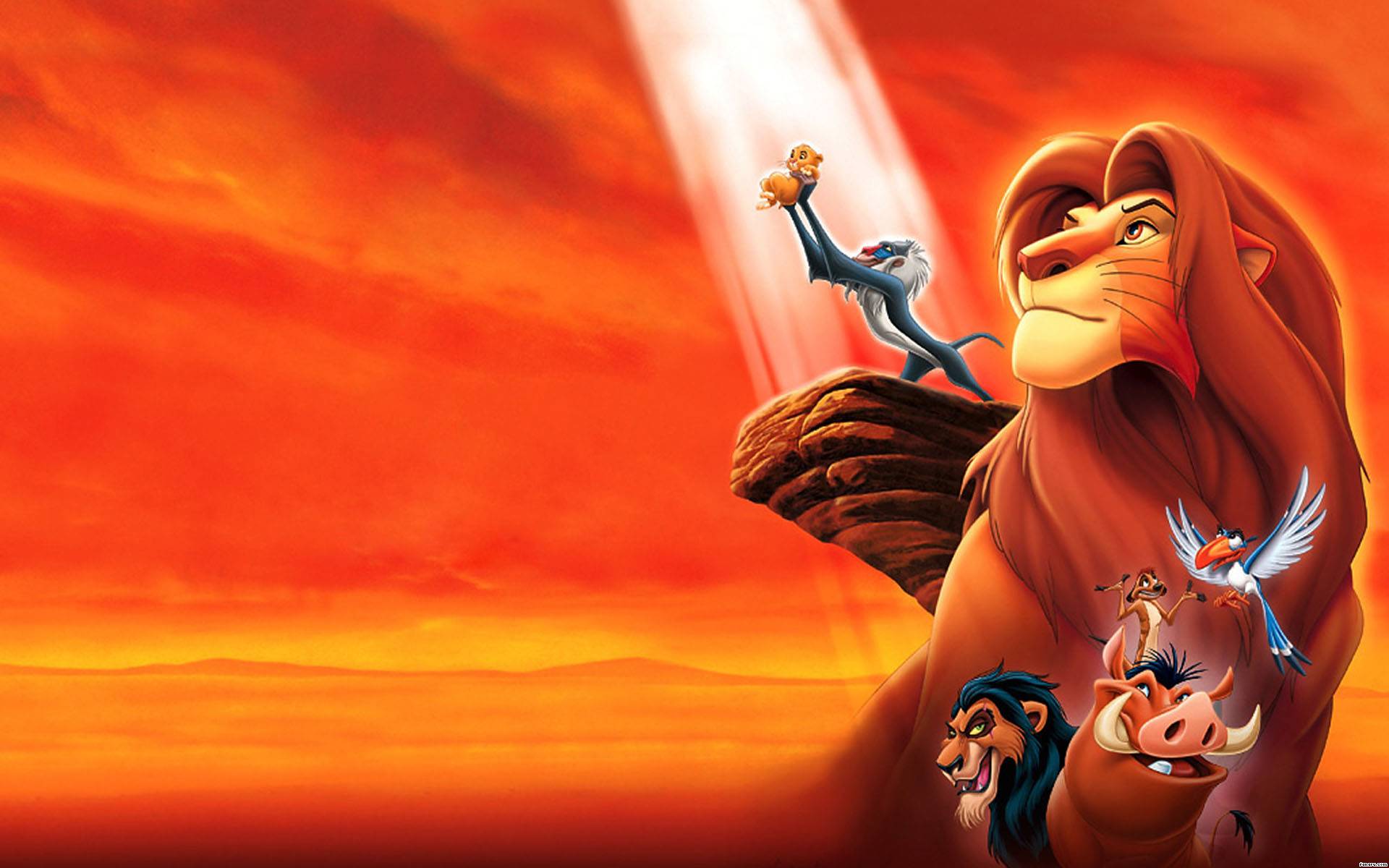
It is arguably the most recognizable frame in animation history. You know the one. A colorful, eccentric mandrill stands on the precipice of a jagged rock, hoisting a golden lion cub toward the heavens while a Zulu chant explodes in the background. If you close your eyes, you can probably hear the opening notes of "Circle of Life" right now. But there is a lot more to the Lion King monkey holding Simba than just a cool visual or a meme-worthy moment.
Honestly, the scene almost didn't happen the way we remember it.
When Disney was developing The Lion King in the early 90s, the "B-team" was working on it because the "A-team" was busy with Pocahontas. They thought the lion movie was a secondary project. Little did they know they were crafting a cultural juggernaut. The image of Rafiki—the character everyone calls "the monkey" even though he's technically a mandrill—lifting Simba on Pride Rock became the literal face of the franchise. It’s the first thing you see in the trailer. It’s the last thing you see before the credits in the 2019 "live-action" remake. It’s basically the heartbeat of the movie.
Who is the Lion King Monkey Holding Simba?
Let’s get the technical stuff out of the way because it actually matters for the lore. Rafiki is often called a baboon by characters in the film, but his colorful face and blue backside clearly mark him as a mandrill. However, mandrills don’t actually have long tails, and Rafiki does. Character designer Don Hahn and the animation team took some creative liberties to make him more expressive.
He isn't just a random animal in the Pride Lands. He’s a shaman. A bridge between the physical world and the spirit world.
In the original 1994 film, Rafiki’s role in the presentation of Simba is deeply ritualistic. He cracks open a baobab fruit, smears a red juice across the cub's forehead, and sprinkles sand over him. It’s a baptism. When he lifts that cub, he isn't just showing off a baby; he’s announcing the continuation of a lineage. He’s telling the world that Mufasa’s legacy is secure. It’s heavy stuff for a kids' movie, but that’s why it stuck.
The way he holds him is specific too. It's firm. Reaching. It’s a gesture of offering. If you look at the 1994 animation versus the 2019 CGI version, the physics change slightly, but the intent is identical. In the original, Rafiki has this wild, manic energy—he’s a "mad" prophet. By the time he reaches the edge of Pride Rock, he settles into a stillness that feels ancient.
The Cultural Weight of the Presentation Scene
Why does everyone obsess over this specific moment? Why do people still post photos of themselves holding their cats or babies in the air to the "Circle of Life"?
It’s the scale.
The song, composed by Elton John with lyrics by Tim Rice and that incredible opening vocal by Lebo M., creates a sense of "the sublime." In art history, the sublime is something so vast and powerful it’s almost terrifying. When the Lion King monkey holding Simba appears, the music hits a crescendo that vibrates in your chest. The animals below—the elephants, the giraffes, the zebras—all bow.
It represents order.
Most people don’t realize that The Lion King is basically Hamlet with fur, but it’s also a story about the "Great Chain of Being." The presentation scene is the visual manifestation of that philosophy. When Rafiki holds Simba up, he is asserting that there is a place for everyone in the circle. The sun hits the cub, and for a second, everything in the world is right.
What the Remake Changed (And Why People Noticed)
When Jon Favreau directed the 2019 version, the scene was recreated almost shot-for-shot. But something felt different. In the original, Rafiki’s hands are long and almost human-like, which adds to the emotional weight. In the 2019 version, the realism of the mandrill's hands made the lift look a bit more... biological? Less mystical?
Fans debated this for months.
Some loved the "National Geographic" feel of the new Lion King monkey holding Simba. They felt the realism made the African landscape feel more majestic. Others missed the exaggerated expressions. In the 1994 version, Simba looks confused and adorable. In the 2019 version, he looks like a real lion cub—which is to say, he looks like he has no idea what’s happening.
The Animation Mastery Behind the Lift
The animation of Rafiki was led by James Baxter, one of the most legendary animators in the business. Baxter is known for his "fluidity." If you watch Rafiki’s movements closely as he climbs Pride Rock, they aren't jerky. They are rhythmic. He moves like a dancer.
Baxter has mentioned in interviews that he looked at how primates actually move, but he had to "humanize" the grip. A real mandrill wouldn't hold a cub like that. It would be awkward. They had to find a way to make it look like a "presentation" while still feeling grounded in the animal kingdom.
They also used "multiplane" camera effects to give the scene depth. As the camera zooms out from the Lion King monkey holding Simba, you see layers of the savanna. This was high-tech stuff back in '94. It’s why the scene feels so "big." You aren't just looking at a drawing; you’re looking into a world.
The Missing Piece: Why Rafiki?
Why isn't Mufasa holding his own son? Or Sarabi?
In many cultures, the "elder" or the "priest" is the one who introduces the new generation to the community. By having the monkey hold Simba, the filmmakers established that the Pride Lands have a culture. It’s not just a bunch of animals eating each other. They have traditions. They have a history.
Rafiki is the keeper of that history. He’s the one who paints the lions on the walls of his baobab tree. He’s the one who knows that Simba is alive when everyone else thinks he’s dead. The presentation is his duty. He is the witness.
Common Misconceptions About the Scene
People get a few things wrong about this moment.
First, the "juice" on Simba’s head. Many people think it’s blood. It’s not. It’s a mashed-up melon or baobab fruit. Disney wasn't going to put blood on a baby lion's forehead in a G-rated movie.
Second, the location. Everyone calls it "The Big Rock." It’s Pride Rock. And it’s not based on one specific location in Africa, though many people think it's in Kenya’s Hell’s Gate National Park. The animators actually went there for inspiration, but Pride Rock itself is a composite of various geological formations.
Third, the "monkey" label. Again, he’s a mandrill. But honestly? Even the creators call him a monkey half the time. It’s fine. You aren't wrong for calling him that.
How to Capture the Magic Today
If you’re looking to revisit this moment, there are a few ways to do it that actually give you a deeper appreciation for what the animators pulled off.
Don't just watch the movie on a loop. Look at the "Making Of" documentaries on Disney+. Seeing the raw pencil tests of the Lion King monkey holding Simba is mind-blowing. You see the skeleton of the movement before the color and the music are added. It’s like seeing the blueprint of a cathedral.
Also, if you ever get the chance to see The Lion King on Broadway, the opening is a religious experience. The way the puppeteers handle the Rafiki character and the "Simba" puppet is a masterclass in physical theater. They recreate the lift using shadows and light, and it hits just as hard as the film.
Practical Ways to Use This Lore
- For Artists: Study the silhouette. The reason this scene works is because the "shape" of the monkey holding the cub is iconic even if you turn the brightness all the way down. It’s a perfect example of strong silhouette design in character art.
- For Storytellers: Use the "Presentation" beat. Every great story needs a moment where the stakes are "presented" to the world. It’s the "call to adventure" before the adventure even starts.
- For Parents: Use it to talk about heritage. The scene is a great springboard for explaining family trees and how we carry on the names of those who came before us.
The Lion King monkey holding Simba isn't just a 90s nostalgia trip. It’s a piece of visual shorthand for hope, responsibility, and the terrifying beauty of growing up. Whether you prefer the hand-drawn grit of the original or the "Photo-Real" 2019 version, that one image remains the pinnacle of Disney’s storytelling power. It reminds us that every life—no matter how small—starts with a moment of being seen.
Next time you watch it, pay attention to the silence right after the music stops. That’s the real magic. The world holds its breath. And then, the title card slams onto the screen. Total perfection.
Take Action: How to Experience the Scene Like an Expert
To truly appreciate the artistry, try these three things:
- Watch the 1994 opening on mute. You’ll see how much "acting" Rafiki does with just his eyes and the tilt of his head.
- Compare the "Simba's Pride" (the sequel) opening to the original. You'll notice the color palette is slightly warmer to signify a different era of the Pride Lands.
- Look up the lyrics to "Nants Ingonyama." Understanding that the chant literally translates to "Here comes a lion, Father" adds a whole new layer of respect to Rafiki’s role as the herald.