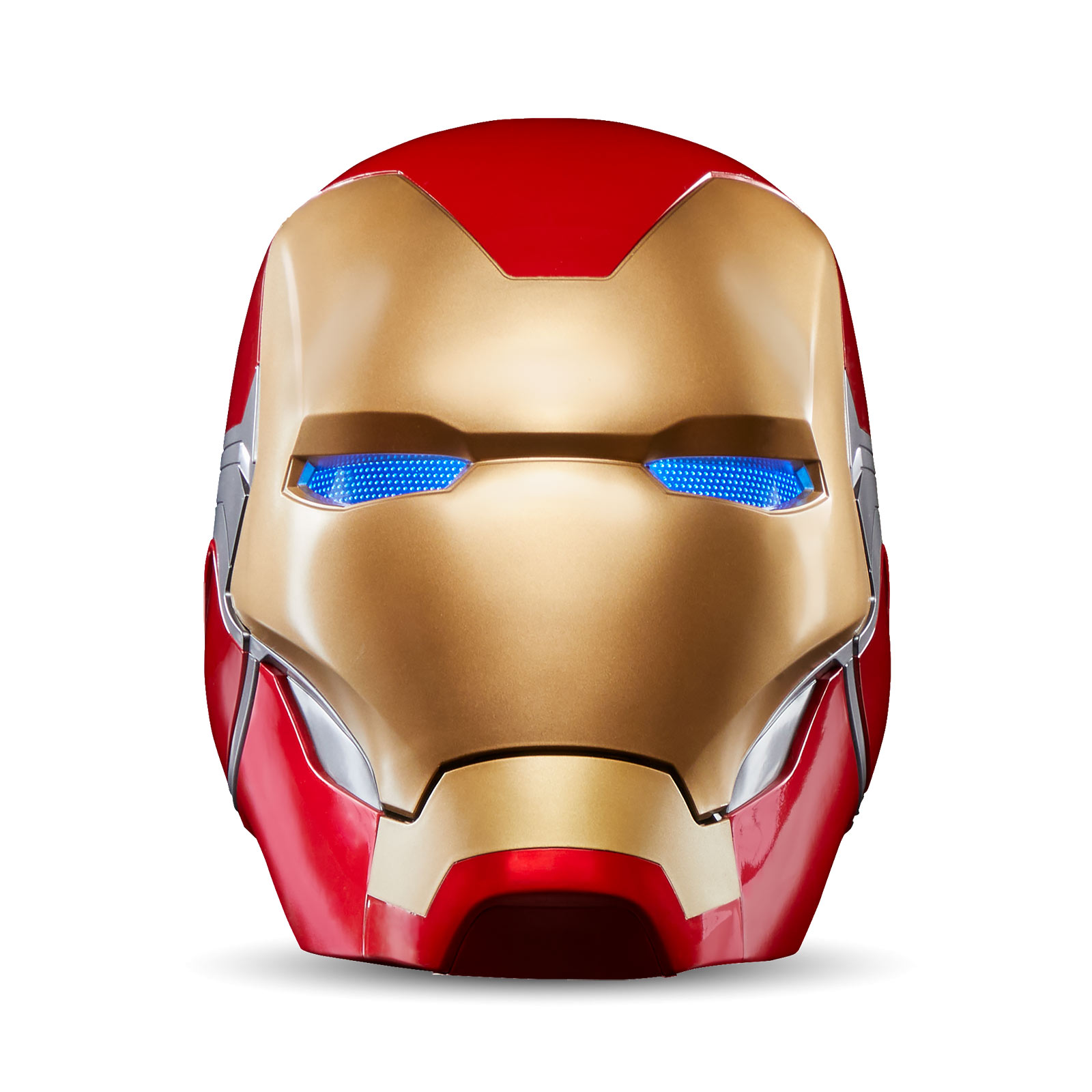
You’ve seen the movies a dozen times. Tony Stark falls through the sky, the suit encases him, and suddenly we’re looking at his face, bathed in a weird blue glow, surrounded by floating icons. It looks cool. It looks high-tech. But if you actually stop and think about the iron man helmet inside for more than a second, you realize it’s a terrifying, claustrophobic nightmare that somehow functions as the most sophisticated piece of military hardware ever conceived.
It's not just a tin can.
People think the helmet is just armor. It’s not. In the Marvel Cinematic Universe—and the comics that birthed it—the interior of that bucket is a masterpiece of sensor integration, neural mapping, and (surprisingly) padding. Because let’s be real: if you headbutt a tank without some serious shock absorption, your brain is turning into a smoothie.
The HUD is actually a lie (Sort of)
We need to talk about the Heads-Up Display. In the films, Marvel uses the "POV shot" to show Robert Downey Jr. reacting to data. It’s a brilliant filmmaking trick. However, the iron man helmet inside doesn't actually have a tiny projector pointing at his eyeballs. That would be blinding. It would also be impossible to focus on. Try holding your phone two inches from your nose and reading a text. You can’t.
What’s actually happening is a retinal projection or a direct neural interface.
The suit isn't showing him a screen; it's overlaying data directly into his visual cortex. This is why Tony can "see" through walls or track 40 targets at once. The "glass" of the eyes isn't even glass in the later models—it’s a solid composite filled with cameras. He isn't looking through eye slits like a medieval knight. He’s looking at a 360-degree reconstructed video feed.
Padding, sweat, and the "G-Force" problem
Imagine the smell. Seriously.
You’re in a metal suit, flying over a desert, probably sweating bullets. The iron man helmet inside has to be lined with something. In the early Mark III days, it was likely a mix of high-impact foam and moisture-wicking synthetics. By the time we get to the Nanotech suits (Mark 50 and beyond), the interior is likely a programmable matter surface that molds perfectly to his skull.
But there’s a physics problem nobody mentions.
When Iron Man takes a punch from Thanos, the helmet moves. If that helmet moves even half an inch and hits Tony’s nose, his nose is gone. The interior has to feature inertial dampeners. In the comics, Stark explicitly mentions "force-field generators" that create a pressurized cushion around his head. Without that, the first time he broke the sound barrier, his brain would have slammed against the back of his skull.
The J.A.R.V.I.S. (and F.R.I.D.A.Y.) Connection
The most important part of the iron man helmet inside isn't the metal. It’s the speakers and the mics.
Think about the noise. A jet engine is screaming three feet from your ears. Yet, Tony can hear a whisper from Peter Parker. This implies the interior of the helmet has active noise-canceling technology that makes a pair of Bose headphones look like two tin cans and a string.
- Bone conduction: It's highly likely the audio isn't coming through speakers, but through bone-conduction transducers built into the helmet’s frame. This allows him to hear the AI over the sound of explosions.
- Neural Link: In the Extremis comic arc by Warren Ellis, the helmet is basically an extension of Tony’s nervous system. He doesn't think "open the mask." He just thinks, and it happens.
- Oxygen Supply: There’s a sealed gasket around the neck. Space is cold. High altitudes lack oxygen. The interior has to be pressurized and climate-controlled.
Why the "Faceplate" is a mechanical marvel
Most cosplayers will tell you: making an Iron Man helmet is easy; making the motorization work is the hard part.
Inside the jawline of the helmet, there are micro-servos. These are tiny electric motors that pull the faceplate up and tuck it into the crown. In the Iron Man (2008) film, you can actually see the mechanical arms and locking pins. It’s tight. There is almost zero clearance. This means Tony’s face is millimeters away from whirring gears.
One glitch and the "mask up" command becomes a "guillotine" command.
It’s tighter than you think
If you look at the prop helmets used in the movies, they are actually slightly oversized compared to a human head to make them look "heroic." But in the "real" world of the MCU, the iron man helmet inside is incredibly thin.
How thin?
The Mark 7 (the Avengers 1 suit) had to be thick enough to house the heavy plating. But the later suits are almost like a second skin. This suggests that the interior isn't just "stuffing." It's a multilayered sandwich of:
- Gold-Titanium Alloy: The outer shell.
- Ceramic Composite: For heat dissipation.
- Sensor Mesh: To track eye movement and brain waves.
- Liquid Crystal Layer: To display the HUD or change opacity.
- Biometric Padding: To keep the suit from rubbing his skin raw.
What we get wrong about the HUD colors
Everyone loves the blue and orange glow. It looks great on camera. But if you were actually inside that helmet, a bright blue light would ruin your night vision.
In real-world fighter jets, like the F-35 Lightning II, the Helmet Mounted Display (HMD) uses green or very specific red wavelengths to preserve the pilot's ability to see the actual world outside. Tony’s blue HUD is likely a stylistic choice by the filmmakers, but within the logic of the suit, it’s probably a multi-spectrum display that only Tony can see. To an outside observer looking through the eye holes, it would probably just look dark.
Actionable insights for the obsessed
If you’re looking to replicate or understand the tech, don’t just look at the shiny red paint. Look at the guts.
- Research F-35 Gen III Helmet Systems: This is the closest real-world tech to the Iron Man helmet. It allows pilots to "look through" the floor of the plane.
- Study Bone Conduction: If you’re building a cosplay, stop using bulky speakers. Use bone conduction transducers against your temples for a more "Stark-like" audio experience.
- Ventilation is King: The biggest enemy inside a closed helmet is CO2 buildup. If you’re wearing one, you need active intake and exhaust fans, or you’ll pass out in twenty minutes.
The iron man helmet inside is a masterclass in "form meets function." It’s a cramped, high-pressure, electronically dense environment that turns a regular man into a god. It’s also probably very itchy.
To understand the helmet is to understand Tony Stark himself: a fragile human core protected by layers of genius, ego, and very expensive hardware. The tech isn't just on the outside; it’s the interface between the man and the machine. Next time you see the faceplate slam shut, remember the micro-servos, the retinal projectors, and the sheer amount of engineering required to keep a human head from exploding at Mach 2. It’s not just a helmet. It’s a life-support system.
Stay focused on the internal mechanics. The real magic isn't the flight or the repulsors; it's the fact that Tony can see, breathe, and think while wrapped in a metal coffin. That's the real engineering feat. Keep an eye on the development of AR and VR haptics, as that's where the real-world version of this tech is currently being born. We aren't far off from our own HUDs, even if we don't have the flying suit to go with them yet.
Next Steps for Enthusiasts:
Check out the latest developments in Integrated Visual Augmentation System (IVAS) goggles used by the military. They are currently the closest existing technology to the Iron Man HUD, featuring night vision, thermal overlays, and squad-tracking data. For builders, prioritize airflow and weight distribution over aesthetics; a heavy helmet with poor ventilation is unwearable for more than a few minutes. Focus on ESP32 or Arduino controllers to manage the servo-timing for the faceplate to avoid the "guillotine" effect mentioned earlier. Finally, look into OpenCV for basic object recognition if you want to build a functional, albeit basic, version of the HUD.