You’ve seen the pink facade. You’ve seen the funicular scaling the side of a jagged, snowy mountain. Maybe you even remember the specific shade of "L'Air de Panache" cologne Zero Moustafa sprays on M. Gustave.
But here’s the thing.
The Grand Budapest Hotel doesn't actually exist in Budapest. It doesn’t even exist in Hungary. Honestly, if you try to book a room there for your next European vacation, you’re going to end up very disappointed and potentially stranded in a random corner of Saxony.
Wes Anderson’s 2014 masterpiece created a world so tactile and detailed that it feels like a historical landmark we simply forgot to visit. It’s a trick of the light, basically. The movie is a nesting doll of narratives, but the hotel itself is the biggest illusion of all. People search for it every single day. They want the concierge, the purple uniforms, and the Courtesan au Chocolat from Mendl’s.
Instead of a real hotel, what we actually have is a brilliant mix of a defunct German department store, a lot of handmade miniatures, and a deep obsession with the fading glamour of Central Europe between the wars.
Where the Grand Budapest Hotel actually lives
If you want to touch the walls of the "hotel," you have to go to Görlitz. It’s a tiny town on the German-Polish border. Most people have never heard of it, but Hollywood loves it. They call it "Görliwood."
The interior of the hotel was filmed inside the Görlitzer Warenhaus. This was an old department store built in 1913. It has this incredible Art Nouveau skeleton—huge staircases, stained glass ceilings, and chandeliers that look like they belong in a palace. When Wes Anderson and his production designer, Adam Stockhausen, saw it, they knew they’d found the lobby.
It wasn't a hotel, though.
The crew basically lived in the town and spent months transforming this empty retail space. They built a hotel within a store. They painted over the walls, brought in custom furniture, and created two distinct eras of the hotel within the same physical space. You have the 1930s version, which is all red carpets and gold leaf, and then the 1960s version, which is that depressing, wood-paneled, Soviet-era orange and brown.
The exterior? That’s a model.
It’s a hand-painted miniature. About 14 feet long. It’s not CGI. Anderson famously hates that "flat" look of digital effects. He wanted the audience to feel the texture. By using a physical model, the light hits the balconies and windows in a way that feels "real" even if the proportions are slightly off. It’s meant to look like a postcard, not a photograph.
The Stefan Zweig connection you probably missed
If you watch the credits, there’s a small note saying the film was inspired by the writings of Stefan Zweig.
Most modern audiences don't know who that is. In the 1920s and 30s, he was one of the most famous writers in the world. He was a Viennese intellectual who watched his world crumble when the Nazis rose to power. His memoir, The World of Yesterday, is basically the blueprint for the movie's soul.
Zweig wrote about a Europe that was elegant, intellectual, and borderless—and then he watched it get torn apart by "the faint aroma of fascist butchers," as M. Gustave might put it.
The character of M. Gustave isn't just a funny guy in a purple suit. He represents the "last of the old world." He’s a man maintaining a standard of civility while the world outside becomes increasingly brutal. Ralph Fiennes played him with this frantic, poetic energy that shouldn’t work, but it does. It’s funny, sure. But it’s also incredibly sad.
The film captures that specific Central European "Galgenhumor" (gallows humor). It’s the idea of laughing because if you don’t, you’ll start screaming.
Designing a fictional country from scratch
The movie takes place in the Republic of Lutz.
It’s not a real country. But it has its own history, its own currency, and even its own stamps. Graphic designer Annie Atkins is the person responsible for this. She didn't just make props; she made a world.
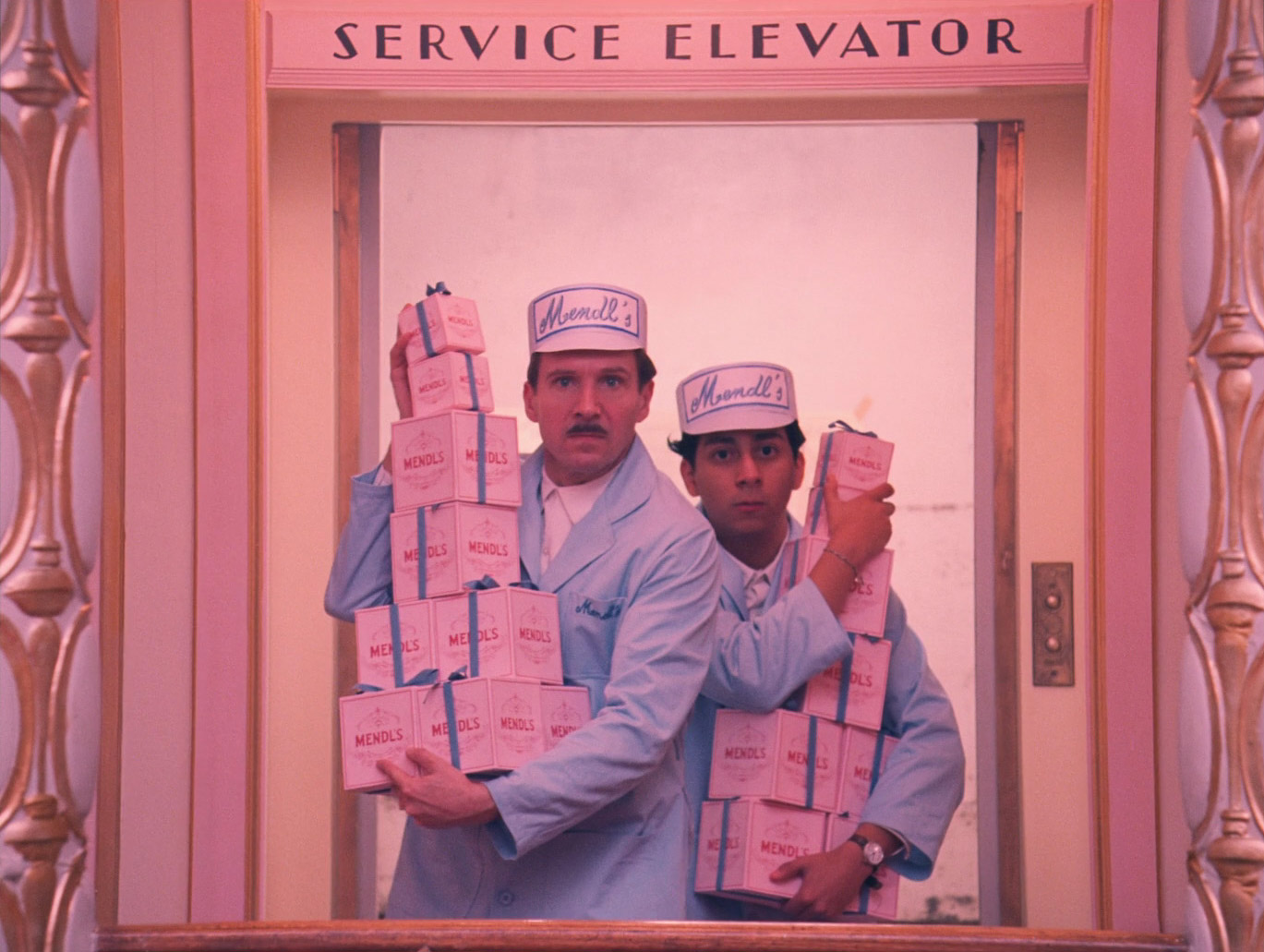
Think about the pink pastry boxes from Mendl’s.
Atkins spent ages getting the typography right. She used real printing techniques from the era. She even made sure that the "Z" on the soldiers' uniforms (the "Zig-Zags") looked threatening but distinct from any real historical insignia to keep the movie in its own fairytale reality.
She famously said that even the things the camera never sees were detailed. If a character opened a drawer, there would be a passport inside. That passport would be stamped. The stamps would be for countries that don’t exist.
That’s why the movie feels so dense. It’s because the creators treated the fiction as if it were a historical fact.
Why we are still obsessed with the aesthetic 12 years later
Go on Instagram or TikTok and search for "Accidental Wes Anderson."
You’ll find thousands of photos of symmetrical buildings, pastel colors, and centered compositions. The Grand Budapest Hotel solidified an aesthetic that has become a visual shorthand for "cool and quirky."
But people often miss the point of the symmetry.
In the film, the symmetry represents M. Gustave’s attempt to control his environment. He wants everything perfect because the world outside is chaotic. When the camera pans 90 degrees or stays perfectly centered, it feels like we are looking through his eyes.
The color palette also changes to reflect the timeline:
- The 1930s: Saturated pinks, deep reds, and purples. The peak of luxury.
- The 1960s: Mustard yellows, sage greens, and drab browns. The era of Communism and decline.
- The 1980s/Modern Day: More neutral, realistic tones. The magic has faded.
It’s visual storytelling at its most aggressive. You don't need the dialogue to tell you the hotel is dying; you can see it in the carpet.
Real-life inspirations for the "Grand" experience
If you can't stay at the Grand Budapest, where do you go?
The Grandhotel Pupp in Karlovy Vary (Czech Republic) is the biggest influence on the look of the hotel. It’s massive. It’s white. It sits in a valley surrounded by trees. If you look at a photo of the Pupp and then a photo of the movie’s miniature, the resemblance is striking.
Then there’s the Hotel Gellért in Budapest.
It has those famous thermal baths. It has the old-world grandeur. While it wasn't a filming location, it’s the place that most closely matches the "vibe" of a luxury hotel in a fading empire.
Actually, many of the world's grand hotels from that era met the same fate as the one in the movie. They were nationalized. They were turned into government offices. They were divided into cheap apartments. Or they were just left to rot until a developer turned them into a Marriott.
The truth about the "Boy with Apple" painting
In the movie, the plot revolves around a priceless Renaissance painting called Boy with Apple.
It looks real. It’s convincing. But it was painted in 2012 by an artist named Michael Taylor.
Anderson commissioned it specifically for the film. He wanted it to look like a Mannerist masterpiece—something like a Bronzino or a Holbein. The actor who played the young boy in the painting actually had to sit for the portrait.
The "Egon Schiele" sketch that replaces it after the theft? That was also a fake, created by the production’s lead illustrator.
These aren't just props; they are the anchors of the movie's reality. By creating "high art" specifically for the film, the production team avoided the distraction of using a famous real-world painting. It kept the audience inside the Republic of Lutz.
How to visit the locations today
If you want to do a "Grand Budapest" pilgrimage, you’re heading to Eastern Germany.
Start in Görlitz. You can visit the department store (though it’s often closed for renovations or other film shoots). You can walk the streets where the chase scenes happened.
Then, go to Dresden.
- The Zwinger Museum served as the location for the art gallery.
- The Pfunds Molkerei (the "most beautiful dairy shop in the world") was used as the interior for Mendl’s. It’s a real shop covered in hand-painted tiles. You can actually buy cheese there.
Finally, visit the Bastei Bridge in Saxon Switzerland. It’s a rock formation that looks exactly like the jagged landscapes in the movie’s wide shots.
Practical steps for fans and travelers
If you’re looking to capture a bit of that M. Gustave energy in your own life, you don't need a funicular.
1. Study the source material. Read The World of Yesterday by Stefan Zweig. It’s a heavy read, but it explains why the movie feels so nostalgic and melancholic.
2. Visit Görlitz. Don't just go for the movie spots. It’s one of the few German cities that wasn't destroyed in WWII, so the architecture is 100% authentic.
3. Look for "Palace Hotels." If you want the service level of M. Gustave, look for hotels with "Leading Hotels of the World" or "Palace" designations in Europe. The Ritz in Paris or the Savoy in London are the closest you'll get to that level of obsession with detail.
4. Appreciate the craft. Watch the movie again, but ignore the plot. Just look at the corners of the frames. Look at the menus. Look at the way the light hits the pastries.
The Grand Budapest Hotel is a ghost story. It’s a story about a world that was already gone by the time the story started. That’s why it resonates. We all have a "Grand Budapest" in our minds—a place that was more beautiful, more civil, and more colorful than the world we live in now.
You can’t stay there. But you can always visit for a couple of hours if you have the DVD. Or the Blu-ray. Or the Criterion Collection edition, which, honestly, is the only way to see those pinks and purples in their true glory.
Next Steps for Your Research:
- Search for the "Görlitzer Warenhaus" to see current photos of the interior restoration.
- Look up the work of Annie Atkins to see the high-resolution files of the props used in the film.
- Check the availability of the Hotel Gellért if you want to experience the actual thermal baths of Budapest that inspired the film's atmosphere.