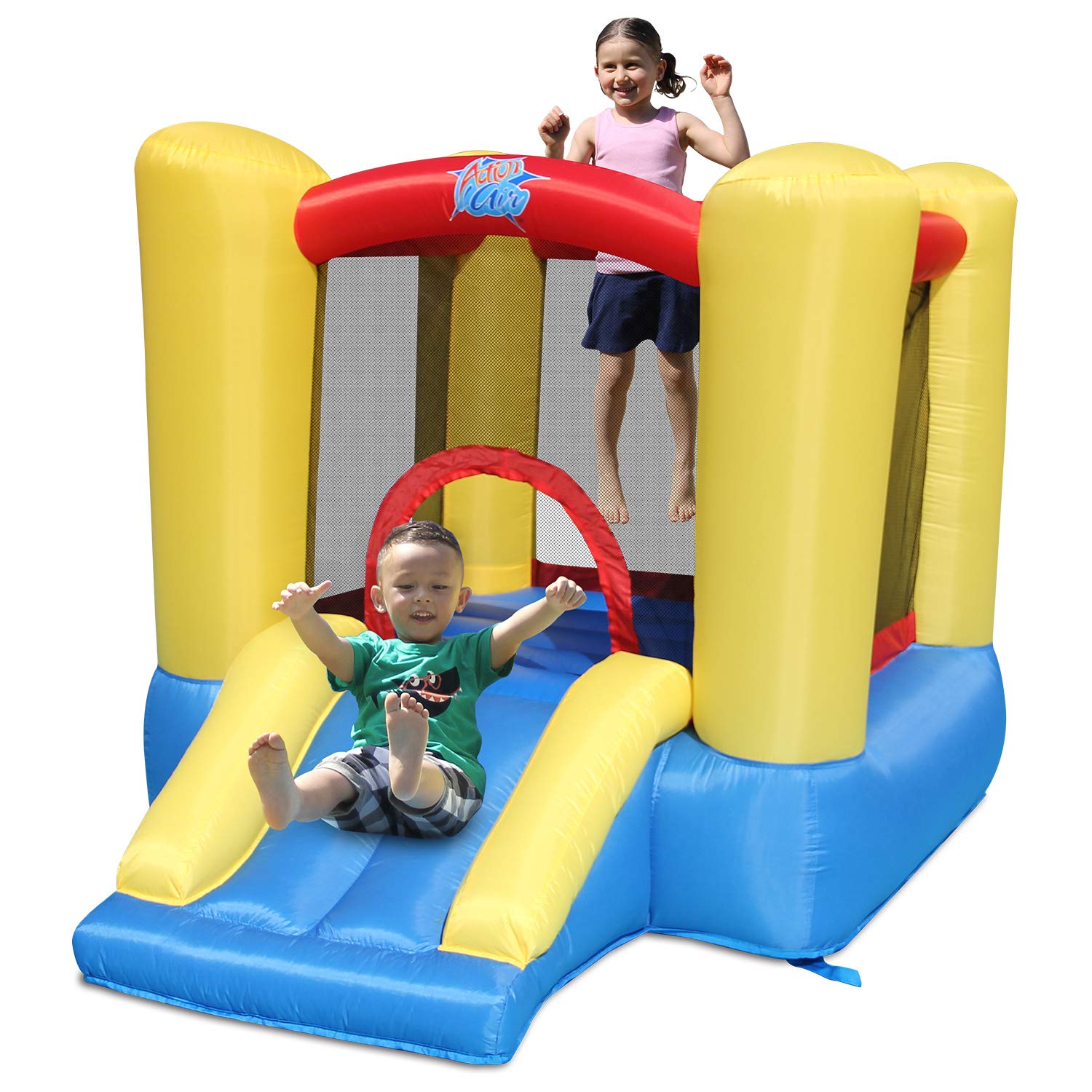
You know that feeling. It’s 2:00 PM on a Saturday, the kids have been stuck inside for three hours, and the energy levels in your living room are approaching a nuclear meltdown. You've considered the park, but the drive is a hassle. You've thought about the backyard, but "just running around" loses its charm after ten minutes. Then you remember that massive orange and blue box sitting in the garage.
Honestly, the Costco inflatable bounce house—specifically the Happy Hop and Banzai models they tend to rotate through their warehouses—is probably the most underrated parenting "hack" of the last decade. It’s not just a toy. It’s a 15-minute setup that buys you three hours of peace while your kids get a high-intensity cardio workout.
But buying one isn't just a "grab and go" situation. If you’ve ever stood in the middle of the Costco aisle staring at a $250 box wondering if it’ll actually fit in your trunk or explode the moment a ten-year-old touches it, you aren't alone.
What You’re Actually Buying (The Happy Hop vs. Banzai Reality)
Costco doesn't manufacture these things. They curate them. Usually, you’re looking at a partnership with brands like Happy Hop or Banzai. These aren't the heavy-duty, commercial-grade PVC monsters you see at professional party rentals. Those weigh 200 pounds and require a literal dolly to move.
The Costco inflatable bounce house is typically made of a heavy-duty polyester oxford or a "nylon-lite" material. It’s light. It’s manageable. One person can carry it, though you might grunt a little.
The big difference is the air. Commercial units are "sealed" or high-pressure. These residential units are "constant air." This means the blower has to stay on the entire time. If you unplug it, the whole thing sags like a sad souffle in about thirty seconds. This is a safety feature, actually. Since the material is porous, it allows air to leak through the seams. That’s why you hear that hissing sound when the kids are jumping. It’s supposed to do that. If it didn't leak, the pressure from a kid landing would pop the seams like a balloon.
The Specs That Matter
Most of these units, like the popular Happy Hop 7-in-1 Play House often spotted in warehouses, have a weight limit that surprises people. We're talking maybe 250 to 300 total pounds.
Think about that math.
If you have four 60-pound kids, you’re pushing the limit. If a 180-pound dad decides to "show the kids how it's done," he’s probably going to bottom out and hit the grass, or worse, tear the interior baffles. These are kid zones. Strictly.
The Setup: It’s Faster Than You Think
People dread the setup. They think it's like putting together IKEA furniture. It's not.
- You drag the bag to a flat-ish spot in the yard.
- You unroll the pancake of fabric.
- You attach the long "snorkel" tube to the yellow blower motor.
- You flip the switch.
It inflates in literally 60 seconds. Watching it rise is actually kind of therapeutic. The real work is the staking. Do not skip the stakes. A light gust of wind can turn a Costco inflatable bounce house into a very expensive kite, and if your toddler is inside, that’s a nightmare scenario. Use the plastic stakes provided, or better yet, go to a hardware store and buy some heavy-duty metal tent stakes.
The "Costco Factor" and the Return Policy
Why buy it at Costco instead of a random site online? Two words: Risk mitigation.
Inflatables are prone to "pinhole leaks" and "mold issues" if you pack them away damp. Most retailers will give you a 30-day window to return a defective unit. Costco? Well, we all know the legendary Costco return policy. If the motor dies in month four, or if the seams start fraying after three uses, you can generally take it back for a full refund.
That peace of mind is worth the $20 premium you might pay over a generic Amazon brand.
The Dirt, The Mold, and The "Death" of a Bouncer
Here is the part nobody mentions in the glowing five-star reviews. These things are moisture magnets.
If you live somewhere with morning dew or high humidity, you cannot—I repeat, CANNOT—roll this thing up and put it in the bag while it's even slightly damp. If you do, you’ll open it two weeks later to find a science experiment of black mold.
Once mold gets into the interior fibers of a Costco inflatable bounce house, it’s game over. You can’t really bleach it out without damaging the waterproof coating.
The pro move? After the kids are done, keep the blower running for an extra hour. Let the sun bake the fabric. Check the "pockets" where the slide meets the climbing wall. That’s where the water hides. If it rained, you might even need to flip the whole thing over to dry the bottom.
The Hidden Costs: Electricity and Grass
"How much does it cost to run?"
Surprisingly little. Most of these blowers are 450 to 750 watts. That’s basically like running a high-end gaming PC or a couple of old-school lightbulbs. You won't see a massive spike in your electric bill unless you're running it eight hours a day, every day.
The real cost is your lawn.
If you leave a bounce house in the same spot for three days, your grass will turn yellow. Leave it for a week, and you’ve got a dead brown rectangle that will take all summer to recover. Move the unit every time you inflate it. It's a small price to pay for a green yard.
Comparison: Renting vs. Owning
A professional bounce house rental usually costs between $200 and $450 for a single day.
The Costco inflatable bounce house usually retails between $199 and $349.
The math is stupidly simple. If you use it twice, it has paid for itself. Yes, the rental is bigger and "cooler," but having a bouncer available for a random Tuesday afternoon is a level of parenting luxury that’s hard to quantify.
Is Your Yard Big Enough?
Don't eyeball it. Measure.
A standard Costco unit is roughly 12 feet by 10 feet, but you need "buffer space." You don't want the exit slide dumping your kid directly into a rose bush or a fence. You need at least 3 to 5 feet of clearance on all sides.
Also, check your circuit breaker. These blowers pull a decent "surge" of power when they first kick on. If you have it plugged into an outdoor outlet that’s shared with a garage freezer or a string of heavy-duty lights, you might trip the breaker.
Why Kids Love This Specific Model
Most Costco versions come with more than just a jumping area. They usually have a slide, a small climbing wall, and maybe a ball pit area.
Variety is key.
Straight jumping gets boring after twenty minutes. A slide adds a "circuit" element. They climb up, slide down, run around, and repeat. It turns the bounce house into an obstacle course. This is what actually exhausts them.
Common Myths About Inflatables
- "It’s puncture-prone." Honestly, they are tougher than they look. Unless your kid is wearing cleats or carrying a screwdriver, it’s hard to pop these. Most kits come with patches anyway.
- "It's too loud." The blower sounds like a loud hair dryer. If you’re standing right next to it, it’s annoying. If you’re on the patio 20 feet away, it’s just white noise.
- "It takes forever to pack up." This is the only legitimate complaint. Getting all the air out to fit it back into the original bag is like trying to put toothpaste back in the tube. Pro tip: Don't use the bag. Use a large plastic bin or a heavy-duty cinch strap and a tarp.
The Verdict: To Buy or Not to Buy?
If you have kids between the ages of 2 and 8, just buy the Costco inflatable bounce house. It is the ultimate insurance policy against "I'm bored" and "Can I watch YouTube?"
It’s durable enough to last 2-3 seasons if you treat it well. It’s cheap enough that you won't cry when it finally gives up the ghost. And it's backed by a return policy that makes the investment virtually zero-risk.
Just remember the golden rules:
- Keep the big kids out.
- Dry it till it's bone-dry.
- Stake it down like your life depends on it.
Actionable Next Steps for Success
Ready to pull the trigger? Here is how to handle the first 48 hours of ownership.
- Check the Floor: Before you even unbox it, sweep the area of your yard where it's going. One rogue stick or a sharp rock can ruin your day.
- The "Dry Run": Set it up on a weekday before the "big event" or party. You want to make sure the blower works and there are no factory defects before you have ten screaming kids waiting in line.
- Invest in a Tarp: Don't put the bounce house directly on the grass. Buy a cheap 12x15 tarp to put underneath it. It keeps the bottom clean and adds an extra layer of puncture protection.
- Buy a "Real" Storage Bag: The bag it comes in is garbage. Get a heavy-duty "moving bag" or a large 50-gallon plastic tote with wheels. It makes moving it from the garage to the yard ten times easier.
- Set "House Rules": No shoes, no food, no sharp toys, and no "dog-piling." Establish these early. It will save the seams and prevent trips to the urgent care.
The Costco inflatable bounce house isn't a permanent backyard fixture, but as a "break glass in case of emergency" toy, it’s practically unbeatable. Keep an eye on the seasonal aisles starting in late March; that’s usually when they hit the floor, and they rarely last until July.