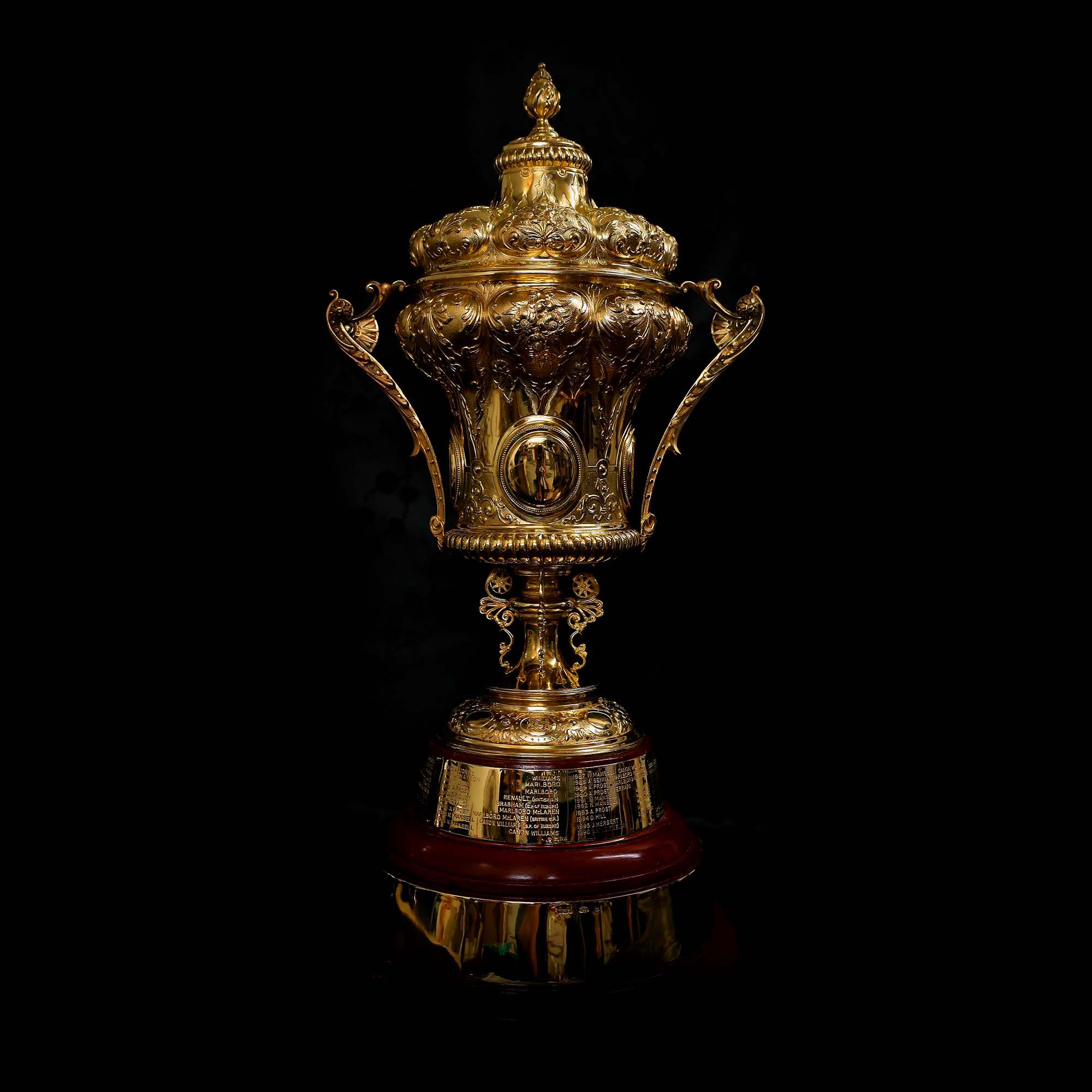
You’ve seen the photos. Lewis Hamilton or Max Verstappen standing on that podium at Silverstone, drenched in champagne, hoisting a massive, ornate gold cup that looks like it belongs in a royal treasury. It's iconic. But here’s the thing that trips up even the most hardcore F1 fans: that gold cup isn't the only British Grand Prix trophy handed out on Sunday afternoon.
If you watch closely, you’ll notice the drivers often juggle two very different prizes. One is a historic masterpiece steeped in 19th-century silversmithing. The other is usually a modern, sponsor-heavy piece of branding that looks like it was designed in a CAD program last Tuesday. Honestly, the story of how the British Grand Prix trophy—specifically the Royal Automobile Club Trophy—became the most prestigious prize in motorsport is a weird mix of high society, strict tradition, and a very specific set of rules about who actually gets to keep what.
The Gold One You Can’t Keep
The real star of the show is the Royal Automobile Club (RAC) Trophy. It is, without a doubt, the most beautiful prize on the F1 calendar. First awarded in 1948 at the very first British Grand Prix held at Silverstone, this trophy actually predates the Formula 1 World Championship itself.
It’s gold. It’s heavy. It’s incredibly valuable.
But here is the catch: the winner doesn’t get to take it home. Not permanently, anyway. Unlike the cheap plastic or carbon fiber trophies you might see at other races, the RAC Trophy is a "perpetual" award. The driver gets their name engraved on the base, they get to hold it for the photos and the national anthem, and then? It goes right back into the vault at the Royal Automobile Club in Pall Mall, London.
The drivers get a replica. Sometimes the replica is great; sometimes it’s a bit of a letdown compared to the five-figure masterpiece they were holding five minutes earlier. It’s kinda like the Wimbledon trophy in that regard. You’re part of a lineage, not an owner of the hardware.
Why the Design Looks So "Non-Racing"
If you look at the British Grand Prix trophy, you’ll notice it doesn't have cars on it. There are no checkered flags etched into the gold. No stylized tires. Instead, it’s a classic Victorian-style loving cup.
This is because the trophy wasn’t originally made for car racing. It was actually commissioned in the late 1800s. The craftsmanship is staggering. We’re talking about intricate floral patterns, delicate handles, and a level of detail that modern manufacturing just doesn't replicate for sporting events anymore. It represents an era where the RAC was the ultimate authority on "automobilism" in the UK, a time when racing was a hobby for the daring elite rather than a multi-billion dollar global industry.
When you see a driver lifting it, they aren't just celebrating a win. They are touching a piece of history that has been handled by Stirling Moss, Jim Clark, Jackie Stewart, and Ayrton Senna. That’s the weight of it. It’s not just the gold; it’s the ghosts.
The "Sponsor Trophy" Confusion
Ever noticed how the podium ceremony sometimes looks a bit cluttered? That's because of the secondary British Grand Prix trophy.
F1 is a business. A massive one. Title sponsors like Rolex, Santander, or Pirelli pay tens of millions of dollars for the naming rights to the race. Part of that deal usually includes the right to design and present the "official" race trophies.
This leads to some awkward moments.
In some years, we've seen drivers look genuinely confused by the sponsor trophies. Remember the "plastic" looking trophies from a few years back? Or the ones that look like giant versions of a sponsor's logo? Drivers often treat these like a piece of merchandise. They’ll hoist the RAC Trophy with reverence, but the sponsor trophy gets handed off to a mechanic pretty quickly.
A Quick Breakdown of the Hardware
- The RAC Trophy: The gold, historic cup. Stay-at-the-club. The one everyone wants.
- The Event Trophy: Provided by the title sponsor. The driver/team usually keeps this one.
- The Constructors' Trophy: Usually a separate award given to the winning team’s representative on the podium.
The 2014 Drama: When the Trophy Went "Red"
One of the funniest—or most frustrating, depending on who you ask—moments in the history of the British Grand Prix trophy happened in 2014. Lewis Hamilton won his home race. The crowd was going wild. But when he got to the podium, the traditional gold trophy was nowhere to be seen.
Instead, he was handed a bright red, plastic-looking trophy that looked suspiciously like the Santander logo.
Hamilton didn't hide his disappointment. He actually complained about it in the post-race interviews. He basically said, "Where's the real one?" It was a rare moment where the commercial side of F1 clashed directly with the soul of the sport. Fans hated it. The media roasted the design.
Since then, there's been a much better balance. The RAC Trophy is almost always front and center now, ensuring that the heritage of Silverstone isn't buried under corporate branding. They realized that you can't replace a century of history with a molded piece of painted resin.
The Engraving Process: A Nervous Tradition
There is a very specific tradition regarding the names on the RAC Trophy. It isn't just a matter of scratching a name on with a pen. The engraving is handled with extreme care, adding to the list of legends that wraps around the base.
Because the British Grand Prix is one of the oldest continuously held rounds of the World Championship (alongside the Italian GP), the space on the trophy is precious. We’ve reached a point where the base has had to be extended or modified over the decades to accommodate new winners.
Think about the names on there.
- Giuseppe Farina (the first-ever F1 winner in 1950)
- Alberto Ascari
- Juan Manuel Fangio
- Nigel Mansell
- Michael Schumacher
When a new driver wins for the first time, they aren't just winning a race; they are literally joining a list of the greatest humans to ever get behind a steering wheel.
What Happens if You Drop It?
It’s heavy. It’s slippery with champagne. And yes, it’s a nightmare for the insurance companies. While we haven't seen a "Lando Norris at the Hungarian GP" moment where the British Grand Prix trophy was smashed into pieces, the fear is always there.
The RAC Trophy is worth hundreds of thousands of pounds, not just for the gold content, but for its historical significance. There are security guards. There are white gloves. It’s handled more like a Crown Jewel than a sports prop.
If a driver were to drop the RAC Trophy, it wouldn't just be an expensive mistake. It would be a national scandal in the UK racing community. This isn't a trophy you can just "order another one" of from a catalog.
The Myth of the "Permanent" Trophy
There’s a common misconception that if you win the British Grand Prix three times in a row, you get to keep the gold trophy.
Nope.
Not even Lewis Hamilton, who has won the race a record eight times, gets to put the RAC Trophy on his mantelpiece in Monaco. He has a very impressive collection of replicas, but the original stays in London. The Royal Automobile Club is very protective of its history. They see themselves as the custodians of the sport’s British roots, and that means the trophy stays with the club.
Practical Insights for Fans and Collectors
If you're heading to Silverstone or just watching from home, here is how to "spot the real stuff" and appreciate what's happening on that podium.
Look for the "Two-Handed" Lift
The RAC Trophy is significantly heavier than the sponsor trophies. When you see a driver using both hands and looking like they’re actually lifting some weight, that’s the gold one. The sponsor trophies are often hollow or made of lighter composites and can be waved around with one hand.
Check the Base
If you ever get a chance to see the trophy in person (it’s often displayed in the Silverstone Museum or at RAC events), look at the names. The font changes slightly over the decades as different engravers have taken up the mantle. It’s a tactile timeline of the sport.
The Replica Game
For the die-hard collectors, you can often find high-quality scale models of the British Grand Prix trophy. However, be aware that most "official" F1 merchandise focuses on the sponsor trophies. To find a model of the RAC Trophy, you usually have to look at high-end memorabilia dealers who specialize in historical replicas.
Silverstone Museum
If you want to see the history of the race without breaking into a private club in London, the Silverstone Museum is your best bet. While the "live" trophy is often at the RAC, the museum houses incredible replicas and the actual trophies from specific eras of British racing history. It gives you a sense of the scale that TV cameras usually miss.
The British Grand Prix trophy is more than just metal. It’s the physical manifestation of Silverstone’s claim as the "Home of British Motorsport." Every time it’s lifted, it bridges the gap between the 1940s and the high-tech, hybrid-engine era of today. It reminds us that while the cars change every year, the prestige of winning in the English countryside remains exactly the same.
Next Steps for the F1 Enthusiast:
- Visit the Silverstone Museum: Located at the entrance to the circuit, it's the best place to see the evolution of British racing trophies in person.
- Watch the Podium Feed Early: The RAC Trophy is usually presented first, before the sponsor trophies. If you tune out as soon as the race ends, you’ll miss the historical handoff.
- Research the RAC: Understanding the Royal Automobile Club’s role in early 20th-century racing explains why the trophy looks the way it does. It was about "gentleman drivers" long before it was about corporate sponsors.
The trophy remains the ultimate goal for any driver. You can win the world title, but your career feels slightly incomplete without your name etched into that specific piece of gold at Pall Mall.