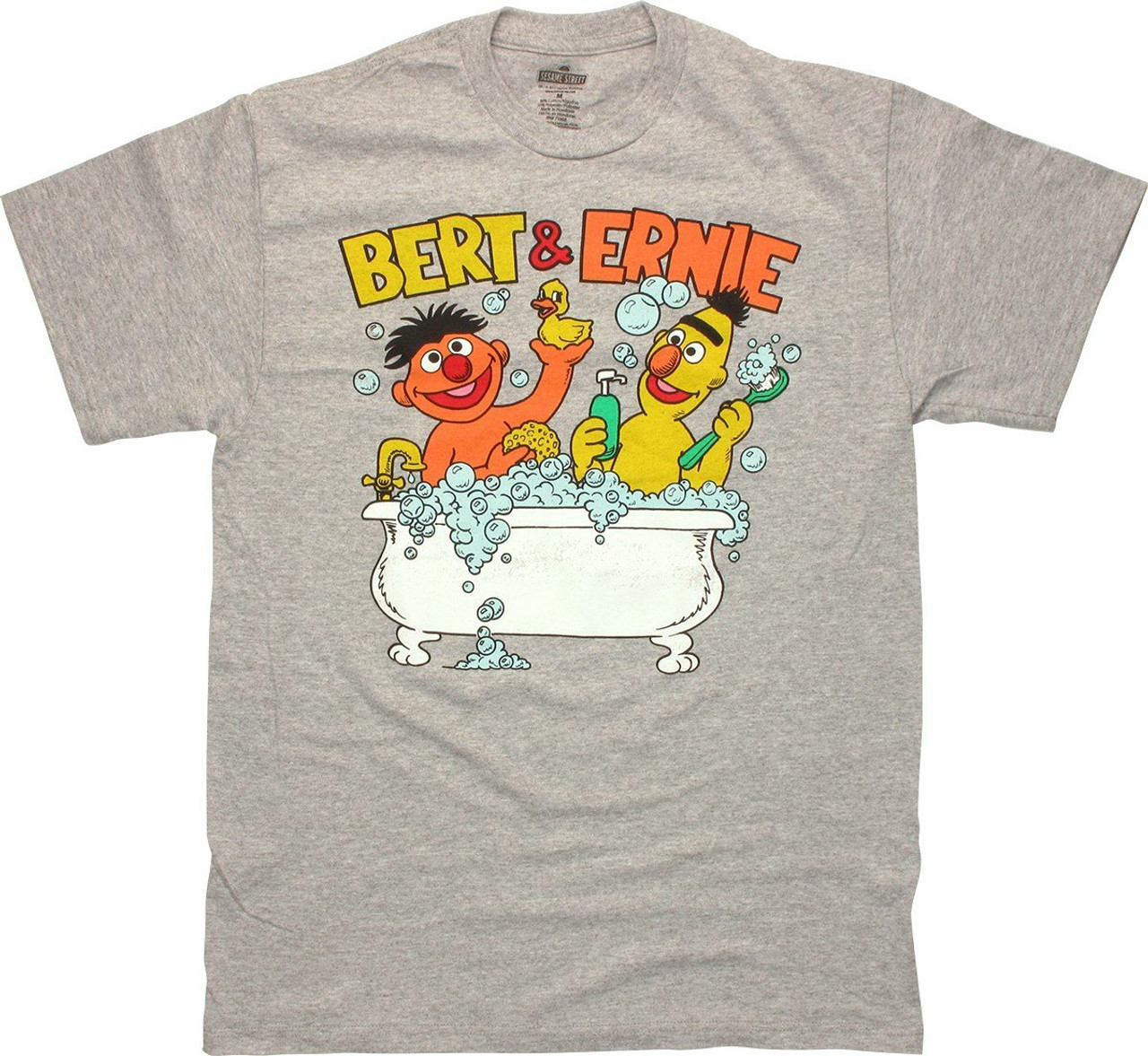
You’ve seen it a thousand times. That orange, round-headed guy sitting in a tub of suds, squeezing a yellow duck that squeaks like it’s being tickled. It is, perhaps, the most famous bathroom in the history of television. But when you actually look at the Bert and Ernie bathtub scenes through a modern lens, things get a little weird.
For starters, where exactly is the bathroom?
If you grew up watching Sesame Street, you probably assume there's a fixed floor plan for 123 Sesame Street. You'd be wrong. In the earliest episodes from 1969, the creators didn’t even have a dedicated bathroom set. For the very first bathtub sketch, the crew literally just dragged a tub into the middle of the living room set. It sat right there next to the chairs. No plumbing. No walls. Just Ernie and a whole lot of water in the middle of the carpet.
The Song That Changed Everything
We can't talk about the Bert and Ernie bathtub without talking about the "Rubber Duckie" song. It debuted on February 25, 1970, in episode 78. Most people think of it as just a cute kids' song, but it was actually a massive crossover hit.
Written by Jeff Moss—the show's head writer—and performed by the legendary Jim Henson, the track actually climbed to number 16 on the Billboard Hot 100 in September 1970. Imagine that for a second. A puppet singing about bath toys was competing with Creedence Clearwater Revival and The Carpenters.
It was a vibe. Honestly.
The duck itself has its own history. The original puppet prop wasn't a custom-built Muppet creation. It was a mass-produced toy called "Waddles," manufactured by the now-defunct Alan-Jay Plastics, Inc. Interestingly, the first version Ernie used wasn't even yellow. It was white with orange highlights. If you look at the cover of the 1970 Sesame Street Book and Record, you can see the white duck clear as day. Eventually, they swapped it for the iconic solid yellow version we know today, mostly because the yellow popped better on the era's television screens.
Why the Bert and Ernie Bathtub Scenes Mattered
Most kids' shows back then were... stiff. They were educational, sure, but they lacked the messy, relatable chaos of real life. Then came Ernie.
Ernie’s bathtub wasn’t just for cleaning; it was a sanctuary of imagination and, frankly, a place for him to annoy the heck out of Bert. There’s a classic sketch where Ernie brings an umbrella, a flashlight, and a bowling ball into the tub. Bert, being the high-strung, pigeon-loving realist that he is, thinks it’s ridiculous.
"Ernie, why do you have a bowling ball in the bathtub?"
Ernie’s logic was flawless: he needed it just in case someone showed up and asked to borrow a bowling ball while he was mid-scrub. The kicker? In the world of Sesame Street, that’s exactly what happens. The lights go out, the roof leaks, and a voice asks for a bowling ball.
It taught kids something subtle: being prepared for the absurd is a valid way to live.
The Evolution of the Set
As the show's budget grew, so did the bathroom. By the 1980s and 90s, the Bert and Ernie bathtub area had become a permanent part of the basement apartment set. It gained blue tiled walls and a window. This was a big deal for the puppeteers.
Performing these scenes was a physical nightmare.
To film a bathtub scene, the "tub" usually had to be built on a raised platform. Jim Henson (Ernie) would have to crouch underneath the tub, reaching up through a hole in the bottom that was sealed with waterproof gaskets or hidden by thick bubbles. Frank Oz (Bert) would be standing nearby, often leaning over the edge. Because they were working with actual water and real soap, the puppets would get soaked.
Muppets don't dry quickly.
They had "stunt" ducks and "stunt" puppets for these scenes. You couldn't just use the main Ernie puppet because the foam and fleece would rot if they stayed damp. They had to use specific versions of the characters treated for water resistance.
Cultural Impact and the "Ring Around Rosie"
There's a bit of trivia that usually gets lost in the mix. Ernie actually has a name for his bathtub. He calls it "Rosie."
Why? Because every time he takes a bath, he leaves a "ring around Rosie."
It’s a terrible dad joke, but it’s part of the DNA of the show. This kind of humor is why Sesame Street worked. It didn't talk down to kids; it invited them into a world of wordplay and character-driven comedy.
The relationship between the two roommates in that bathroom space also helped define their dynamic. Bert is the one who values hygiene and order; Ernie is the one who values the experience of the bath. In the 1978 special Christmas Eve on Sesame Street, there’s a heart-wrenching "Gift of the Magi" parody involving the bathtub. Ernie trades his beloved Rubber Duckie to Mr. Hooper to buy a cigar box for Bert’s rock collection. Meanwhile, Bert trades his prized paperclip collection to get a soap dish for Ernie’s duck.
It’s a heavy moment for a show with puppets, showing that the bathtub wasn't just a site for gags—it was a symbol of their friendship.
Practical Insights for the Nostalgic Collector
If you're looking to recreate the Bert and Ernie bathtub vibe at home—maybe for a kid’s bathroom or just because you’re a 70s/80s baby who misses the simplicity of Muppet-filled afternoons—there are some real-world details to keep in mind.
- The Authentic Duck: You can’t find the original "Waddles" by Alan-Jay Plastics easily anymore; they are high-value collector items. However, the "Celebrity Duck" line and various Sesame Street official merch have released replicas over the years. Look for the ones with the slightly matte finish if you want the vintage look.
- Color Schemes: The classic Bert and Ernie bathroom used a very specific "70s basement" palette. We're talking muted blues, off-whites, and that specific orange-yellow light. If you're painting, look for a "Cornflower Blue" for the tiles.
- National Rubber Ducky Day: Yes, this is a real thing. It’s January 13th. It was allegedly chosen because it’s the date Ernie first got his duckie, according to a 1970s Sesame Street calendar. If you’re a fan, that’s your high holiday.
The legacy of these sketches is more than just nostalgia. It’s about how Jim Henson and Frank Oz took a mundane, everyday chore—taking a bath—and turned it into a masterclass in character acting. They took a cheap plastic toy and made it a global icon of childhood.
Next time you see a yellow rubber duck, you aren't just seeing a toy. You're seeing the ghost of a 1970s Billboard hit and a testament to the idea that even in a basement apartment at 123 Sesame Street, bath time can be a legitimate adventure.
To really lean into the history, you can track down the original 1970 vinyl recording of "Rubber Duckie." Notice the subtle differences in Jim Henson's voice back then—it was slightly higher, more frantic, and arguably more full of the "good, clean fun" he was singing about. You can also look for the "Put Down the Duckie" special from 1988, which serves as a sort of spiritual sequel to the bathtub years, featuring Hoots the Owl and a massive list of celebrity cameos.