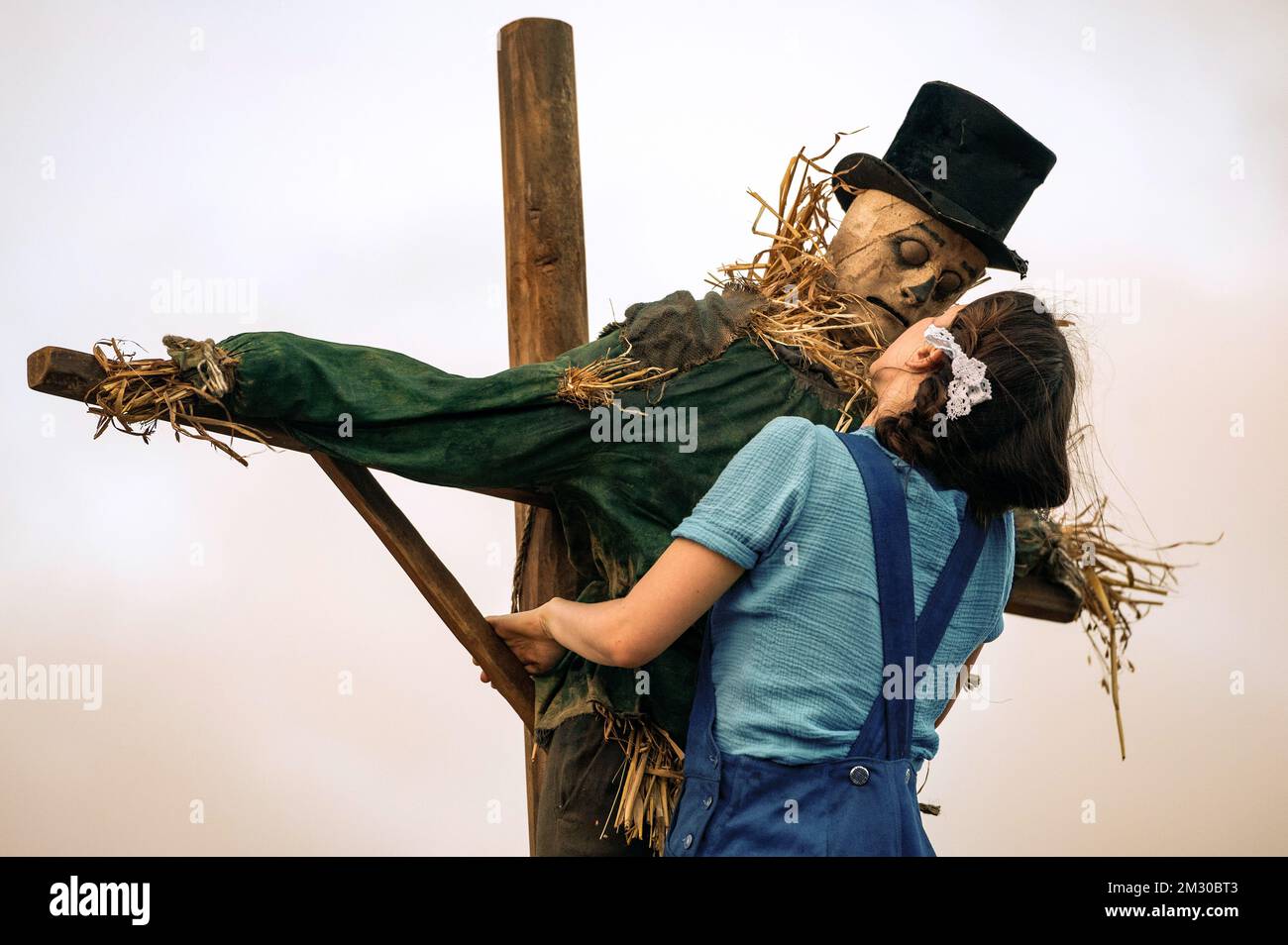
If you’ve spent more than five minutes on TikTok or film Twitter in the last couple of years, you’ve seen her. The braids. The smeared red lipstick. That wide, terrifyingly desperate grin. Mia Goth’s performance in Ti West’s Pearl basically rewrote the rules for modern "elevated slasher" icons, but one specific moment sits in the collective brain like a splinter. I’m talking about Pearl and the scarecrow. It’s uncomfortable. It’s weird. It’s deeply sad. Honestly, it’s probably the most misunderstood sequence in the entire A24 "X" trilogy.
Most people treat the scene like a jump scare or a "WTF" meme. You know the one—the part where a lonely farm girl decides a stuffing-filled effigy is a suitable romantic partner. But if you look closer, that encounter in the cornfield isn't just there for shock value. It is the literal pivot point for the entire movie. It’s where Pearl stops being a girl who dreams and starts being a monster who acts.
The Desperation Behind the Cornfield
Let's set the stage. It’s 1918. The Spanish Flu is ravaging the world, the Great War is winding down, and Pearl is trapped. She’s stuck on a stagnant Texas homestead with a paralyzed father she has to bathe and a mother, Ruth, whose bitterness is practically a physical weight. Her husband, Howard, is off at war. She is starving for attention. Not just "I want a hug" attention, but "I need the world to look at me and tell me I’m special" attention.
When Pearl wanders into that cornfield and encounters the scarecrow, she isn't just looking for a laugh. She is projecting every single one of her repressed sexual and emotional desires onto a burlap sack.
Why the scarecrow?
The scarecrow represents the ultimate submissive audience. Unlike her mother, it doesn't criticize her. Unlike the projectionist she meets later, it can’t leave her. For a few minutes in that field, Pearl is the star of her own twisted romantic drama. She dances with it. She talks to it. And then, in a sequence that made theater audiences audibly gasp, she gets intimate with it.
Ti West shot this with a saturated, Technicolor-inspired palette that mimics old Disney movies or The Wizard of Oz. That contrast is what makes it so jarring. You have this beautiful, lush cinematography paired with an act of pure, isolated desperation. It’s "The Wizard of Oz" if Dorothy had a psychotic break and decided the Scarecrow was her only ticket out of Kansas.
Mia Goth’s Mastery of the Uncomfortable
We have to talk about Mia Goth. She didn't just play the role; she co-wrote the script with West. Because she had such a hand in the character's DNA, the Pearl and the scarecrow scene feels grounded in a very specific kind of logic. Pearl isn't "crazy" in a way that feels random. She is logical within her own broken framework.
Goth plays the scene with a sincerity that is frankly heartbreaking. If she had winked at the camera or played it for laughs, the movie would have fallen apart. Instead, she treats the scarecrow like a long-lost lover. The way she whispers to it—it’s intimate. It’s vulnerable. When she finally "finishes" and the realization of what she’s doing starts to creep back in, you see the mask slip. That’s the genius of the performance. She makes you feel bad for a woman who is, at that very moment, doing something objectively repulsive.
The Projectionist vs. The Burlap Man
A lot of viewers miss the direct parallel between the scarecrow and the projectionist (played by David Corenswet). The scarecrow is the rehearsal; the projectionist is the performance.
- The Scarecrow: Pure fantasy. Controlled. Pearl is in charge.
- The Projectionist: Reality. Unpredictable. He represents the "Bohemian" life she craves.
When Pearl eventually kills the projectionist later in the film, it’s because he fails to live up to the version of a "fan" or "lover" that the scarecrow was. The scarecrow stayed still. It let her be whatever she wanted to be. The projectionist had the audacity to be a real human with fear and boundaries. When he got scared of her, he broke the fantasy. And in Pearl’s world, if you break the fantasy, you die.
Is it Actually Based on Anything?
While Pearl is a fictional prequel to X, the themes of isolation-induced psychosis are very real. Psychologists often point to "Objectophilia" or "Objectum Sexuality" as a real phenomenon, though in Pearl’s case, it’s clearly a symptom of her extreme environmental isolation and the brewing psychopathy that runs through the film.
Historically, 1918 was a time of immense loneliness for many women. With men at the front and a pandemic forcing people into quarantine, the "cabin fever" Pearl experiences wasn't entirely far-fetched. Obviously, most people didn't go out and murder their families with pitchforks, but the feeling of being "left behind" by the world was a universal trauma of that era.
The Visual Language of the Scene
Notice the framing. West keeps the camera at a distance for much of the encounter, making us feel like voyeurs. We are trespassing on something deeply private. It isn't shot like a horror movie kill; it's shot like a forbidden tryst. The sunlight is golden. The corn is high. It’s almost... romantic? And that’s exactly why it sticks in your gut. It’s the perversion of the "American Dream" aesthetic.
Why We Can’t Stop Talking About It
Social media loves a "weird" moment, but the reason Pearl and the scarecrow became a pillar of 2020s horror culture is that it taps into a modern fear of being "unseen."
We live in an era of curated identities. Everyone wants to be a "star" on their own digital stage. Pearl is the extreme, blood-soaked version of that urge. She wants to be a chorus girl. She wants to be on the big screen. When she realizes the world doesn't care, she turns to the only thing that will listen: a silent man made of straw.
It’s the ultimate "main character syndrome" gone wrong.
Moving Past the Shock: What to Watch Next
If you’ve finished Pearl and you’re still thinking about that field, you’ve probably realized that horror is moving away from simple jump scares and toward "character studies of the damned." Pearl isn't a monster because she has supernatural powers; she's a monster because she's lonely and entitled.
To truly understand the evolution of this character, you have to watch the films in order of their release, even if the timeline is jumping around.
- Step 1: Watch 'X' (2022). You need to see the "old" Pearl first to understand the tragedy of the "young" Pearl. Seeing her as an elderly woman desperate for her youth makes the scarecrow scene in the prequel even more pathetic.
- Step 2: Re-watch the 'Pearl' monologue. The six-minute unbroken shot at the end of the film is where the "scarecrow energy" finally boils over. She admits everything. It’s the greatest acting of Mia Goth’s career to date.
- Step 3: Dive into 'MaXXXine'. The final installment takes the "fame at any cost" theme and moves it to 1980s Los Angeles. It’s the logical conclusion of Pearl’s bloodline—the idea that some people will do literally anything to avoid being ordinary.
The takeaway from the scarecrow scene isn't just "wow, she’s crazy." It’s a warning about the rot that sets in when we prioritize being "loved" by an audience over being a human being. Pearl wanted to be a star, but she ended up alone in a basement, smiling at a husband who was too terrified to leave. The scarecrow was the only one who got out easy.