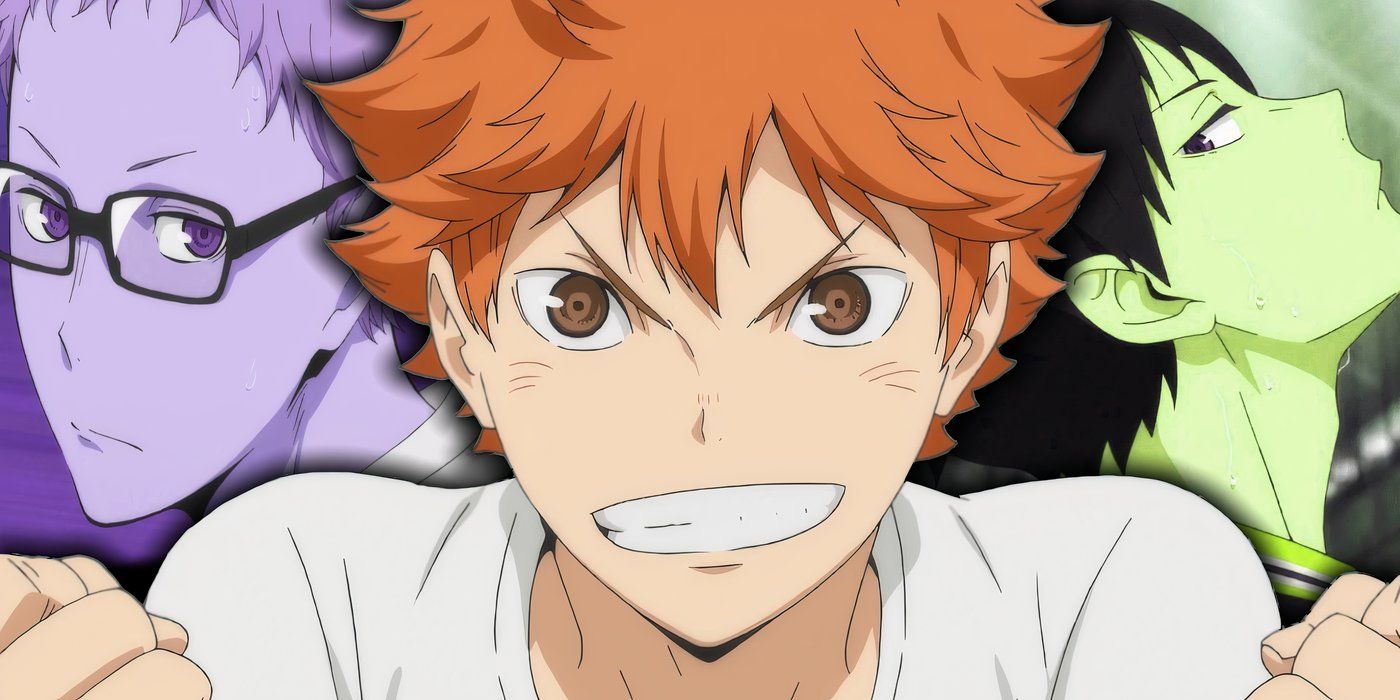
For years, he was just a silhouette. A ghost in a black jersey.
If you've spent any time watching Haikyuu!!, you know that the entire series is basically built on the back of a myth. Shoyo Hinata sees a tiny guy jumping over giant blockers on a grainy TV screen at an electronics store, and boom—a lifelong obsession is born. We call him the Little Giant. He’s the reason Karasuno became a powerhouse in the first place, and he’s the reason the "Crows" eventually found their wings again.
But here’s the thing. The Little Giant Haikyuu fans expected isn't exactly the guy we eventually met.
The story of Tenma Udai is actually a lot more complicated—and arguably more moving—than just a "legendary player" trope. It’s a story about what happens when you aren't the protagonist of the universe anymore. It’s about the reality of sports that most shonen anime refuse to touch with a ten-foot pole.
The Myth vs. The Man: Who was Tenma Udai?
When we talk about the Little Giant Haikyuu lore, we’re talking about a specific window of time roughly ten years before the main events of the series. Tenma Udai was the ace of Karasuno High School. He stood at roughly 170 cm (about 5'7"), which is minuscule for a high-level spiker.
He didn't succeed because he was "chosen." He succeeded because he was a technical nightmare for opponents.
While Hinata relies on raw speed and the "freak quick" with Kageyama, Tenma was a master of the tool. He used the block against itself. He aimed for the fingertips to force "block outs." He had this eerie, intense focus that made him look like a monster on the court. Saeko Tanaka, Ryunosuke’s older sister, famously recalls him as someone who radiated a terrifying aura. He wasn't just "good." He was the kind of player who made you feel small, even if he was the shortest guy in the gym.
But why did he disappear?
In most anime, a legend like that goes on to play for the national team. Or maybe he becomes a legendary coach. But Haruichi Furudate, the creator of the manga, decided to do something much more grounded. When Hinata finally meets his idol during the Nationals arc, Tenma isn't there to play. He’s there as a spectator. He’s a college student. He’s a mangaka.
And he’s not even playing volleyball anymore.
The Crushing Weight of Being an Idol
Imagine being Shoyo Hinata in that moment. You’ve spent three years of middle school and your entire high school career chasing a shadow. You’ve modeled your entire identity around this one person. Then, you meet him, and he tells you, "I'm not doing that anymore. I wasn't even that good in college."
It’s a gut-punch.
Tenma Udai reveals that he stopped playing because he simply found people who were better than him. He lost his spark for the game. This is the "A-side" of sports that people don't like to talk about. Not everyone who is a star in high school becomes a pro. In fact, most don't.
Why the "Little Giant" stopped playing
- The Physical Ceiling: In high school, you can technical-skill your way past a 190 cm blocker. In the pro leagues or even high-level college ball, everyone is 190 cm and they also have the technical skill.
- The Loss of Motivation: Tenma admitted he just didn't have the same drive once he hit a wall.
- New Passions: He shifted his focus to drawing, eventually creating a manga called Zombie Knight. (Which, hilariously, was not very successful in the Haikyuu universe initially).
The Evolution of the "Little Giant" Title
The term Little Giant Haikyuu eventually stops belonging to Tenma Udai. This is a crucial pivot in the narrative. During the Quarterfinals of the Spring Tournament, Karasuno faces Kamomedai High. This is where we meet Korai Hoshiumi.
Hoshiumi is everything Hinata wanted to be. He’s short, but he’s an all-rounder. He can serve, receive, set, and spike with elite precision. When Hoshiumi and Hinata face off, the commentator explicitly refers to Hoshiumi as the "current" Little Giant.
This creates a fascinating three-way comparison:
- Tenma Udai: The Original. The one who proved it was possible.
- Korai Hoshiumi: The Perfection. The one who took the "Little Giant" archetype to its absolute peak.
- Shoyo Hinata: The Successor. The one who realized he didn't want to be the Little Giant—he wanted to be the Greatest Decoy.
What Most People Get Wrong About Tenma's Impact
There’s a common misconception that Tenma Udai’s "quitting" makes his legacy less important. That’s wrong. Honestly, it makes it more important.
Tenma’s existence provided a blueprint. Without him, the Karasuno volleyball club would have folded into obscurity long ago. He was the reason the "Little Giant" nickname became a symbol of hope for short players across Japan. Even if he didn't continue, the ripples he created changed the lives of Hinata, Hoshiumi, and even Kageyama.
It’s also worth noting that Tenma isn't "sad" about his choice. When he shows up at Nationals to cheer for Karasuno, he’s genuinely happy. He’s moved by seeing Hinata wear the number 10. He’s okay with being a "former" player. There is a profound maturity in acknowledging that your peak in one area of life might be behind you, but your life isn't over.
The Technical Style: How He Actually Played
If you're trying to emulate the Little Giant Haikyuu style in your own game (or just want to understand the mechanics), you have to look at his "wipe" technique.
Tenma didn't try to hit through the block. He hit off the block. By deliberately aiming for the outer edge of a blocker's hand, he ensured the ball would ricochet out of bounds. This is a nightmare for defenders because even if they "touch" the ball, they can't control it.
He also had incredible air walk capabilities. Furudate draws him with a specific posture: chest out, back arched, and a late swing. This allowed him to see the block forming in mid-air and adjust his trajectory at the last possible millisecond. It’s not just jumping high; it’s staying up long enough to make a decision.
The Reality of the "Little Giant" Keyword in 2026
Looking back at the series now, the Little Giant Haikyuu fans once worshipped has been redefined. We see him in the final chapters as a successful (or at least working) mangaka who still hangs out with Akiteru Tsukishima.
The legacy of the Little Giant isn't a trophy or a pro contract. It’s the fact that a short kid in a middle school club with no members saw a tiny figure on a screen and decided to jump.
It’s about the spark.
If you're a fan looking to dive deeper into the lore, I highly recommend re-reading chapters 338 through 340. That’s where the "meeting of the giants" happens. It’s a masterclass in character writing that subverts every expectation you have for a sports mentor figure.
Key Takeaways for Fans and Players
- Don't Box Yourself In: Hinata eventually realized he didn't need to be a carbon copy of Tenma to be successful.
- Technicality Trumps Height: If you're short, your "wipe" and "tooling the block" skills are your best friends.
- Legacy is Fluid: You can inspire someone for a lifetime even if you only play for three years.
- Life Post-Sports: It’s okay to move on. Tenma Udai is a rare example of a character who "failed" the traditional sports trajectory but succeeded as a human being.
If you really want to understand the impact of the Little Giant Haikyuu narrative, stop looking at the stats and start looking at the influence. Tenma Udai didn't need to win a gold medal to change the world of volleyball. He just needed to jump once, at the right time, while a kid named Shoyo was watching.
Actionable Insight for Creators and Athletes:
Next time you feel limited by your "specs"—whether that's height in sports or lack of resources in a career—look at the "wipe" technique. Don't hit the wall head-on. Aim for the edges. Use the obstacle's own weight and position to your advantage. And remember: your "peak" doesn't define your worth for the rest of your life. Keep drawing, keep playing, or keep moving—just make sure you're the one choosing the direction.