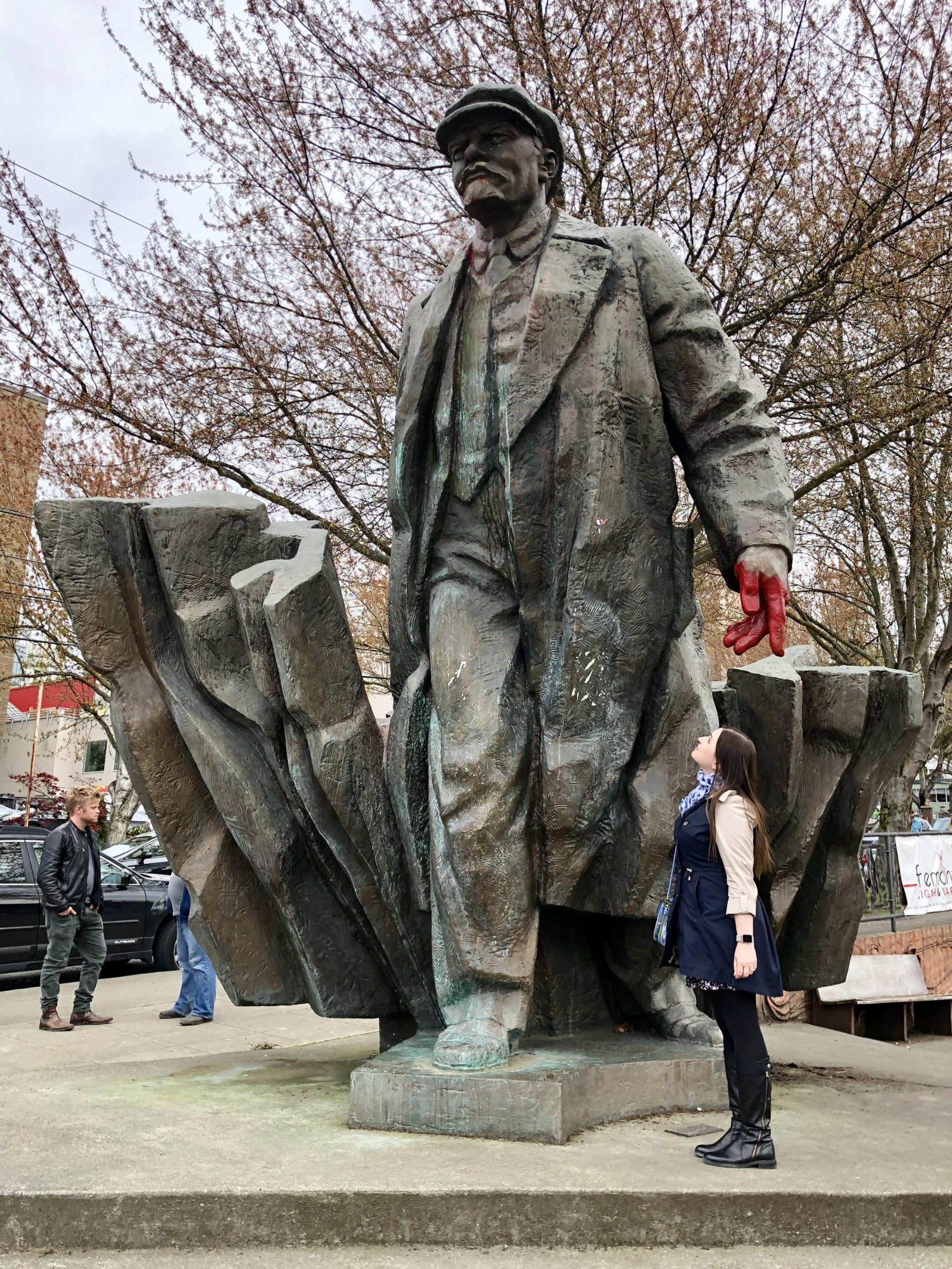
You’re walking through Seattle's Fremont neighborhood, maybe nursing a latte or looking for a vintage flannel, and suddenly—boom. There he is. A 16-foot-tall bronze Vladimir Lenin, scowling and striding through abstract flames and guns.
It's jarring.
Honestly, it’s one of those things that shouldn't exist in the middle of a high-end, tech-heavy American city. Yet, the statue of Lenin Seattle has stood its ground at the intersection of North 36th Street and Evanston Avenue North since the mid-90s. Most people see it and immediately wonder if they’ve accidentally wandered into a socialist enclave. But the reality of how this seven-ton relic ended up in the "Center of the Universe" is way more about a guy with a mortgage and a failed restaurant dream than it is about a communist uprising.
From a Slovakian Scrapyard to the Pacific Northwest
This isn't some cheap replica. It’s a genuine piece of Soviet-era propaganda.
In 1988, the Communist Party of Czechoslovakia commissioned Bulgarian sculptor Emil Venkov to build this beast. Venkov was a bit of a rebel, though. While most Lenin statues at the time showed him as a peaceful scholar holding a book, Venkov went dark. He sculpted Lenin as a violent revolutionary, surrounded by the machinery of war. It was barely on display for a year before the Velvet Revolution hit in 1989.
Communism fell. Lenin was toppled. The statue was hauled off to a scrapyard in Poprad, Slovakia, to be melted down for the bronze.
Enter Lewis Carpenter.
Carpenter was an English teacher from Issaquah, Washington, working in Poprad. He found the statue lying face down in the mud with a homeless man literally living inside the hollow torso. Most people would see scrap metal; Carpenter saw art. He mortgaged his house, spent about $13,000 on the bronze, and dropped another $28,000 to cut it into pieces and ship it across the Atlantic.
He wanted to put it outside a Slovakian restaurant in Issaquah. Unfortunately, Carpenter died in a car accident in 1994 before he could make it happen. His family was left with a seven-ton communist leader in their backyard and no idea what to do with it.
Why the Statue of Lenin Seattle Stays Put
Fremont is a neighborhood that prides itself on being weird. Its motto is literally "De Libertas Quirkas" (The Freedom to be Peculiar). In 1995, a local foundry owner named Peter Bevis convinced the Carpenter family to let him display the statue on a triangular patch of private land in Fremont until they could find a buyer.
That "temporary" display has lasted over 30 years.
The Legal Loophole
You might wonder why the city doesn't just tear it down. The answer is simple: they can't.
- The statue sits on private property.
- It is privately owned by the Carpenter family trust.
- The First Amendment protects the right to display it, regardless of how offensive people find the subject.
Because it isn't a government-sanctioned monument, it doesn't fall under the same rules as the Confederate statues that have been removed across the country. It’s basically a massive, controversial lawn ornament.
A Neighborhood’s Mixed Feelings
If you visit today, you’ll notice Lenin’s hands are almost always covered in bright red paint.
Locals do this intentionally. It’s a constant reminder of the "blood on his hands" and the millions who died under the regime he founded. It’s an ongoing conversation between the art and the community.
Fremont treats the statue with a level of irony that is uniquely Seattle. One week, he’s wearing a tutu for the Solstice Parade. During the holidays, he gets wrapped in Christmas lights and topped with a star. At Halloween, someone usually turns his head into a giant pumpkin.
It’s not an endorsement. For most people living here, the statue is a trophy of the Cold War. It’s a "we won, you lost" statement. As the local saying goes, the best way to insult a dictator is to put him in a neighborhood where he’s surrounded by taco shops, gelato stands, and drag queens.
The $250,000 Price Tag
Here is the kicker: the statue of Lenin Seattle is still for sale.
The Carpenter family has been trying to offload it for decades. The asking price has fluctuated over the years, but it usually hovers around $250,000. So far, no one has bit. It’s a hard sell. You need a massive crane, a flatbed truck, a lot of money, and a very thick skin to deal with the inevitable protests that would follow its relocation.
If You’re Planning a Visit
If you want to see it for yourself, it’s an easy stop.
- Location: Intersection of N 36th St and Evanston Ave N.
- Parking: Good luck. Fremont is notoriously tight. Try the paid lot under the Aurora Bridge or look for street spots a few blocks north.
- Nearby: You’re only two blocks away from the Fremont Troll and the Rocket. Make a loop of it.
Actionable Insights for the Curious
If you’re heading to see the statue or debating its presence, keep these points in mind:
- Read the Plaque: There is an informational sign near the base. It explains the history and the fact that it is a "relic of a vanished empire." It provides the context that often gets lost in social media outrage.
- Respect the Neighborhood: Fremont residents have a complex relationship with the bronze guy. Don't assume everyone there is a Marxist—most are just used to the quirky landscape.
- Check the Calendar: If you want to see Lenin at his most ridiculous, go during the Fremont Solstice Fair in June. The costumes are... something else.
- Understand the Ownership: If you feel strongly that it should be removed, the only legal way is to buy it from the family. The city government has zero jurisdiction here.
The statue remains a lightning rod. Every few years, a politician or a protest group tries to get it moved, but the legal reality of private property always wins out. It serves as a bizarre, uncomfortable, and fascinating reminder that history—even the parts we hate—tends to stick around in the most unexpected places.