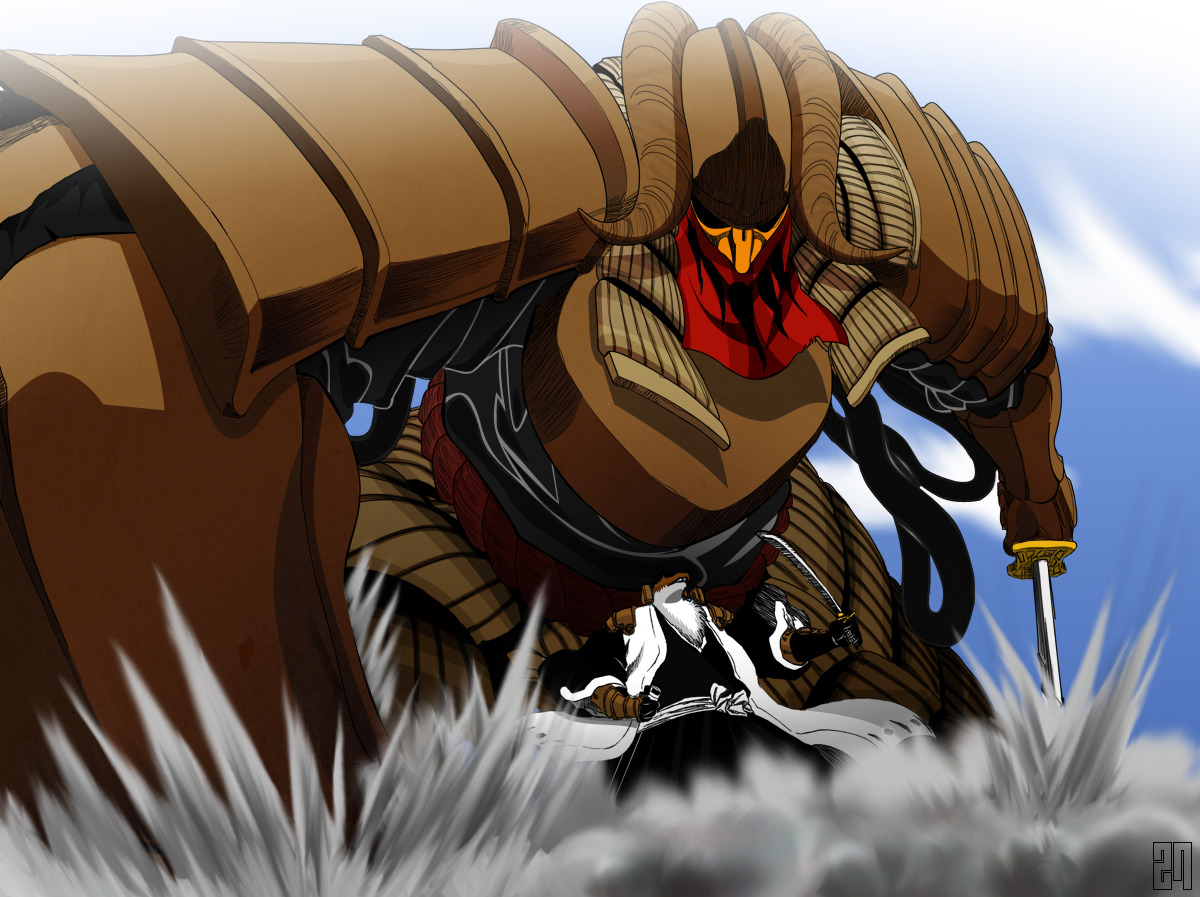
Sajin Komamura is a dog. Well, a wolf-man. But for the longest time in Tite Kubo’s Bleach, he was just the "big guy with the bucket on his head" who eventually became the Soul Society’s most loyal heart. When we talk about the Sajin Komamura Bankai, most fans immediately picture that massive, armored samurai looming over the battlefield. It’s iconic. It’s heavy. It’s also one of the most misunderstood powers in the entire Gotei 13.
Most Bankai function like a tool or an elemental buff. Ichigo gets fast. Hitsugaya makes ice. But Komamura? His Bankai is a literal extension of his own flesh and blood. That sounds cool until you realize it means every time his giant samurai gets stabbed, Komamura feels the blade.
Honestly, it’s a miracle he survived as long as he did.
The Mechanics of Kokujo Tengen Myoo
So, what is it? The name translates roughly to "Kala Sutra Heavenly Punishment" or "Vidyaraja of Kalasutra." It summons a giant. Simple as that. This hundred-meter-tall titan mimics Komamura’s every move. If Sajin swings his sword, the giant swings a mountain-sized version of it. It’s raw, blunt-force trauma on a spiritual scale.
The link between the user and the Zanpakuto is unique here. In the Bleach universe, if a Bankai is broken, it usually can't be fixed. Mayuri Kurotsuchi explains this during the Thousand-Year Blood War arc. However, Komamura is the exception to the rule. Because he and the giant are "one," if the Bankai is damaged, Komamura gets hurt, but if Komamura heals, the Bankai restores itself.
It’s a double-edged sword. You get a self-repairing giant, but you also become a massive, walking target.
During the battle with Kaname Tosen and later against the Arrancar, we saw the sheer destructive output of this thing. It’s not about finesse. It’s about crushing the ground beneath your feet. But against opponents with high speed or hax abilities, the Sajin Komamura Bankai often felt like a liability. It’s slow. It’s cumbersome. It’s a giant hitbox for anyone with a Cero or a Quincy arrow.
The Humanization Technique and the Dangai Joe Form
Everything changed during the Quincy invasion. After getting his Bankai stolen by Bambietta Basterbine, Komamura went back to his roots. Literally. He visited the elder of his clan—a massive, ancient wolf—and performed a ritual to gain the "Humanization Technique" (Jinrenka).
He ripped his own heart out.
By sacrificing his heart, he gained a temporary human form and immortality. But the real upgrade was to his Bankai. When he summoned it in this state, it shed its armor. This is the Kokujo Tengen Myoo: Dangai Joe.
In this form, the giant is just a mass of exposed muscle and spiritual energy. It’s terrifying. It’s fast. And because Komamura was technically immortal during the technique’s duration, the Bankai became invulnerable too.
Why Dangai Joe is Different
- Armor Shedding: The armor was actually a seal or a weight. Without it, the giant moves with frightening speed.
- Immortality Link: Since Sajin couldn't die, the giant couldn't be destroyed. It basically turned the Sajin Komamura Bankai into an unstoppable force of nature for a few brief minutes.
- Visual Shift: The giant looks like a demonic king. It fits the theme of "Heavenly Punishment" perfectly.
It’s a brutal irony. To protect the Soul Society, the most loyal man in the series had to discard his humanity (and his heart) to become a monster. The fight against Bambietta wasn't even a fight; it was a slaughter. She blasted him with bombs that should have vaporized a captain, and he just kept walking.
The Tragic Aftermath of the Wolf Clan's Curse
Power always costs something in Bleach. For Komamura, the price of using the ultimate version of the Sajin Komamura Bankai was his sentience. Once the Humanization Technique wore off, he didn't just go back to being a wolf-man. He became a full, regular wolf.
He lost his ability to speak. He lost his rank. He lost his place in the Gotei 13.
It’s one of the most heartbreaking endings for any character in the series. Tite Kubo didn't give him a hero's retirement. He gave him a quiet life on the hillsides, handled by his lieutenants, Iba and others. He sacrificed his soul to settle a grudge and protect his friends.
Some fans argue that Komamura’s choice was driven by vengeance rather than duty. That's a fair point. His elder specifically called him out on it. He wanted to kill Yhwach and the Sternritter because they hurt his "world," which was basically Captain Commander Yamamoto. When Yamamoto died, Komamura lost his moral compass.
What Most People Get Wrong About His Power
You'll see people on Reddit or Twitter saying Komamura is "weak" because he lost a lot of fights. That’s a bit of a shallow take.
The Sajin Komamura Bankai is a scaling nightmare. If you are a physical fighter, you lose to him. You can't out-muscle a guy who controls a hundred-meter samurai. The problem is that Bleach characters are often literal gods with reality-warping powers. Aizen defeated him because, well, it's Aizen. Tosen defeated him because he used sound and sensory deprivation.
In terms of raw physical strength, Komamura is likely the strongest Captain outside of Kenpachi Zaraki.
Also, the "link" between him and his Bankai isn't a weakness—it's a trait. People forget that most Bankai owners are screwed if their sword breaks anyway. Sajin just makes the connection literal.
Actionable Insights for Fans and Lore Hunters
If you're revisiting the series or watching the Thousand-Year Blood War anime, keep an eye on these specific details regarding Komamura's evolution:
- Watch the Armor: In the early arcs, the armor on the giant is pristine. As the series progresses and Komamura becomes more desperate, the "unarmored" concept starts to make more thematic sense.
- Symbolism of the Heart: The ritual isn't just a power-up. It's a rejection of the Buddhist cycle of reincarnation. The Wolf Clan was cast into the "Beast Realm" because of their sins. By taking human form, Komamura briefly escaped that cycle, only to fall further into it by the end.
- The Iba Connection: Pay attention to Tetsuzaemon Iba’s reactions. He is the one who truly understands the weight of Komamura's Bankai. He knows that every swing costs his captain years of his life.
The Sajin Komamura Bankai remains one of the most visually stunning abilities in anime history. It’s not just a big robot; it’s a manifestation of a man's loyalty and his eventual descent into the very beastly nature he tried to hide. It serves as a grim reminder that in the world of Soul Reapers, the greatest power usually requires the greatest sacrifice.
If you want to understand the true themes of Bleach—duty, revenge, and the cost of war—look no further than the giant samurai standing behind a man who just wanted to prove he was more than a monster.
To truly appreciate the depth of this transformation, re-read chapters 556 through 558 of the manga. The artwork there captures the visceral nature of the Dangai Joe form in a way the original anime couldn't quite reach. It’s raw, it's bloody, and it’s the definitive end of one of the series' most honorable heroes.