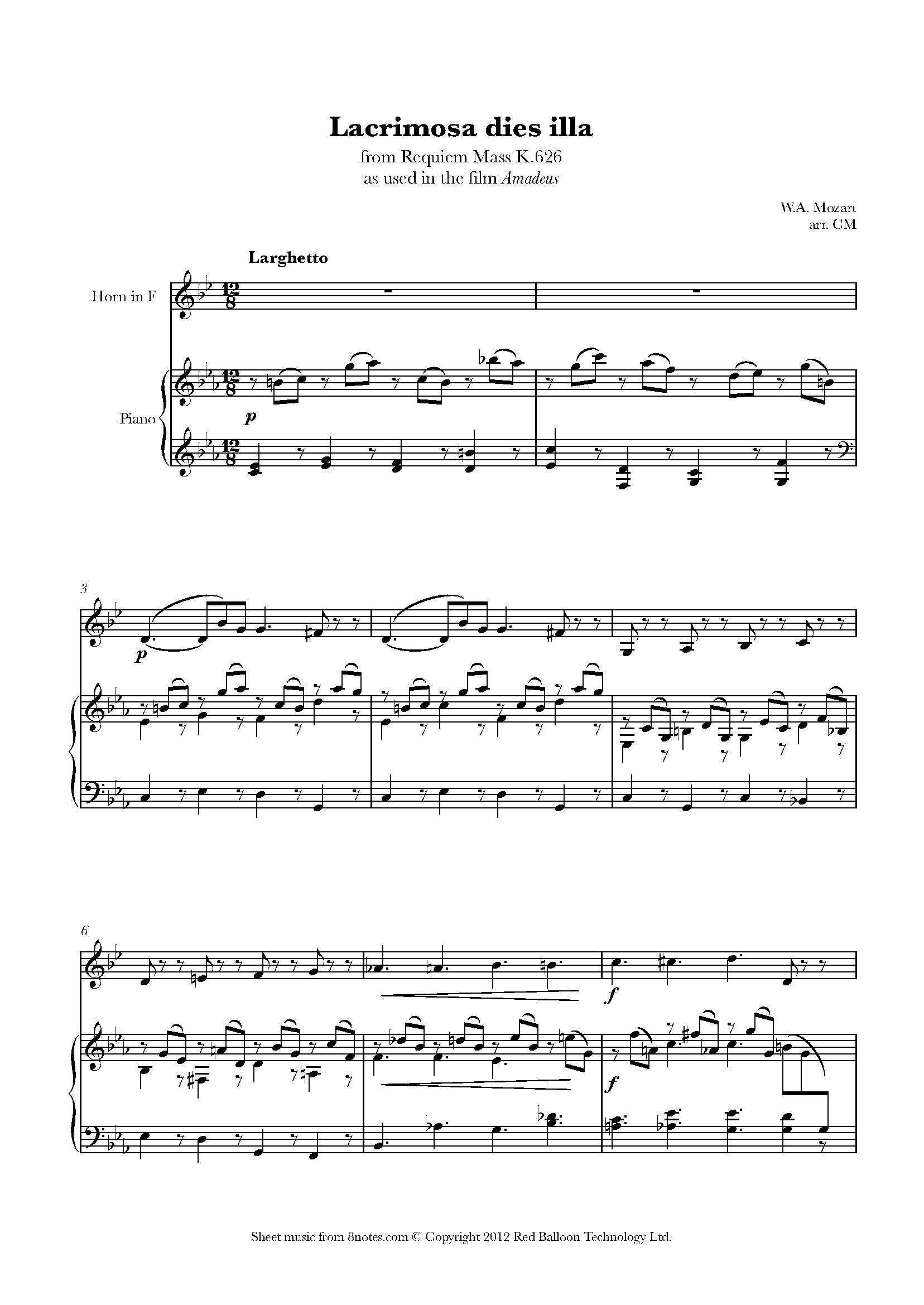
Imagine sitting at a wooden desk in a cold house in Vienna, realizing you’re writing the music for your own funeral. That’s not some dramatic movie trope. It was the literal reality for Wolfgang Amadeus Mozart in late 1791. The Requiem in D Minor Lacrimosa Mozart is arguably the most famous piece of unfinished music in history, and honestly, the "Lacrimosa" is the heart of that tragedy. It’s eight measures of pure, concentrated grief. After those eight bars, Mozart died. The pen literally dropped.
People love a good mystery. Was he poisoned? Was there a "Grey Messenger" sent by a rival? Most of that is just Amadeus fiction, but the truth is actually weirder. Mozart was obsessed. He was sick, likely from rheumatic inflammatory fever, and he convinced himself he was being tasked by a supernatural force to compose a mass for his own death.
Why the Lacrimosa Hits Different
There’s a reason this specific movement shows up in every sad movie trailer or dramatic TikTok edit. It’s the "weeping" movement. The word Lacrimosa literally means "tearful."
Musically, it’s built on a "sighing" motif. You hear the strings—two notes, one rising, one falling—that mimic the sound of someone sobbing. It’s haunting. Mozart chose the key of D minor for a reason. In the 18th century, different keys were thought to hold specific emotional "colors." D minor was the key of melancholy and devotion. Think about the opening of Don Giovanni where the Commendatore drags Don Giovanni to hell. Same key. Same terrifying weight.
But here's the thing: Mozart only wrote the first eight bars of the Lacrimosa.
He got to the words Homo reus (the guilty man) and then... nothing. The rest of what you hear when you listen to a recording today was actually finished by his student, Franz Xaver Süssmayr. This creates a massive debate among musicologists. Some think Süssmayr did a decent job; others think he was a hack who ruined Mozart’s vision.
The Mystery of the "Grey Messenger"
We have to talk about Count Franz von Walsegg. He’s the guy who actually commissioned the work. He wasn't a ghost. He was just a wealthy guy who liked to pretend he was a genius composer. He would commission works from famous artists, copy them out in his own hand, and then perform them as his own.
He wanted a Requiem for his young wife, Anna, who had passed away. He sent a servant to Mozart's house to arrange the deal anonymously. Mozart, already suffering from hallucinations and intense physical pain, didn't know it was just a local aristocrat with an ego problem. He thought it was a divine warning.
What Mozart Actually Wrote
If you look at the original manuscript—which you can actually see digitized via the Austrian National Library—you can see the exact moment the handwriting changes. Mozart finished the "Introitus." He sketched out the "Kyrie," the "Sequence," and the "Offertorium."
But the Requiem in D Minor Lacrimosa Mozart is where the paper essentially goes blank.
- Mozart’s part: The first 8 bars (The iconic rising violin line and the first vocal entries).
- Süssmayr’s part: The remaining 22 bars, including the massive "Amen" at the end.
- The Controversy: Many experts, including the legendary conductor Nikolaus Harnoncourt, have pointed out that Süssmayr's orchestration is a bit "thick" and lacks Mozart's subtle transparency.
Constanze Mozart, Wolfgang’s widow, was in a tough spot. If the work wasn't finished, she didn't get the final payment. She basically ran a 18th-century "ghostwriting" operation, asking several of Mozart's students to finish it in secret so she could pass it off as his completed final masterpiece.
The "Amen" That Never Was
In the 1960s, a musicologist named Wolfgang Plath found a "Lachrymosa" sketch (spelled with a 'y' back then) that looked like a complicated fugue for an "Amen" section. This discovery turned the classical music world upside down.
It suggests that Mozart intended for the Lacrimosa to end with a massive, complex vocal puzzle, rather than the simple, somewhat clunky ending Süssmayr wrote. Modern composers like Robert Levin have actually tried to "re-finish" the Requiem using these sketches to get closer to what Mozart might have intended.
Why We Are Still Obsessed
Is it the music or the myth? Honestly, it’s both.
The music is mathematically perfect yet emotionally devastating. When the choir enters on that first "Lacrimosa dies illa," it feels like the world is ending. It taps into a universal human fear: leaving things unfinished.
We see ourselves in Mozart’s struggle. We’ve all had projects we couldn't finish, words we didn't get to say, or a feeling that time is running out. Listening to the Requiem in D Minor Lacrimosa Mozart is like eavesdropping on a man's final conversation with the universe.
Common Misconceptions About the Requiem
- Antonio Salieri didn't kill him. They were actually on decent terms. Salieri even attended a performance of Mozart's The Magic Flute and raved about it.
- He didn't dictate the whole thing on his deathbed. The movie Amadeus shows him dictating the "Confutatis" to Salieri. In reality, Mozart was mostly unconscious toward the very end, though his friends did reportedly sing through parts of the Requiem with him the afternoon before he died.
- It wasn't a "failure." Even unfinished, the Requiem became an instant legend. It was performed at a memorial for Mozart shortly after his death, and it solidified his status as a "martyr" of music.
How to Truly Experience the Lacrimosa
If you want to move beyond just "listening" and actually "understand" the piece, you need to change your environment. Turn off the lights. Put on high-quality headphones.
Don't just listen to the melody. Follow the bassline. The way the lower strings "walk" creates a sense of inevitable movement toward a destination no one wants to reach. Notice the "plagal cadence" at the very end—the "Amen." It sounds like a deep, final exhale.
Actionable Steps for Classical Newbies
If you're just getting into this, don't just shuffle a random Spotify playlist.
- Compare Versions: Listen to the Herbert von Karajan 1975 recording for a massive, "wall of sound" Romantic feel. Then, listen to Philippe Herreweghe’s version for a "period accurate" sound that is leaner and more haunting.
- Read the Text: Look up the Latin "Dies Irae" poem. Knowing that the lyrics are about the "Day of Wrath" where the world turns to ashes makes the music ten times more intense.
- Watch the Score: Search for "Lacrimosa score" on YouTube. Seeing those eight bars stop and the different ink begin for Süssmayr’s completion makes the history feel real.
- Explore the "New" Completions: Check out the Robert Levin completion. It includes that "Amen" fugue based on Mozart's lost sketches. It's faster, more aggressive, and arguably more "Mozartian."
The Requiem in D Minor Lacrimosa Mozart isn't just a piece of music; it's a historical artifact of a genius's final breath. It reminds us that even when life is cut short, the "sketches" we leave behind can change the world for centuries.
To get the most out of this masterwork, start by listening to the "Introitus" to understand the themes Mozart established before he reached the breaking point of the Lacrimosa. Compare the structural density of the movements Mozart finished himself against the Süssmayr sections to train your ear to recognize Mozart's specific harmonic "thumbprint."