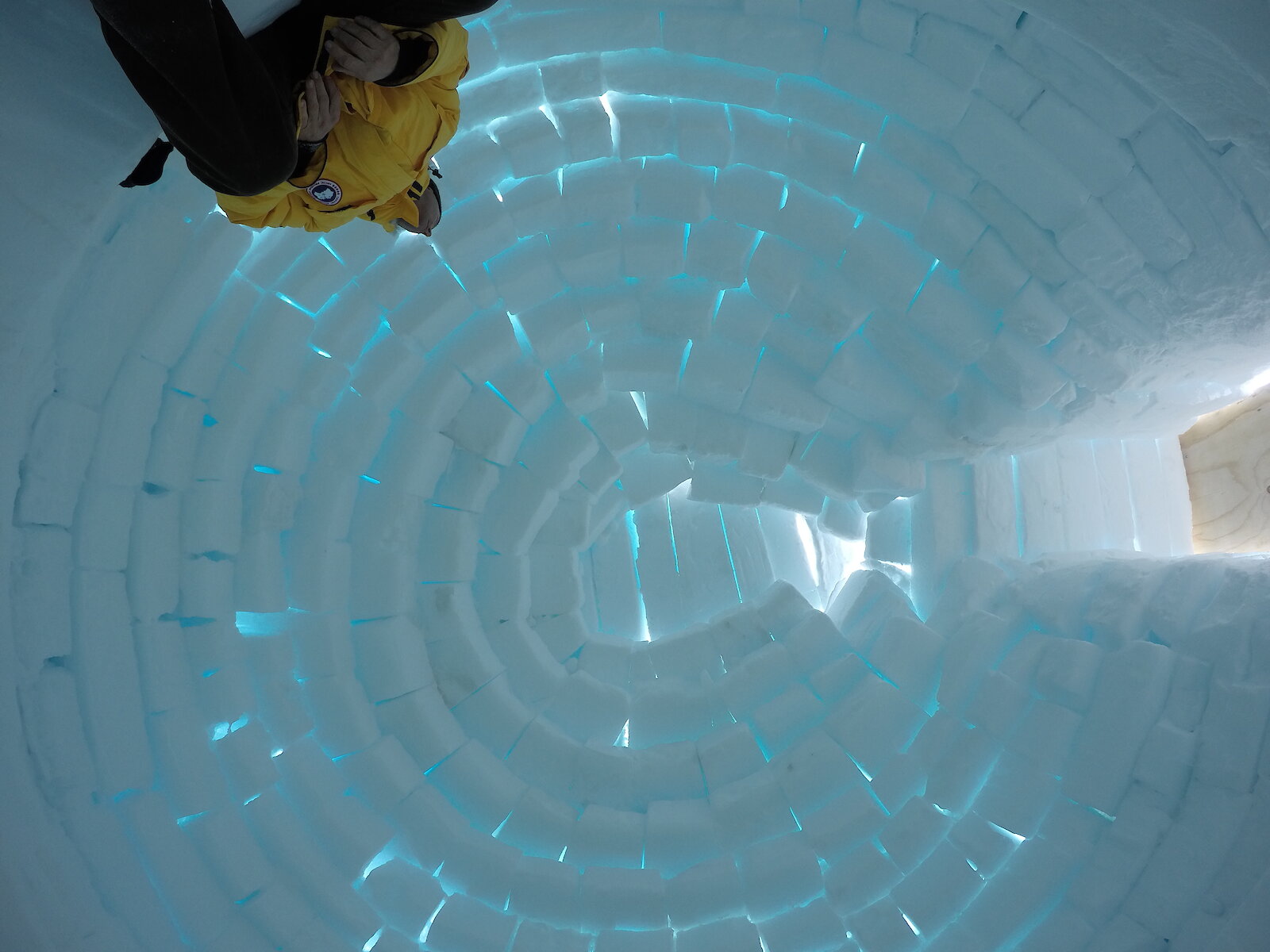
It is dead quiet. That is the first thing you notice. When you are standing in a real life igloo inside, the world outside—the howling Arctic wind, the crunch of snow, the distant drone of a snowmobile—just vanishes. It’s like being wrapped in a giant, frozen marshmallow. Most people think it’s going to feel like standing inside a commercial walk-in freezer at a restaurant. It doesn't.
Actually, it feels cozy. Sounds weird, right? But the snow is a massive insulator. It traps air.
If you’ve ever wondered why Inuit hunters didn't just freeze to death in minutes, the answer lies in thermodynamics. A well-built igloo can keep the interior temperature about 40 to 60 degrees Fahrenheit warmer than the outside air. If it’s -40°C outside, it might be a relatively balmy 0°C to 5°C inside just from your own body heat. No furnace. No campfire. Just you and a very specific type of compressed snow.
The Physical Reality of a Real Life Igloo Inside
Forget the cartoons. You don’t see penguins (they live in the Southern Hemisphere anyway) and you don't see perfectly clear ice cubes stacked like Legos. Real igloos are made of "pukak." That’s the wind-packed snow that is hard enough to be sawed into blocks but light enough to hold air pockets.
When you step through the entrance, you usually have to crawl. This isn't just because the builders were being humble. It’s a "cold trap." The entrance tunnel is dug lower than the main living floor. Since cold air is denser than warm air, the cold sinks into that trench, while the heat from your breath and skin stays up on the sleeping platform where you actually need it.
Inside, the walls aren't flat. They are curved in a catenary arch—the same shape a hanging chain makes—which is the most stable structure in nature. Over time, the heat from the occupants slightly melts the innermost layer of the snow blocks. Then, it refreezes into a thin, icy glaze. This makes the structure incredibly strong. It’s basically a self-welding building.
Lighting and Atmosphere
The light is the best part. During the day, the snow acts as a diffuser. The whole real life igloo inside glows with a soft, ethereal blue light. It’s dim, but you can see perfectly well. If someone lights a qulliq—the traditional Inuit oil lamp made of soapstone—the ice reflects the flame, and the whole dome turns a flickering orange.
It smells like nothing. Just clean, cold air.
There is a specific silence here that you can’t find in a house. Modern homes have hums. Fridges, HVAC systems, the buzz of electricity. In an igloo, there is zero resonance. The porous snow absorbs every vibration. You can hear your own heartbeat if you sit still long enough.
Why It Doesn't Melt (Mostly)
You’d think a bunch of humans huddling together would turn the place into a puddle. It doesn't happen because of the constant battle between the heat inside and the freezing temperatures outside. The snow blocks are thick. The cold from the Arctic tundra is constantly "wicking" the heat away from the outer surface.
As long as the outside air stays well below freezing, the igloo remains a solid fortress. However, if you get too many people in there or leave a stove running too high, you’ll start to see "weeping." That’s when droplets form on the ceiling. Experienced builders fix this by shaving the ice or slightly increasing ventilation through the small hole at the top of the dome.
That hole is vital. Without it, you’d run out of oxygen or get carbon monoxide poisoning if you’re using a lamp. It’s a delicate balance. Living in an igloo is an active process of managing your environment, not just sitting in a box.
Modern Igloo Experiences vs. Traditional Reality
If you go to an "Ice Hotel" in Sweden or Quebec, you’re seeing a version of this, but those are often "snice"—a mix of snow and ice sprayed over metal frames. A real life igloo inside a traditional structure is much more intimate.
Dr. Stephen Loring, an anthropologist with the Smithsonian, has written extensively about the social structure of these spaces. It’s not just a shelter; it’s a communal hub. In a traditional setting, the "bed" is a raised snow platform covered in layers of willow branches and caribou skins. Caribou hair is hollow, making it one of the best natural insulators on the planet. You don't sleep on the snow; you sleep on a literal cloud of fur.
Misconceptions to Toss Out
- It’s cramped: Not necessarily. Large community igloos used to be built that could hold 20 people for dances and feasts.
- It’s wet: If it’s built right, it stays dry. The sublimation process (ice turning straight to vapor) helps keep the humidity manageable.
- It’s temporary: While hunters built small ones in an hour, a permanent winter igloo could last an entire season.
Survival Gear and Comfort
If you’re planning on visiting an igloo or staying in one at a place like the Zermatt igloo village in Switzerland, you need to dress in layers. Wool is your best friend. Synthetic materials work too, but stay away from cotton. Cotton gets damp from your breath and then it steals your body heat.
You’ll likely use a high-R-value sleeping pad. Even with caribou skins, modern campers usually want that extra barrier. The temperature will likely hover around 32°F (0°C). That sounds cold until you realize it's much better than the -20°F wind chill happening five feet away on the other side of the wall.
Practical Steps for Experiencing the Arctic Interior
If you want to see a real life igloo inside for yourself, you have a few realistic paths. You don't have to be an Arctic explorer, but you do have to be prepared.
- Seek out Indigenous-led tourism: Don't just go to a commercial resort. Look for tours in Nunavut, Canada, or Greenland led by Inuit guides. They provide the context of how these structures functioned as the backbone of a culture for thousands of years.
- Learn the "Cold Trap" principle: If you ever try to build a snow shelter in your backyard, remember the floor must be higher than the entrance. This is the #1 mistake beginners make.
- Manage your moisture: When inside, take off your heavy outer parka once you settle in. If you sweat, you freeze later. Keeping your clothes dry is more important than keeping them thick.
- Test the snow density: You cannot build an igloo with "powder." You need snow that has been compacted by wind or time so that it can be cut into structural bricks.
The igloo is a masterpiece of prehistoric engineering. It uses the very thing that threatens your life—the snow—to save it. Stepping inside one isn't just a travel "bucket list" item; it’s a lesson in how humans can thrive in the most inhospitable places on Earth by working with physics rather than against it.