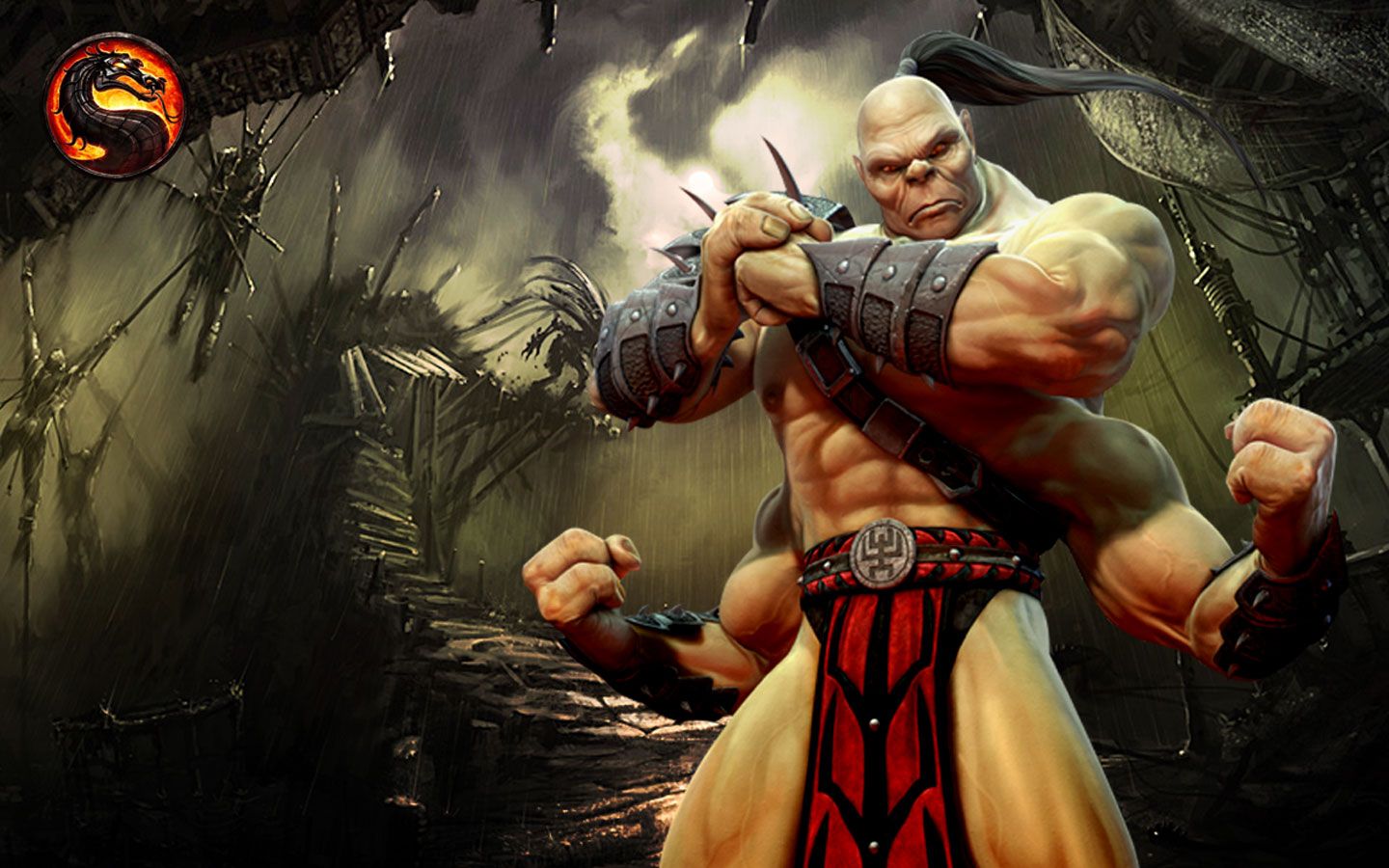
He was the original "keyboard breaker." Long before modern fighting games had balanced rosters and frame-perfect data, there was just this massive, four-armed nightmare standing between you and Shang Tsung. If you grew up in the 90s, the name Prince Goro wasn't just a character choice; it was a genuine hurdle. You could smell the stale popcorn and cigarette smoke of the arcade the second his roar echoed through the cabinet speakers.
Most people remember him as the sub-boss from the first Mortal Kombat, but he’s actually way more than just a muscle-bound gatekeeper. He represents the peak of Midway’s stop-motion era. While other characters were digitized actors in spandex, Goro was a physical clay model. He felt different. He moved differently.
Honestly, he’s probably the reason half of us have trust issues with boss fights today.
The Half-Dragon Prince of the Shokan
Goro isn't just some random thug. He’s royalty. Specifically, he’s the Prince of the Shokan, a race of subterranean warriors from the realm of Outworld. He’s half-human and half-dragon, which explains why he has more limbs than sense and a temperament that makes Scorpion look chill. When we first meet him, he’s already a legend. He had been the reigning champion of the Mortal Kombat tournament for five hundred years.
Think about that. Five centuries.
He didn't just win; he dominated. He was the one who finally took down the Great Kung Lao, a feat that cemented Outworld’s dominance and nearly led to the total enslavement of Earthrealm. He was the ultimate undefeated heavyweight. When you face him in the original 1992 game, you aren't just fighting a monster; you’re fighting history.
The Shokan are divided into two lineages: the Draco and the Tigrar. Goro belongs to the Draco line. This is why he has that iconic regal look—the top-knot hair, the gold jewelry, and the skin that looks like toughened leather. He isn't some mindless beast. He’s a general. He’s a statesman. He just happens to be a statesman who can rip your torso in half if you miss a block.
Why the Original Prince Goro Was a Technical Marvel
It’s easy to look at 4K graphics now and laugh at the old sprites, but in 1992, Goro was a revolution. John Tobias and Ed Boon couldn't just film a guy with four arms. It wouldn't work. Instead, they turned to stop-motion animation.
Sculptor Curt Chiarelli created the original Goro model. It was a complex armature covered in latex and paint. They filmed the model frame by frame, just like the old Ray Harryhausen monster movies. This gave Prince Goro a weight and a jittery, uncanny movement that the human actors didn't have. It made him feel alien. It made him feel "other."
When he jumped off-screen and stomped on you, it felt like the entire arcade cabinet shook. That move—the "Teleport Stomp"—is the stuff of legend. There was no warning. You just saw his shadows, and then bam, half your health bar was gone. If you tried to projectile him, he’d just block or throw a green fireball back that seemed to come out of nowhere. He was cheap. He was unfair. He was perfect.
The Shift from Villain to Anti-Hero
As the Mortal Kombat lore expanded, Goro stopped being a one-note villain. By the time we got to Mortal Kombat 4 (and specifically the Gold version on Dreamcast), his motivations got... complicated. He wasn't just Shao Kahn’s lapdog anymore. He started caring about the sovereignty of the Shokan.
He actually allied with the good guys for a bit. Kitana negotiated a peace treaty between the Shokan and the Centaurians (their blood rivals), and Goro signed off on it. Seeing the Prince of Pain engage in diplomacy was a weird turn for fans, but it added layers. He became a tragic figure—a fallen prince trying to regain his people’s honor in a world ruled by gods and sorcerers.
Then came the 2011 reboot and Mortal Kombat X.
In the newer timeline, Goro’s status is even more precarious. In the MKX comics (which are actually canon and surprisingly brutal), Goro loses his arms to Kotal Kahn. Imagine that. The guy famous for having four arms reduced to none. It was a shocking moment for long-time fans. It showed that in the New Era, no one—not even the most iconic sub-boss in history—was safe from the "Jobber" curse.
Debunking the Goro Misconceptions
There’s a lot of misinformation floating around about Goro, mostly because the movies keep changing his story.
- He didn't die in the first tournament. In the original game lore, he simply disappeared after being defeated by Liu Kang. He didn't fall off a cliff to his death like in the 1995 movie.
- He isn't the king. His father, King Gorbak, was the ruler of the Shokan. Goro is the Prince. People often promote him in their heads because he’s the only Shokan they know, but the hierarchy is strict.
- Sheeva isn't his wife. She’s a Shokan warrior, yes, and later a Queen, but their relationship is professional and political, not romantic. Shokan society is a bit more complex than just "four-armed people sticking together."
Playing as the Prince: The Evolution of Mechanics
For years, Goro was unplayable. He was the "boss" you could only access with cheat codes or GameShark. When he finally became a regular member of the roster, the developers had a problem: how do you make a boss-tier character balanced?
The answer was making him a "Grappler."
In games like Mortal Kombat X, Prince Goro is a heavy hitter. He’s slow. He’s a big target. But if he gets his hands on you, the round is basically over. His move set is a tribute to his history:
- The Punch Walk: A relentless forward-moving flurry of all four fists.
- The Shokan Grab: Lifting the opponent with two hands and pummeling them with the other two.
- The Dragon Breath: A nod to his half-dragon heritage.
Playing Goro requires patience. You have to be okay with being outmaneuvered by faster characters like Kitana or Cassie Cage. But there is a visceral satisfaction in landing a grab with Goro that you just don't get with anyone else. It feels heavy. It feels mean.
The Legacy of the Shokan Prince
Why do we still care about a character who debuted over thirty years ago? It’s because Goro represents the "Secret Sauce" of Mortal Kombat. He’s a blend of 80s fantasy tropes, martial arts cinema, and pure, unadulterated body horror. He’s a reminder of a time when games were experimental and slightly janky in the best way possible.
He also set the template for every sub-boss that followed. Kintaro, Motaro, Moloch—they all owe their existence to the four-armed prince. But none of them ever quite captured the same dread. Kintaro felt like a palette swap with tiger stripes. Motaro was a nightmare to program and even harder to fight, but he lacked Goro’s personality.
Goro is the guy. He’s the face of the franchise’s "impossible" challenges.
How to Actually Beat Goro (The Pro Strategy)
If you find yourself playing the classic arcade versions or the Klassic towers in modern games, Goro can still be a wall. Here is how you actually take him down without throwing your controller.
First, stop jumping. Goro has the best anti-air in the game. If you’re in the air, he will snatch you out of it or hit you with a fireball. Stay grounded.
Second, abuse the "crossover." In the older games, jumping over him and hitting a kick on the way down often confuses his AI. It’s a bit "cheesy," but hey, he has four arms and you have two. Life isn't fair.
Third, in modern iterations, use his size against him. He’s a massive hitbox. Use your fastest pokes and projectiles to keep him at bay. Don't let him get close enough to start a command grab chain. If you’re playing a character with a teleport (like Kung Lao or Scorpion), use it sparingly. Goro’s AI is notorious for reading inputs and punishing teleports with a back-breaker that takes 30% of your health.
The Future of Goro
With the timeline being reset again in Mortal Kombat 1 (2023), Goro’s role has shifted once more. Seeing him as a "Kameo" fighter was a bit of a shock to the system. On one hand, it’s great to see his classic design back in high definition. On the other, seeing the great Prince reduced to a "support" character feels a bit like seeing a heavyweight champion acting as a corner man.
But that’s the beauty of this franchise. No one stays down forever. Whether he returns as a main roster titan or continues to haunt the lore from the shadows, Prince Goro remains the ultimate benchmark for what a fighting game boss should be.
He’s loud, he’s ugly, and he’s earned every bit of his legendary status.
Actionable Takeaways for MK Fans:
- Check the MKX Comics: If you want the deepest Goro lore, the comic series by Shawn Kittelsen is essential reading. It covers his fall from grace and the loss of his limbs in brutal detail.
- Master the Frame Data: If you play as Goro in MKX, focus on his "plus frames." His pressure is his greatest weapon; don't let the opponent breathe.
- Watch the 1995 Movie: Despite the dated CGI, the animatronic Goro used in the original film is a masterpiece of practical effects and still looks better than many modern digital versions.
- Respect the Stomp: When fighting Goro in the arcade versions, always move horizontally. Never stand still when he jumps off-screen.
The Prince of Shokan isn't just a character. He’s the soul of Outworld. Next time you see those four arms flex, remember: you’re looking at five hundred years of undefeated history. Block high, pray often, and watch out for the stomp.