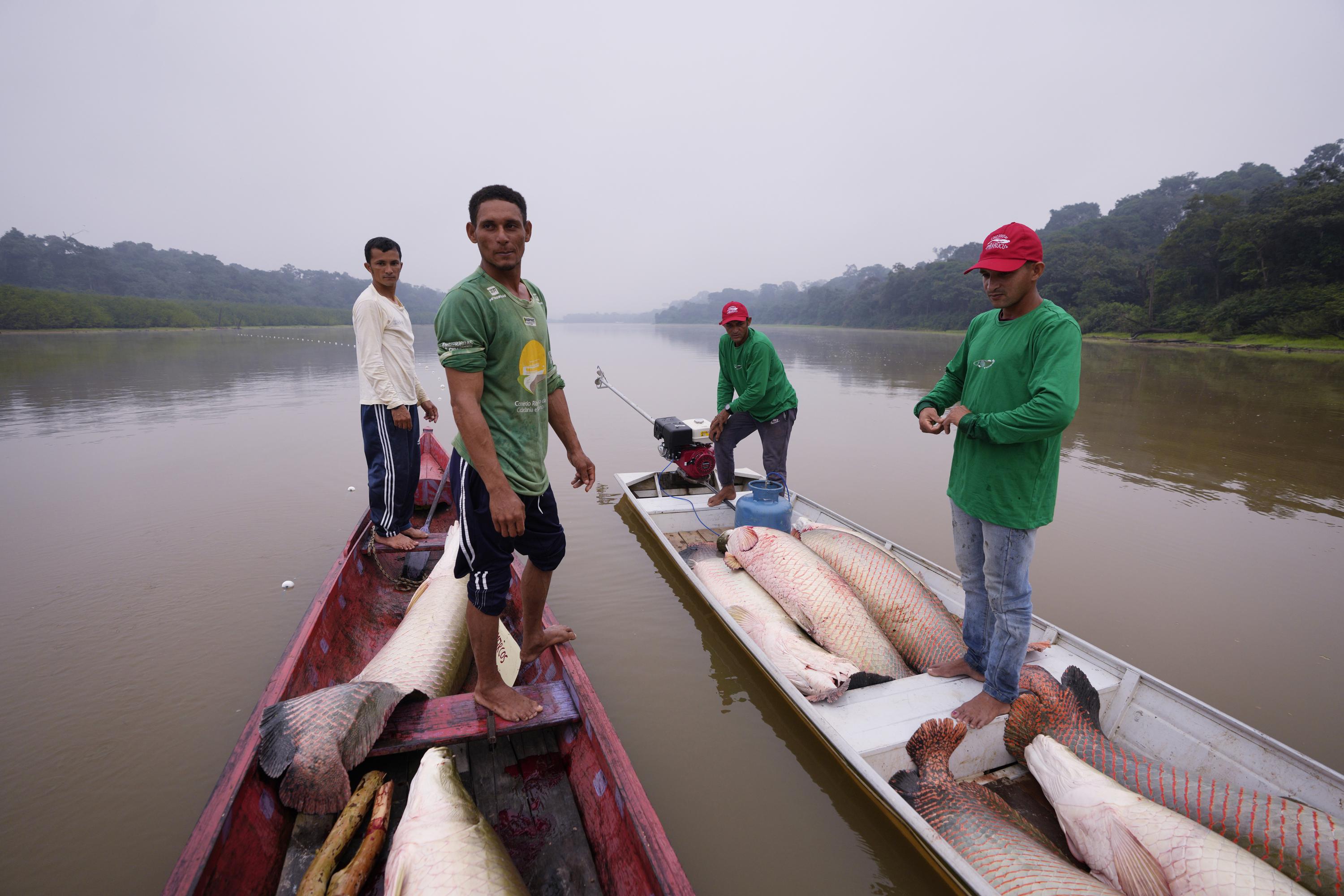
The Amazon isn't just a river. It's an inland sea of mud-colored water, tangling roots, and shadows that move. If you've ever stood on a rickety wooden dock in Iquitos or Manaus, looking down into that opaque soup, you’ve probably felt it. That primal shiver. Something huge is down there. We’re talking about the largest fish in Amazon river ecosystems, creatures that honestly look like they belong in a Paleozoic fossil bed rather than a modern waterway.
It's not just one giant. It’s a hierarchy.
People usually argue about which one takes the crown. Is it the air-breathing armored giant or the sleek, shark-like catfish that can swallow a monkey whole? Science leans toward two specific heavyweight champions: the Pirarucu (Arapaima gigas) and the Piraiba (Brachyplatystoma filamentosum).
The Arapaima is Basically a Living Dinosaur
You’ve probably seen the Pirarucu on nature documentaries. It’s the one with the red-tipped scales that looks like a torpedo made of chainmail. This fish is a biological freak of nature, and I mean that in the best way possible.
It breathes air.
Think about that for a second. While most fish are struggling to pull oxygen out of the warm, stagnant floodwaters of the Amazon basin, the Pirarucu just swims to the surface and gulps. It has a modified swim bladder that acts like a lung. Because of this, you can actually hear them. They make a distinct "coughing" or gulping sound that eco-guides and local fishermen use to track them.
Why the Pirarucu is a Heavyweight Contender
They get massive. We are talking upwards of 440 pounds (200 kilograms) and lengths reaching 10 feet. Though, honestly, finding a 10-footer these days is like finding a needle in a haystack because of overfishing. Most you’ll see in the wild now top out at around six or seven feet.
Their scales are a marvel of evolution. Researchers at UC San Diego have actually studied Arapaima scales because they are incredibly tough yet flexible. They have a hard, mineralized outer layer and a tough-but-pliable inner layer of collagen fibers. Why? Because the Amazon is full of Piranhas. The Pirarucu basically wears a suit of biological Kevlar that allows it to live in piranha-infested waters without getting nipped to death.
It’s a predator, too. It eats fish, sure, but it’s opportunistic. If a bird sits too low on a branch or a lizard falls in, it’s game over.
Meeting the Goliath Catfish: The Piraiba
If the Pirarucu is the king of the upper layers, the Piraiba is the undisputed master of the dark, deep channels. This is the largest fish in Amazon river history when you talk about pure weight and power. It’s a catfish, but don't think of those little bottom-feeders in a local pond. This thing is a monster.
The Piraiba, often called the "Goliath Catfish," can grow to nearly 12 feet long. There are stories—mostly unverified but persistent among the Ribereños (river people)—of these fish weighing over 450 pounds.
What makes them truly terrifying? Their appetite.
Deep Water Terrors
Unlike the Pirarucu, which stays near the surface to breathe, the Piraiba lurks in the deep, fast-moving currents of the main river channels. They are apex predators. When you cut one open, you might find almost anything. There are documented cases of Piraiba having monkeys, large birds, and even other giant catfish in their stomachs.
Local folklore is even darker. In some remote villages along the Solimões River, there are rumors of Piraiba attacking humans. While most biologists chalk this up to "river tall tales," the sheer size of the fish makes it physically possible. A 400-pound catfish has a mouth wide enough to fit a human head. It’s creepy.
Interestingly, these fish are incredible marathon swimmers. They perform one of the longest freshwater migrations in the world, traveling thousands of miles from the mouth of the Amazon up to the headwaters in the Andes to spawn. They are the true nomads of the river system.
The Misunderstood Giants: Freshwater Stingrays
When people search for the largest fish in Amazon river, they often forget the rays. The Ocellate River Stingray (Potamotrygon motoro) isn't the biggest in terms of length, but the Short-tailed River Stingray (Potamotrygon brachyura) can reach a diameter of over 5 feet and weigh more than 400 pounds.
- They aren't "fish-shaped" in the traditional sense, but they are absolutely massive.
- They hide in the sand. This makes them arguably more dangerous to people than a giant catfish.
- Their stingers are no joke. A large ray has a barb covered in toxic mucus that causes intense pain and necrosis.
Fishermen fear them more than piranhas. If you're wading in the shallows of a Brazilian tributary, you don't walk—you "shuffle" your feet. This warns the rays you’re coming so you don't step directly on their back. If you step on one, it whips its tail up, and that’s a one-way ticket to a very bad day.
Why These Giants are Vanishing
It’s not all "Monster Fish" episodes and scary stories. The reality for the largest fish in Amazon river basins is pretty grim. These animals are under immense pressure.
Overfishing is the big one. Pirarucu meat is delicious. It’s often called the "cod of the Amazon" because it has firm, white, boneless fillets. Because they have to come to the surface to breathe every 10 to 20 minutes, they are incredibly easy to harpoon. By the 1990s, they were nearly wiped out in many areas.
Dams and Gold Mining. The Piraiba needs open, flowing river systems to migrate. When we build massive hydroelectric dams, we cut off their "highway." On top of that, illegal gold mining in the Amazon uses mercury to separate gold from ore. That mercury ends up in the water, gets absorbed by small fish, and then concentrates in the bodies of the apex predators—the giants.
If you eat a large Piraiba today, you’re likely getting a massive dose of heavy metals.
Conservation is Actually Working (In Places)
There is a bit of a silver lining here. In the Mamirauá Sustainable Development Reserve in Brazil, they started a community-based management program for the Pirarucu.
The deal is simple: Local communities protect the lakes from poachers and only harvest a specific percentage of the adult fish once a year. The results have been insane. In some protected areas, the population of Pirarucu has jumped by over 400%. It turns out that when you stop killing them all, they bounce back pretty fast.
This model is being copied across the basin. It turns these giants from a disappearing resource into a sustainable way of life for the people who actually live alongside them.
What Most People Get Wrong About Amazon Giants
There’s a lot of nonsense floating around the internet about these fish. No, the Pirarucu does not have teeth on its tongue—wait, actually, it does. It has a bony tongue covered in small teeth that it uses to crush prey against the roof of its mouth. So that part is true.
But the idea that the Amazon is "crawling" with 15-foot man-eaters? That’s mostly hype.
Most of these large fish are incredibly shy. They feel the vibration of a boat engine or a splashing human from a mile away and head for the deeps. You could swim in the Amazon for years and never see a Piraiba. They aren't looking for a fight; they’re looking for their next meal, which usually consists of smaller catfish like the Brachyplatystoma vaillantii.
The Real Danger
If you’re traveling to the Amazon, don't worry about being swallowed by a giant fish. Worry about:
- The Black Caiman: A crocodilian that actually does view humans as prey.
- The Electric Eel: Can put out 600-800 volts. That'll stop a heart.
- The Candiru: Look it up if you want a nightmare, but maybe don't do it right before lunch.
How to See These Giants Responsibly
If you want to witness the largest fish in Amazon river habitats for yourself, you have a few options that don't involve a harpoon or a massive fishing hook.
Eco-Tourism in Peru or Brazil
Lodges in the Pacaya-Samiria National Reserve (Peru) or near Manaus (Brazil) often have "Arapaima spotting" excursions. Because these fish are so big and breathe air, they are relatively easy to photograph if you have a patient guide and a fast shutter speed.
Public Aquariums
Honestly, if you want to see a 7-foot Pirarucu without the mosquitoes and the 100% humidity, places like the Shedd Aquarium in Chicago or the Tennessee Aquarium have incredible Amazon exhibits. Seeing them at eye level behind glass gives you a perspective on their size that you just can't get from the seat of a canoe.
Actionable Steps for the Conscious Traveler
If you find yourself in an Amazonian port city and see "Paiche" (the Peruvian name for Pirarucu) on the menu, ask where it came from.
- Avoid wild-caught meat in areas without management plans.
- Support farmed Pirarucu. Aquaculture for these giants is growing, providing a sustainable protein source that doesn't deplete the river.
- Check for Mercury Warnings. If you’re an angler looking for a "Goliath" catch-and-release, be aware that many of these top-tier predators are heavily contaminated in mining regions like the Tapajós River.
The Amazon is changing. The giants are still there, but they are no longer the infinite resource they once seemed. Respecting the "water gods" of the rainforest means ensuring the next generation of travelers can still look into that brown water and wonder what’s lurking in the deep.
To help protect these species, you can support organizations like the Amazon Conservation Association or the Wildlife Conservation Society (WCS), which work directly with indigenous communities to establish sustainable fishing zones and stop illegal mining operations that poison the food chain. Understanding the balance between the river's top predators and the people who rely on them is the only way these prehistoric giants will survive the 21st century.
Next time you see a photo of a massive fish from South America, remember it’s not just a monster. It's a survivor of a world that existed long before we did. Keep that in mind, and you'll see the river in a whole new light.
For those planning a trip, look into the Mamirauá Reserve for the best-managed wildlife viewing. Stick to the dry season (July to November) when the water recedes and these massive fish are concentrated in smaller lakes and channels, making them much easier to find.
Always travel with a local guide who understands the behavior of these animals; not only does it support the local economy, but it also keeps you from accidentally stepping on a ray or drifting into a caiman nesting site. The Amazon is beautiful, but it demands a specific kind of respect that only comes from living on its banks.
Be sure to check local regulations before any fishing trip. Catch and release is the standard for Piraiba in many regions to ensure the breeding stock remains healthy. Using heavy-duty gear is a must—a 300-pound fish will snap a standard rod like a toothpick. Gear up properly or don't go at all.
That’s the reality of the Amazon. It’s big, it’s messy, and it’s full of giants that deserve our protection as much as our awe.