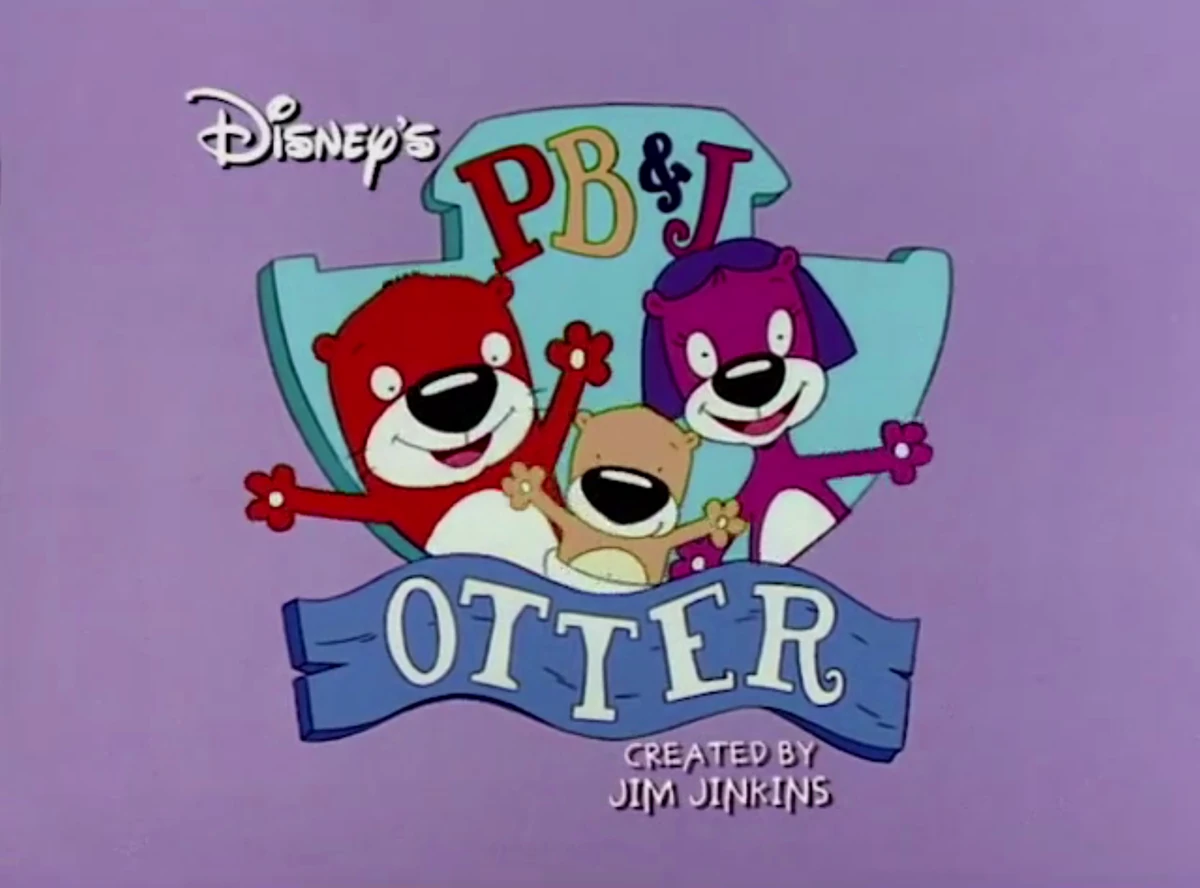
Honestly, if you grew up in the late '90s, your brain probably houses a very specific, permanent resident: a catchy-as-hell song about dancing while you think. You know the one. The "Noodle Dance." It’s been decades since PB&J Otter first splashed onto Playhouse Disney, but the show has a weirdly strong grip on the nostalgia of Gen Z and millennials. It wasn’t just another "educational" cartoon. It felt different. It was colorful, a bit musical, and centered on a houseboat-dwelling family of river otters who basically lived the dream.
Jim Jinkins, the guy who gave us Doug, was the mastermind behind this. If you look closely, you can see the DNA. There's that same gentle pacing and focus on social-emotional learning, but with more fur and a lot more water. The show premiered on March 14, 1998. It ran for 65 episodes, spanning three seasons until October 2000. But the reruns? Those lived on forever, cementing the show in the collective memory of a generation.
The Noodle Dance was basically a lesson in mindfulness
Most kids' shows have a gimmick. Some have a "thinking chair," others have a magical backpack. PB&J Otter had the Noodle Dance. Whenever Peanut, Jelly, or Baby Butter hit a snag—and in Lake Hoohaw, snags were frequent—they didn’t just sit there. They danced.
Peanut, the oldest, usually played the "reluctant" role. He’d complain, "I’ll use my noodle, but I’m not dancing!" But then the music would start. The rhythm would take over. By the end, he was always in the mix. There's a real lesson there, isn't there? It’s basically teaching kids that when you’re stuck, you need to shift your perspective. You need to move. You need to shake up your brain to let the ideas fall out.
Jelly was usually the one to yell, "I've got it!" once the lightbulb appeared over her head. It was a formula, sure, but it worked. It turned problem-solving into a celebration rather than a chore.
Who was actually who?
The names were always the best part. Peanut, Jelly, and Baby Butter Otter. Together, they make a sandwich. It’s a bit on the nose, but as a kid, it was brilliant.
- Peanut (Adam Rose): The smart, loyal, red-furred big brother.
- Jelly (Jenell Slack-Wilson): The purple-furred middle child and the de facto leader of the group’s brainstorm sessions.
- Baby Butter (Gina Marie Tortorici): The toddler who mostly communicated in babbles but was surprisingly observant.
Then you had the supporting cast. Flick Duck, voiced by Eddie Korbich, was the "tough guy" who was actually a softie. Munchy Beaver was the nervous wood-chewer. And we can't forget the Snooties—Ootsie and Bootsie—the rich poodles who lived in a literal mansion and were basically the "villains" in the gentlest way possible. They weren't evil; they were just out of touch.
Jim Jinkins and the Harvard Connection
A lot of people don't realize that PB&J Otter wasn't just a colorful distraction. Jim Jinkins and his team at Jumbo Pictures actually worked with experts from Harvard University's Graduate School of Education. They wanted to make sure the "Positive Ways to Resolve Problems" (the show's core curriculum) actually made sense for a preschooler’s development.
This is why the show feels so "correct" even when you watch it as an adult. The conflicts weren't about world-ending stakes. They were about losing a favorite toy, feeling left out of a party, or dealing with stage fright.
The town of Lake Hoohaw was a character in itself. It was a rural fishing community where everyone knew everyone. Ernest Otter, the dad, ran a floating general store. Opal, the mom, was a seamstress. It was a cozy, idyllic world. It felt safe. In an era where kid's TV was starting to get louder and faster, PB&J Otter was a calm, rhythmic breath of fresh air.
The music was genuinely good
Seriously. Dan Sawyer, Fred Newman, and Rich Mendoza handled the songs. Every episode had at least one. We aren't talking about annoying earworms, either. The music had variety. They did parodies of The Sleeping Beauty (The Sleeping Beagle) and even mixed in different genres like country-western or big band.
Fred Newman, for those who don't know, is a sound-effects legend. He did a lot of the voices and sounds on Doug, too. His influence is why the show sounds so organic and "plucky."
What most people get wrong about the show
One of the biggest misconceptions? That it was a "baby show." While it aired on Playhouse Disney, the writing had enough wit that older siblings didn't mind watching it.
Another weird thing: people often forget that Baby Butter was a girl. On Reddit threads today, you’ll see fans "unlocking memories" and realizing they’d spent their whole childhood thinking Butter was a boy. It’s a common Mandela-effect style mix-up. Also, the name "Lake Hoohaw" hits a little different when you're 30 compared to when you're 5. Let's just say the internet has had some fun with that one.
Why we’re still talking about it in 2026
The show was nominated for an Annie Award in 2000 for its music. It wasn't just fluff. It represented a peak era of Disney Channel's preschool programming—the same era as Bear in the Big Blue House and Rolie Polie Olie.
But PB&J Otter stands out because of its heart. It wasn't trying to sell you toys as much as it was trying to sell you the idea that you’re smart enough to solve your own problems. It encouraged creativity and community.
If you're looking to revisit Lake Hoohaw, the best way to do it is to look for the series on Disney+. It's a trip down memory lane that actually holds up. The animation is simple but charmingly hand-drawn (or at least looks like it), and the messages are timeless.
If you have kids of your own now, it’s worth a watch. It's way less "manic" than some of the modern stuff you'll find on YouTube or Netflix. It’s slow. It’s sweet. And honestly? We could all probably use a Noodle Dance every once in a while.
Actionable Insight: If you're feeling stuck on a work project or a personal problem, try the "PB&J method." Stand up, move your body for two minutes, and let your brain reset. It sounds silly, but the science behind "incubation" in problem-solving actually backs up what these otters were doing all along. Just maybe skip the "Noodle, use your noodle" lyrics if you're in an open-plan office.