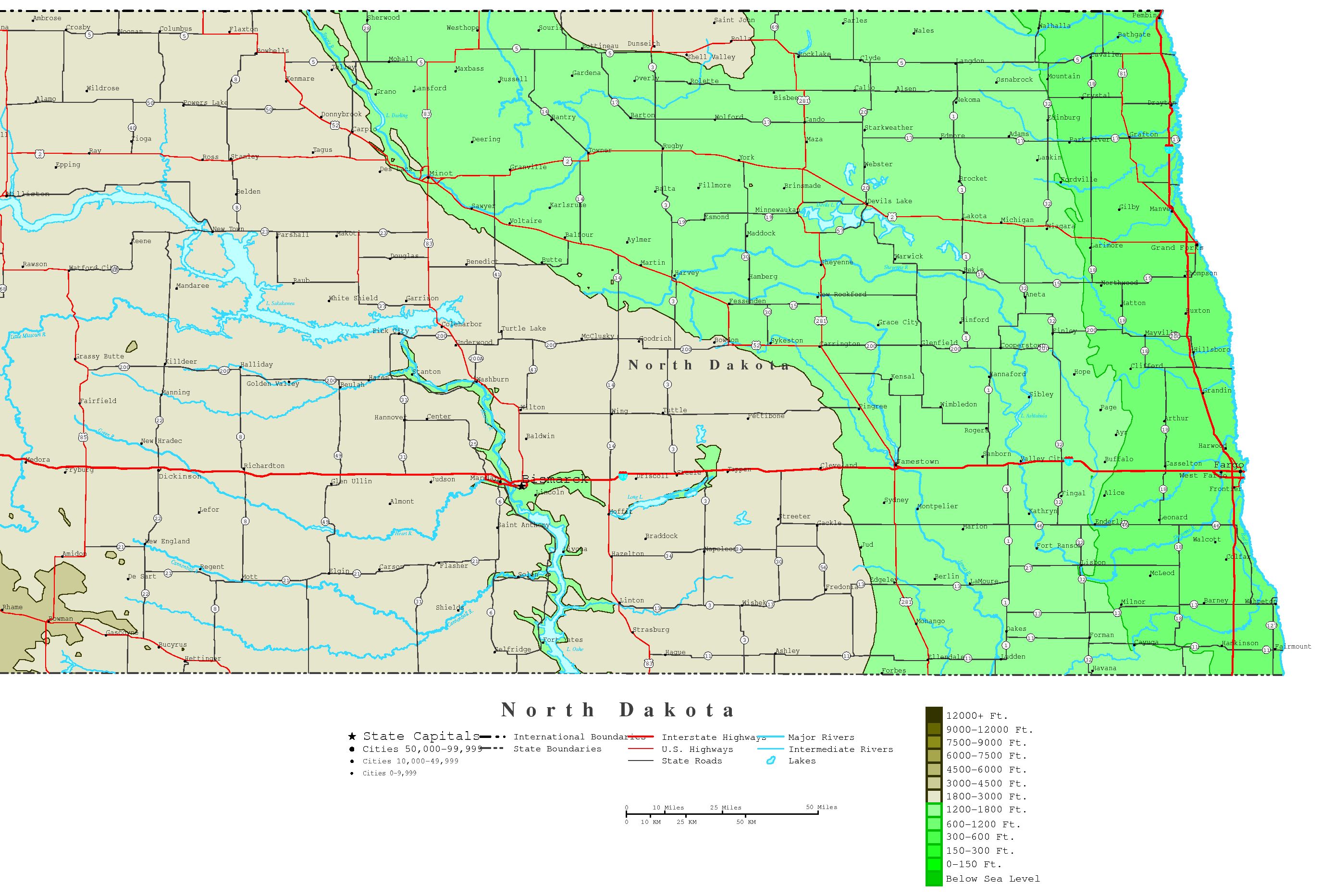
If you look at a standard north dakota terrain map, you might see a whole lot of nothing. Or at least, that’s the stereotype. People think it’s just one giant, frozen pool table stretching from Fargo to the Montana border. They’re wrong. Honestly, if you’ve ever driven I-94 at two in the morning, you might believe the lie because the darkness hides the truth. But North Dakota is actually a tilted tabletop, a massive geological ramp that rises slowly but surely toward the Rocky Mountains.
It’s subtle. You don't feel the elevation change in your inner ear like you do in Colorado, but by the time you hit the western edge, you’re thousands of feet higher than where you started.
The Three Giant Steps of the North Dakota Terrain Map
The state is basically divided into three distinct levels. Think of them as giant stairs.
First, you have the Red River Valley. This is the flat part everyone talks about. It’s actually the bottom of an ancient, massive glacial lake called Lake Agassiz. Because it was a lake bed, it’s incredibly level and the soil is basically black gold for farmers. If you drop a marble in Grand Forks, it stays put. It’s one of the flattest places on the entire planet. But that’s only the far eastern sliver of the state.
Once you move west, you hit the Drift Prairie. This is where the north dakota terrain map gets bumpy. Thousands of years ago, retreating glaciers dumped piles of rocks and dirt everywhere. Geologists call this "glacial till." It created millions of tiny "potholes" or wetlands. If you’re a duck, this is paradise. If you’re a road builder, it’s a headache.
Then comes the big one: The Missouri Escarpment.
This is a literal wall of earth that rises hundreds of feet. When you drive up it, you’re entering the Great Plains proper. This is the Missouri Plateau. It’s rugged. It’s windy. It’s high. By the time you reach the southwestern corner of the state, you’re looking at Black Butte, the highest point in the state at 3,506 feet. That’s higher than most peaks in the Blue Ridge Mountains out east, yet people still call North Dakota "flat."
The Badlands Are the Real Star
You can't talk about the topography here without mentioning the Theodore Roosevelt National Park area. This isn't just a different terrain; it’s a different planet. Millions of years of wind and water have carved the soft sedimentary rock into jagged peaks, deep canyons, and multi-colored "clinker" layers.
When you look at a high-resolution north dakota terrain map, the western side looks like someone took a giant grater to the landscape.
The Little Missouri River is the culprit here. It cut through the plateau, revealing layers of coal, bentonite clay, and sandstone. It’s messy. It’s beautiful. It’s also incredibly difficult to navigate if you aren’t on a paved road. Theodore Roosevelt himself said the ruggedness of this land changed him from a sickly city boy into a man fit for the presidency.
Why the Map Matters for Your Gear
If you’re planning to visit or hike, don't let the "flat" rumors fool you.
Wind is a topographical feature here. Because there are so few trees and the Missouri Plateau is so high, the wind gathers speed like a freight train. On a map, a trail might look like a straight, easy shot. In reality, you’re fighting 40 mph gusts and constant micro-elevation changes as you dip in and out of coulees.
- East (Red River Valley): Bring boots that can handle mud. The clay soil here turns into "gumbo" when it rains. It sticks to your shoes and weighs ten pounds.
- Central (Drift Prairie): Great for birding, but the terrain is rolling. Expect lots of "false summits" on small hills.
- West (Missouri Plateau/Badlands): This is cactus country. Seriously. You need thick soles because prickly pear is everywhere.
The Misconception of the "Empty" Middle
There is a section of the state called the Coteau des Prairies. It’s a massive highland plateau that sits like a wedge in the southeast. On a north dakota terrain map, it looks like a thumbprint. It was formed because two different lobes of a glacier couldn't quite meet, leaving a massive pile of debris in the middle.
This area is full of lakes and surprisingly steep ravines. It’s not the "endless horizon" people expect. It’s actually quite claustrophobic in some spots because the hills are so tight together.
Modern Mapping and Energy
Today, the most detailed versions of these maps aren't being used by hikers—they’re being used by oil companies. The Bakken Formation, which sparked a massive oil boom, sits deep underneath the western terrain. Engineers use LiDAR (Light Detection and Ranging) to map the surface down to the inch.
They need this because the terrain is so unstable in the west. Bentonite clay expands when wet and shrinks when dry. This "popcorn soil" can literally move hillsides, snapping pipelines and buckling roads. A map here isn't a static thing; it's a snapshot of a landscape that is constantly, albeit slowly, sliding around.
How to Actually Use This Information
If you want to experience the best of the North Dakota terrain, don't just stick to the highway. Get off I-94.
- Drive the Enchanted Highway: It takes you through the heart of the Drift Prairie. You’ll see the rolling hills and massive metal sculptures that highlight the scale of the sky against the ground.
- Visit Lake Sakakawea: This is a massive man-made lake on the Missouri River. The terrain around it is rugged and "breaky," meaning the land breaks away into the water in sharp cliffs.
- The Maah Daah Hey Trail: This is 144 miles of the most intense terrain in the state. It connects all three units of the National Park. If you want to prove the state isn't flat, bike five miles of this trail. Your quads will provide the evidence.
Final Reality Check
North Dakota isn't a postcard of a mountain; it’s a portrait of the earth’s bones. The lack of heavy forest cover means you can see the geology. You can see how the water moved ten thousand years ago. You can see where the glaciers stopped and gave up.
Stop looking for "scenery" in the traditional sense. Start looking at the scale. When you stand on the Edge of the Cedars or at the top of a butte in the Killdeer Mountains, you realize the "flat" myth is just a lack of perspective.
The north dakota terrain map shows a state that is tilted, carved, and ruggedly resilient. It’s a place that requires you to look closer. Once you do, the flatness disappears, replaced by a complex, multi-layered landscape that has been millions of years in the making.
Go west. Watch the horizon line rise. Feel the wind hit you as you climb the escarpment. That’s the real North Dakota.
Actionable Next Steps
- Download Offline Maps: Cell service is non-existent in the deep coulees of the Badlands. Use an app like Gaia GPS or OnX to download topographical layers before you leave the hotel.
- Check the NDRoads App: Topography here dictates the weather. A little bit of snow on a high plateau becomes a life-threatening drift in minutes.
- Visit in the "Golden Hour": Because the terrain is subtle, midday sun flattens everything out. To see the actual ridges and valleys on the north dakota terrain map in real life, you need the long shadows of sunrise or sunset. That's when the land finally reveals its true shape.